TL;DR

Get home appliances delivered free with Prime
- Fast, free delivery on millions of items
- Prime Video, Amazon Music and more included
- Member-only deals all year
A Hunker report describes bookshelf artist Dansy Thomas’s DIY bookcase, built from cardboard boxes and homemade paper clay. Her Instagram posts show the construction and decoration process, but the report does not provide load testing, cost figures or durability details.
Bookshelf artist Dansy Thomas has turned cardboard boxes and homemade paper clay into a colorful, sculptural bookcase, according to a report by Hunker. Thomas documented the project in a series of Instagram posts showing how she assembled a cardboard frame, covered it with paper clay and decorated the finished shelves, offering an upcycling idea for people seeking storage made from reused materials.
The bookcase combines various-sized cardboard boxes with a paper-based coating Thomas made using shredded paper, water, joint compound and white glue. Hunker describes the finished piece as having a rounded form, a lime-green exterior and a hot-pink interior, with decorative details that give it a playful appearance. The report says the project’s process is shown across Thomas’s Instagram posts; it does not independently verify measurements, material quantities or construction performance.
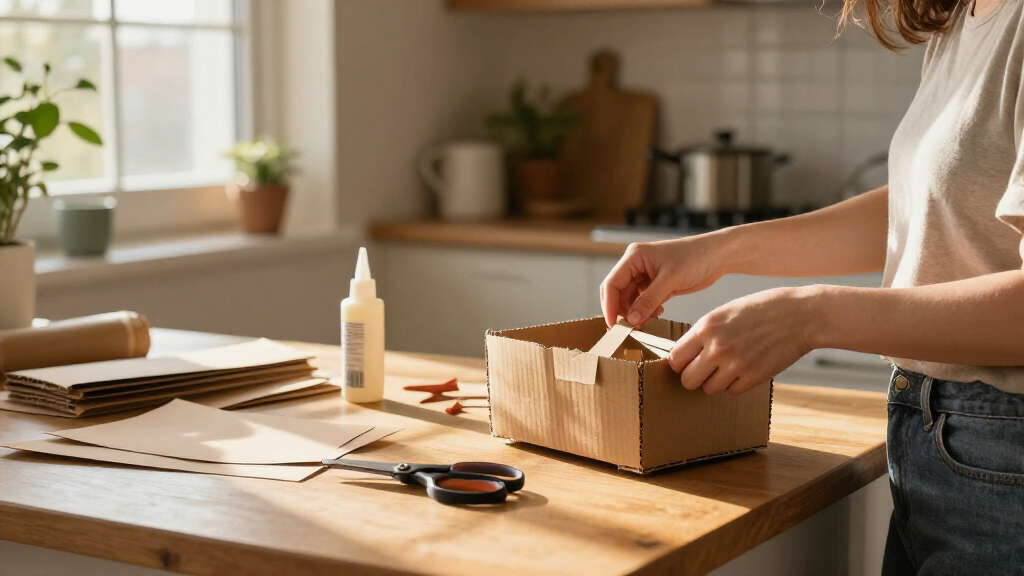
For the frame, the boxes are opened by removing their top flaps, then reinforced with tape along the bottom and sides. They are arranged into shelves or cubbies and taped together. In the approach described by Hunker, the lower boxes are filled with packing materials and paper scraps to add weight and support. Cardboard arches or small shapes such as stars and flowers can be attached before the surface is covered.
The paper-clay process begins with paper cut or shredded into small pieces and soaked in boiling water for at least a day. The softened mixture is blended, strained and squeezed to remove extra water. Salt and vinegar are added, followed by equal parts joint compound and glue, and the mixture is combined until it has a clay-like consistency. After spreading it over the cardboard and allowing it to dry, the maker can paint or seal the surface. Hunker says Thomas used house paint, while presenting color and finish as personal choices.
A Second Use for Moving Boxes
The project offers a practical example of turning discarded packaging into storage, rather than sending it directly to recycling or disposal. It may appeal to people who have boxes left after a move and want a custom-sized piece without buying conventional shelving. The materials described are widely familiar household or building supplies, though the source does not establish that the finished bookcase costs less than store-bought furniture.
The DIY also shows how a simple box structure can be altered with surface texture, color and decorative shapes. That flexibility makes the idea adaptable to different rooms and styles. However, the report offers no load rating or independent durability assessment, so it should not be read as proof that a cardboard unit can safely carry heavy books or remain stable in every setting.
Products Worth Considering

Philips Hue White and Color Ambiance Smart Light Starter Kit, 2 A19 Bulbs with Hub

Philips Hue Smart LED Candle Bulbs, B39, E12, White and Color Ambiance, 2-Pack

Bose TV Speaker (2nd Gen) Compact Soundbar
As an affiliate, we earn on qualifying purchases.
How Thomas Builds the Shelving
Hunker frames the bookcase as an alternative use for the cardboard boxes that often accumulate after a move. Rather than relying on a single purpose-made frame, Thomas uses boxes of different sizes to form the structure, reinforcing them with tape and adding material inside the base. The paper-clay coating then covers the assembled cardboard and provides a surface for finishing.
The report presents the project through Thomas’s Instagram demonstrations, rather than as a tested furniture product or a formal construction guide. Its account outlines the main stages—frame, paper clay, drying and decoration—but does not give a complete set of dimensions or specify how much weight the shelves can hold. Hunker also notes that leftover cardboard could be used for other small projects, including picture frames.
““a unique, fully upcycled bookcase””
— Hunker, describing Thomas’s bookcase
Strength and Use Limits
The supplied report does not state the bookcase’s dimensions, total cost, build time or maximum safe shelf load. It also does not describe testing for stability, moisture resistance or long-term wear. Those omissions matter because cardboard can vary in thickness and condition, and the strength of a finished piece may depend on its design, materials and workmanship.
It is also unclear whether Thomas used a specific sealant, how long the paper clay took to dry, or whether the method is suitable for every type of room. Hunker presents paint and sealing as options, but does not provide product recommendations or performance claims. Readers should treat the described method as a creative DIY concept, not a certified furniture plan.
Try the Method With Care
Thomas’s Instagram posts remain the source Hunker points readers to for the visual construction sequence. Anyone attempting a similar project can use that material alongside the report’s written outline, while adapting the shape and finish to their own needs. Before adding books or other objects, makers should check that the frame is stable and avoid loading shelves beyond what the structure can support.
No further update or testing is identified in the supplied report. The next useful details for readers would be measurements, material quantities and documented load or durability tests; none are provided in the source material. For now, the project is best understood as an example of creative cardboard reuse, with its practical limits still unspecified.
Key Questions
What is Dansy Thomas’s bookcase made from?
According to Hunker, it uses cardboard boxes for the frame and homemade paper clay made from paper, water, joint compound and white glue. Tape reinforces the boxes, and paint or a sealant can be used as a finish.
How does the paper clay get made?
The described method soaks shredded or cut paper in boiling water for at least a day, blends and drains it, then mixes in salt, vinegar, joint compound and glue. The report says to combine the ingredients until the mixture feels clay-like.
Can the cardboard bookcase hold heavy books?
The report gives no load rating or test results, so it does not establish how much weight the shelves can safely hold. Check the stability of any homemade unit and avoid assuming it can carry heavy objects.
Does the finished bookcase have to be brightly colored?
No. Hunker describes Thomas’s lime-green and hot-pink design, but says makers can choose other paint colors or leave the clay unpainted and seal it for a different appearance.
Source: hunker.com