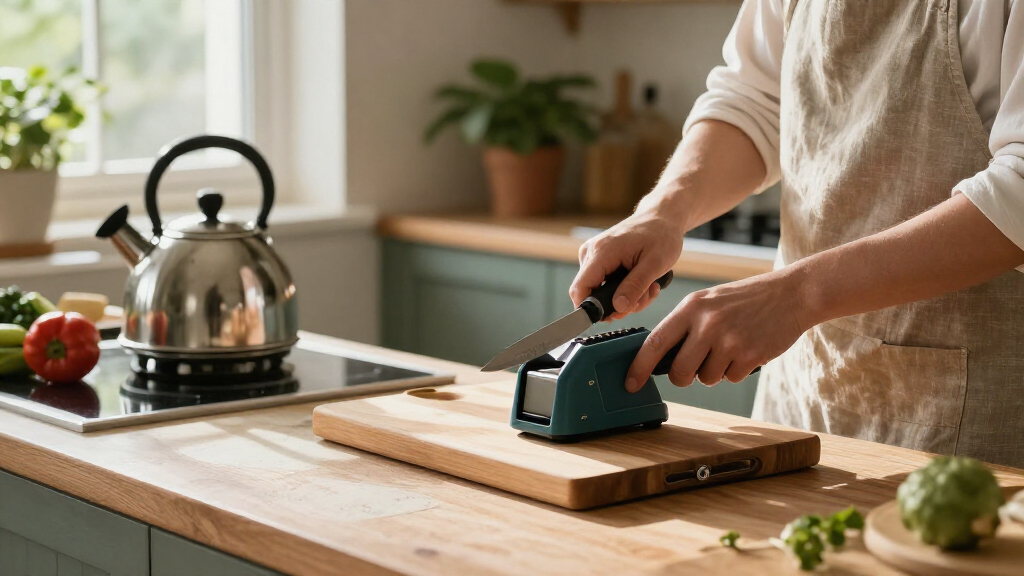
Electric knife sharpeners trade hands-on control for faster, more repeatable edge maintenance. The Chef’sChoice 15XV EdgeSelect is my best overall pick for its multi-stage approach and support for a 15-degree edge, while the Work Sharp E2 stands out for straightforward kitchen sharpening and the Work Sharp MK2 for broader knife and tool use. The main choice is between guided slots that simplify sharpening and more versatile systems that ask you to manage angle, pressure, or belt movement. Abrasive type, blade compatibility, and cleanup needs also separate these models. Read on for the full breakdown and a guide to choosing one for your knives.

Get home appliances delivered free with Prime
- Fast, free delivery on millions of items
- Prime Video, Amazon Music and more included
- Member-only deals all year
Complete the kit


Key Takeaways
- Chef’sChoice 15XV leads the lineup for buyers who want staged sharpening and an established 15-degree edge format; it is less suited to shoppers who need one tool for varied knives and equipment.
- Work Sharp E2 and Presto 08800 favor simpler kitchen routines, while the E2’s positioning makes it a more focused alternative to the Presto models.
- Work Sharp MK2 is the versatility pick because its belt-based design extends beyond kitchen knives, though that flexibility calls for more user control than slot-guided sharpeners.
- Several newer models emphasize diamond abrasives and multiple stages; the extra stages matter only when they match the blade’s condition and the user follows the maker’s guidance.
- Angle adjustment, detachable heads, scissors slots, and dust collectors appear across the field, but each adds value only for buyers who will use that specific capability.


| electric knife sharpener | Dimensions | Model | Sharpening stages |
|---|---|---|---|
| Presto 08810 Professional Ever | 18.43 × 11.25 × 2.18 inches | 08810 | — |
| Work Sharp E2 Electric Kitchen | 6.77 × 10.82 × 5.89 inches | CPE2 | — |
| Hrevzon Electric Knife Sharpen | 12.2 × 4.9 × 4.6 inches | TG2101-1 | 3: coarse, fine, polish |
| Chef’sChoice 15XV EdgeSelect P | 10 × 4.25 × 4.25 inches | 15XV | 3-stage EdgeSelect |
| QN-M866 2-Stage Electric Knife | — | QN-M866 | 2: coarse and fine |
| LEFUGO Electric Knife Sharpene | 11.54 × 4.17 × 3.78 inches | TG2403 | 3 |
| Presto 08800 EverSharp Electri | 8.25 × 5.75 × 4 inches | 08800 | 2: grinding and honing |
| Maestri House 3-Stage Electric | 13.98 × 3.58 × 5 inches | H1392 | 3 |
| Northmas QN-M868 Electric Knif | 7.8 × 2.1 × 3.1 inches | QN-M868 | 2 |
| KAZRBEP 5-in-1 Electric Knife | 5.6 × 12 × 4.5 inches | — | 3 |
| Tkerlo 3-Stage Electric Knife | 11.54 × 4.17 × 3.78 in | — | 3 (120#, 600#, 1000#) |
| Stonetiger 4-in-1 Electric Kni | — | S826-2 | 3 (crude, fine, polish) |
| DSkiley 3-Stage Electric Knife | — | — | 3 |
| Work Sharp MK2 Electric Knife | 7.02 × 2.26 × 1.27 in | — | — |
| Narcissus S867 Electric Knife | 8.2 × 2.9 × 2.7 in | S867-2 | — |
More Details on Our Top Picks
Presto 08810 Professional EverSharp Electric Knife Sharpener
The Presto 08810 earns its place for households that sharpen more than everyday kitchen knives. Its three stages and blade thickness selector let buyers adjust the sharpening setup for blades ranging from paring knives to heavier sport knives. That flexibility gives it a broader role than the Work Sharp E2, which is compact and beginner friendly but described for kitchen knives. The tradeoff is a larger, heavier unit: at 5.1 pounds and over 18 inches long, it takes more counter or storage space than the E2. It also needs a 120V/60Hz outlet, so it is less convenient for international kitchens. I would choose this Presto when versatility across blade types matters more than a small footprint.
Pros:- Three-stage system covers sharpening through a fine ceramic finish.
- Blade thickness selector adapts the setup to different blade types.
- Suitable for kitchen, Santoku, and sport knives.
- Suction cup feet help keep the unit stable during use.
Cons:- At 5.1 pounds and over 18 inches long, it is cumbersome to store.
- Requires a 120V/60Hz power source.
Best for: Home cooks and outdoor enthusiasts who want one countertop sharpener for kitchen, Santoku, and sport knives.
Not ideal for: Apartment cooks with limited drawer or counter space, or international buyers without a compatible 120V/60Hz supply.
- Brand:Presto
- Model:08810
- Sharpening system:3-stage
- Abrasives:Sapphirite wheels, including extra-fine ceramic wheels
- Dimensions:18.43 × 11.25 × 2.18 inches
- Weight:5.1 pounds
- Power:120 V, 60 Hz
- Warranty:1-year limited
Our verdict“Choose the Presto 08810 if your knife collection spans kitchen and sport blades and you have room for a full-size sharpener.”
Work Sharp E2 Electric Kitchen Knife Sharpener
The Work Sharp E2 is the approachable pick for cooks who want guided sharpening without learning to hold a consistent angle. Its slots guide chef, santoku, paring, utility, and serrated knives, making the process simpler than the Presto 08810, whose blade thickness selector and wider range suit a more varied collection. The E2 also weighs just 16 ounces and is sized to fit in a drawer, a practical advantage in smaller kitchens. That convenience comes with limits: it uses replaceable abrasives, and its powered action can remove more metal than careful manual sharpening. Buyers with heavily worn knives or a preference for slower, hands-on edge maintenance may want a different approach. For routine kitchen upkeep, its guided slots make the learning curve short.
Pros:- Guided slots reduce the need to control sharpening angles by hand.
- Handles several common kitchen knife types, including serrated blades.
- Compact size and 16-ounce weight make storage easy.
- Electric operation suits quick routine touch-ups.
Cons:- Replacement abrasives are needed periodically.
- Powered sharpening can remove more blade metal than manual whetstone sharpening.
Best for: First-time sharpener owners and busy home cooks who want guided maintenance for common kitchen and serrated knives.
Not ideal for: Cooks who sharpen sport knives, want to minimize metal removal, or prefer a sharpening method that does not need replacement abrasives.
- Brand:Work Sharp
- Model:CPE2
- Abrasive grit:Medium
- Compatible knives:Chef, santoku, paring, utility, and serrated
- Dimensions:6.77 × 10.82 × 5.89 inches
- Weight:16 ounces
- Included components:Sharpener, power supply, one pair of double-sided abrasives, user guide
Our verdict“Pick the Work Sharp E2 for simple, guided upkeep of everyday kitchen knives in a compact package.”
Hrevzon Electric Knife Sharpener, 3-Stage Automatic Diamond Abrasive System with Magnetic Dust Collector
The Hrevzon TG2101-1 pairs a three-stage sharpening sequence with a magnetic dust collector, a useful detail for cooks who want metal shavings contained at the counter. Its 20-degree angle and diamond abrasives give it a clear, straightforward setup for straight-edge kitchen knives. Compared with the Chef’sChoice 15XV, which also uses diamond abrasives but reshapes edges to 15 degrees and supports serrated knives, Hrevzon is less versatile in blade compatibility and keeps to a different edge angle. The listed compatibility covers chef, paring, and boning knives, not serrated blades. It may also take three or four passes to reach the intended result, so it is not the quickest route for every touch-up. Choose it for contained cleanup and a three-stage process, provided your knives are straight-edged.
Pros:- Three stages move from coarse sharpening to fine honing and polishing.
- Diamond abrasives are specified for all three stages.
- Magnetic collector is designed to capture metal shavings.
- Non-slip silicone pads support stability during operation.
Cons:- Compatibility is limited to straight-edge knives.
- The instructions call for multiple passes, which may slow sharpening.
Best for: Home cooks who sharpen straight-edge chef, paring, or boning knives and value a tidy countertop.
Not ideal for: Owners of serrated knives or anyone who wants a sharpener explicitly suited to multiple blade types and edge angles.
- Brand:Hrevzon
- Model:TG2101-1
- Sharpening stages:3: coarse, fine, polish
- Abrasive type:100% diamond
- Edge angle:20 degrees
- Compatible knives:Straight-edge chef, paring, and boning knives
- Dimensions:12.2 × 4.9 × 4.6 inches
- Material:Metal
Our verdict“Choose Hrevzon if you sharpen straight-edge kitchen knives and want a three-stage setup with shavings collection.”
Chef’sChoice 15XV EdgeSelect Professional Electric Knife Sharpener
The Chef’sChoice 15XV is the most specialized pick here for cooks who want to convert a traditional 20-degree edge to a sharper-feeling 15-degree edge. Its three-stage EdgeSelect system and flexible guides handle both straight and serrated knives, giving it broader stated compatibility than the Hrevzon TG2101-1, which is limited to straight-edge blades. Diamond abrasives support the sharpening stages, while the compact 10-inch length keeps its footprint manageable beside the larger Presto 08810. The tradeoff is the edge choice itself: 15 degrees may not suit buyers who want to retain a traditional profile. It also needs an outlet and occupies more counter room than a manual sharpener. I would place it first for edge conversion, but not for buyers seeking a conventional 20-degree finish.
Pros:- Three-stage system converts 20-degree edges to 15 degrees.
- Compatible with both straight-edge and serrated knives.
- Diamond abrasives are used throughout the system.
- Flexible guides help set the intended sharpening angle.
Cons:- The 15-degree edge may not suit every knife or sharpening preference.
- Requires a power outlet and dedicated counter space.
Best for: Knife owners who want to convert compatible straight or serrated knives from a 20-degree edge to a 15-degree edge.
Not ideal for: Cooks who prefer to preserve traditional 20-degree edges or want a manual, outlet-free sharpener.
- Brand:Chef’sChoice
- Model:15XV
- Sharpening stages:3-stage EdgeSelect
- Abrasives:100% diamond
- Edge angle:15 degrees; converts from 20 degrees
- Compatible knives:Straight-edge and serrated
- Dimensions:10 × 4.25 × 4.25 inches
- Warranty:3-year limited
Our verdict“Choose the Chef’sChoice 15XV if you want a guided 15-degree edge on straight or serrated knives.”
QN-M866 2-Stage Electric Knife Sharpener with Scissors Slot
The QN-M866 adds a scissors slot to a two-stage sharpener, making it the practical choice for households that want one powered tool for straight-edge knives and household scissors. Its 100–240 V input also gives it a wider stated voltage range than the 120V-only Presto 08810. In exchange, it offers a simpler sharpening setup: coarse and fine stages rather than the three-stage systems on the Chef’sChoice 15XV and Hrevzon. Its listed knife compatibility is limited to straight blades such as chef, slicing, and santoku knives; serrated blades are not specified. The instructions also call for keeping the blade angled and against the slot wall, so it is less fully guided than the Work Sharp E2. This makes sense for basic kitchen upkeep plus scissors, not specialized edge work.
Pros:- Two stages provide coarse sharpening and fine finishing.
- Separate slot adds scissors sharpening.
- Magnetic collection box gathers metal shavings.
- 100–240 V input supports a broad range of power supplies.
Cons:- Knife compatibility is specified for straight blades only.
- Blade angle and contact with the slot wall require user attention.
Best for: Households that maintain straight-edge kitchen knives and want a dedicated slot for sharpening scissors.
Not ideal for: Cooks with serrated knives or those seeking a guided three-stage system for edge conversion or polishing.
- Model:QN-M866
- Sharpening stages:2: coarse and fine
- Motor power:30 W DC
- Voltage:100–240 V
- Compatible knives:Straight-edge chef, slicing, and santoku knives
- Additional function:Scissors sharpening slot
- Dust collection:Magnetic collection box
Our verdict“Pick the QN-M866 if you want a basic two-stage knife sharpener that also has a scissors slot.”
LEFUGO Electric Knife Sharpener with Detachable Head and 3-Stage Diamond Abrasive System
The LEFUGO pairs three diamond sharpening stages with a detachable head, making it a practical fit for home cooks who want both edge refinement and easier cleanup. Its 15-degree guide helps keep the sharpening angle consistent, while the suction base is designed to hold the unit steady on a smooth counter. Compared with the two-stage Presto 08800, LEFUGO adds a finer polishing stage and a magnetic dust collector, which may better suit cooks who want more control over the finishing step. That added setup still only covers straight-edge kitchen knives, though: serrated blades, scissors, and ceramic knives at the polishing stage are outside its stated compatibility. The suction base also depends on a smooth surface, so it may be less dependable on textured counters.
Pros:- Three diamond grits support repair, refinement, and polishing in one unit
- Built-in 15-degree guide helps maintain a consistent sharpening angle
- Detachable head and magnetic dust collector simplify cleanup
- Suction base is designed to stabilize the sharpener on smooth counters
Cons:- Does not handle serrated knives or scissors
- Polishing stage is not suitable for ceramic knives
- Suction base may not hold well on textured countertops
Best for: Home cooks with straight-edge kitchen knives who want a guided three-stage sharpener and a removable head for cleaning
Not ideal for: Cooks who need to sharpen serrated knives, scissors, or ceramic knives, or who have a textured countertop
- Model:TG2403
- Sharpening stages:3
- Abrasive grits:120#, 600#, 1000# diamond
- Sharpening angle:15 degrees
- Dimensions:11.54 × 4.17 × 3.78 inches
- Compatible knives:Straight-edge chef, Santoku, slicing, and paring knives
- Not compatible:Serrated knives, scissors, and ceramic knives at the polishing stage
- Materials:ABS and diamond abrasive
Our verdict“Choose the LEFUGO if you want guided, three-stage sharpening for straight-edge kitchen knives and value cleanup features.”
Presto 08800 EverSharp Electric Knife Sharpener
The Presto 08800 keeps sharpening straightforward with two stages and precision blade guides that hold knives at the intended angle. Its Sapphirite wheels handle non-serrated alloy, carbon, and stainless steel blades, while the built-in filing receptacles give metal shavings a place to collect. Compared with the LEFUGO, the Presto has a simpler two-stage process and does not offer a detachable head or magnetic dust collector; in return, it is a compact, focused option for cooks who mainly want to refresh standard kitchen knives. The guides reduce guesswork, but sharpening still requires drawing each knife through the slots by hand. It also excludes fully serrated blades, and the listed 120-volt AC supply may not suit buyers seeking a sharpener for use across different voltage regions.
Pros:- Precision blade guides help hold a consistent sharpening angle
- Two stages combine grinding and honing
- Filing receptacles collect metal shavings during sharpening
- Compact dimensions fit easily on a kitchen counter or in storage
Cons:- Not suitable for fully serrated blades
- Each knife must be drawn through the slots manually
- Listed for 120-volt AC power, limiting its fit for some international kitchens
Best for: Home cooks with non-serrated steel kitchen or sport knives who want an uncomplicated guided sharpening routine
Not ideal for: Owners of serrated knives or international users who need a sharpener compatible with multiple supply voltages
- Model:08800
- Sharpening stages:2: grinding and honing
- Wheel material:Sapphirite
- Voltage:120 volts AC
- Dimensions:8.25 × 5.75 × 4 inches
- Compatible blades:Non-serrated alloy, carbon, or stainless steel
- Warranty:1-year limited
Our verdict“Pick the Presto 08800 for a compact, guided two-stage routine on standard non-serrated steel knives.”
Maestri House 3-Stage Electric Knife Sharpener with Adjustable 12°–22° Angle
The Maestri House stands apart from more focused sharpeners with an adjustable 12-to-22-degree angle range and dedicated slots for scissors, serrated knives, and other tools. That flexibility can make it a better match for a household with different blade styles than the Presto 08800, which is specified for non-serrated steel knives. Its three stages pair diamond abrasives with a ceramic finishing stage, and the magnetic tray is designed to collect metal filings. The tradeoff is a larger 13.98-inch-long body and a guided-slot approach that gives less freedom to cooks who prefer to sharpen freehand. Its fixed grits are also described as less suited to very damaged or chipped blades that need aggressive reshaping. This is the lineup’s versatility pick, rather than the simplest choice for one everyday knife.
Pros:- Adjustable 12-to-22-degree guides accommodate a wider range of blade styles
- Dedicated ports cover scissors, serrated knives, and other tools
- Three stages combine diamond sharpening with ceramic polishing
- Magnetic tray collects metal filings during use
Cons:- Guided slots may not suit cooks who prefer freehand control
- Fixed abrasive grits may be inadequate for severely chipped blades
- At nearly 14 inches long, it takes more counter or storage space than the compact Northmas
Best for: Households that sharpen a mix of Japanese and Western knives, scissors, and serrated blades with one countertop tool
Not ideal for: Cooks who prefer freehand sharpening or need to reshape severely chipped blades
- Model:H1392
- Sharpening stages:3
- Abrasives:360# diamond, 600# diamond, 1200# ceramic
- Angle range:12°–22°
- Motor power:18 W
- Dimensions:13.98 × 3.58 × 5 inches
- Weight:1.57 kg
- Materials:Diamond abrasive, ABS, ceramic, and silicone
Our verdict“Choose the Maestri House if your household needs adjustable angles and sharpening slots for several blade and tool types.”
Northmas QN-M868 Electric Knife Sharpener, 2-Stage Professional Home Use, Blue
At 7.8 inches long and 2.1 inches wide, the Northmas QN-M868 is the space-saving option for kitchens where a sharpener needs to tuck into a drawer or crowded cupboard. Its two-stage design sharpens and polishes, while the 100-to-240-volt specification gives it a broader voltage range than the Presto 08800, which is listed for 120-volt AC. The Northmas makes more sense for routine edge refreshes than for cooks who want the extra stages or angle choices offered by the LEFUGO and Maestri House. The product data also calls for a specific angled technique, so its compact form does not remove the need for careful handling. Its plastic construction and basic two-stage setup may feel limiting to buyers who want a more substantial build or more sharpening control.
Pros:- Compact 7.8 × 2.1 × 3.1-inch body stores easily
- 100-to-240-volt input suits a broad range of electrical systems
- Two stages cover routine sharpening and polishing
- Listed design supports stable operation during repeated use
Cons:- Plastic construction may feel less durable than a heavier-bodied sharpener
- Requires a specific angled technique for effective sharpening
- Offers limited customization compared with the adjustable-angle Maestri House
Best for: Apartment dwellers and frequent travelers who need a small two-stage sharpener with a broad voltage range
Not ideal for: Cooks seeking adjustable angles, detailed sharpening stages, or a more substantial-bodied appliance
- Model:QN-M868
- Sharpening stages:2
- Voltage:100V–240V
- Dimensions:7.8 × 2.1 × 3.1 inches
- Weight:1.2 lb
- Material:Plastic
- Included components:Adaptor and main body
- Service coverage:12-month replacement/refund and 24-month after-sales service
Our verdict“The Northmas is a fit for buyers short on storage space who want basic two-stage sharpening and broad voltage compatibility.”
KAZRBEP 5-in-1 Electric Knife Sharpener with 3-Speed Diamond Abrasives
The KAZRBEP combines three selectable speeds with a guided angle system, giving cooks more operating control than the fixed-angle LEFUGO. Its stated 20-degree setting adjusts up to 32.5 degrees, and the 5-in-1 design covers straight, serrated, ceramic, and cleaver knives as well as scissors and axes. That breadth makes it a more ambitious tool pick than the Presto 08800, which focuses on non-serrated steel blades. The removable swarf plate helps collect metal chips, while an LCD display shows the selected speed. There are tradeoffs: the plastic body may feel less substantial, and the supplied guidance calls for three to five passes per slot to reach a sharp edge. Its listed dimensions also make it a fairly broad unit for a countertop.
Pros:- Three speed settings provide operating choices for different sharpening needs
- Guided angle adjusts from 20 degrees up to 32.5 degrees
- 5-in-1 design covers several knife types, scissors, and axes
- Removable swarf plate collects metal chips for cleanup
Cons:- Plastic construction may feel less durable than heavier-bodied alternatives
- May require three to five passes per slot to achieve the stated edge
- 12-inch width takes more counter space than the compact Northmas
Best for: Confident home cooks who want speed settings and a single guided sharpener for kitchen knives and select tools
Not ideal for: Buyers who want a small-footprint sharpener, a heavier-duty body, or a minimal-pass routine
- Sharpening stages:3
- Speed settings:3: low, medium, and high
- Abrasive type:100% diamond
- Sharpening angle:Fixed 20°, adjustable up to 32.5°
- Dimensions:5.6 × 12 × 4.5 inches
- Material:Plastic
- Included components:Manual, removable ceramic polishing bar, and swarf plate
Our verdict“Choose the KAZRBEP if speed selection and broad tool compatibility matter more to you than compact storage or fewer passes.”
Tkerlo 3-Stage Electric Knife Sharpener with Detachable Head
The Tkerlo pairs three diamond stages with a detachable sharpening head, so cleanup and eventual head replacement are more straightforward than on the fixed-body DSkiley. Its 15° guide also sets it apart from DSkiley’s 20° angle: this may suit buyers who want a narrower edge geometry for compatible straight-edge kitchen knives. Coarse, fine, and polishing stages give you a progression from edge repair to refinement, while the magnetic tray collects filings. The tradeoff is a narrow use case: it is designed for straight-edge kitchen knives, while the Work Sharp MK2 handles a wider mix of knives and tools. The suction base also depends on a smooth countertop, so textured surfaces can undermine its stability.
Pros:- Three diamond stages cover coarse repair, fine sharpening, and polishing
- Detachable head makes cleaning and replacement more convenient
- 15° guide helps beginners hold a consistent angle
- Magnetic collection tray gathers metal filings
Cons:- Not designed for serrated blades
- Suction base may not hold reliably on textured countertops
Best for: Home cooks who want a guided 15° sharpening angle and a removable head that simplifies cleaning
Not ideal for: Cooks with serrated knives or textured countertops, since it is intended for straight edges and its suction base needs a smooth surface
- Sharpening stages:3 (120#, 600#, 1000#)
- Abrasive:100% diamond
- Blade angle:15°
- Dimensions:11.54 × 4.17 × 3.78 in
- Materials:Metal and plastic
- Color:Gold
Our verdict“Choose the Tkerlo if you want a guided three-stage sharpener with a removable head and have compatible straight-edge knives.”
Stonetiger 4-in-1 Electric Knife Sharpener
The Stonetiger is the speed-focused pick here: its 6500 RPM motor and three-stage system are described as sharpening knives or household scissors in about 20 seconds. That makes it a better fit for quick upkeep than the broader, belt-based Work Sharp MK2, which is built to handle varied knives and tools. A spring-loaded guide helps control the angle, and the magnetic dust box catches filings during use. The flexibility comes with limits: the stated compatibility covers straight-blade knives and scissors, not serrated edges, and first-time buyers may need to study the manual to use the stages properly. Its 100–240V input is a practical advantage for international kitchens, though voltage range alone does not settle plug compatibility.
Pros:- 6500 RPM motor supports quick sharpening
- Three stages handle coarse work, fine sharpening, and polishing
- Spring-loaded guide helps control blade angle
- 100–240V input supports use across a wide range of electrical systems
Cons:- Limited to straight-blade knives and scissors
- Manual is needed for best first-time operation
Best for: Busy home cooks who want fast touch-ups for straight-edge kitchen knives and household scissors
Not ideal for: Owners of serrated knives or buyers who want a tool sharpener like the Work Sharp MK2
- Motor speed:6500 RPM
- Sharpening stages:3 (crude, fine, polish)
- Voltage:100–240V
- Materials:Carborundum, diamond, and metal
- Model:S826-2
- Included components:User manual
Our verdict“Pick the Stonetiger for quick guided maintenance of straight knives and scissors, provided you do not need serrated-blade or tool sharpening.”
DSkiley 3-Stage Electric Knife Sharpener with Diamond Wheels
The DSkiley gives buyers who want a fixed 20° guide a simple three-stage path for straight-edge kitchen knives. Its angle differs from the Tkerlo’s 15° guide, so the choice comes down partly to the edge geometry you want to maintain and whether it suits your knives. Diamond abrasives handle repair, sharpening, and polishing, while a non-slip pad and magnetic collector help steady the unit and contain shavings. The one-year replacement warranty is a useful point of distinction in this group. Its scope is limited, though: it is listed for most non-serrated household kitchen knives and requires 110V U.S.-standard power. Unlike the Work Sharp MK2, it is not positioned for scissors, outdoor tools, or a broader range of blade types.
Pros:- Three stages cover repair, sharpening, and polishing
- Preset 20° guide helps keep sharpening consistent
- Non-slip pad supports countertop stability
- Magnetic collector helps gather metal shavings
Cons:- Not listed as compatible with serrated knives
- Requires 110V U.S.-standard power
- Narrower use case than the Work Sharp MK2
Best for: U.S. home cooks maintaining straight-edge kitchen knives who prefer a preset 20° angle
Not ideal for: Cooks with serrated blades, international-voltage needs, or sharpening tasks beyond household kitchen knives
- Sharpening stages:3
- Abrasive:100% diamond
- Sharpening angle:20°
- Power:110V, U.S. standard
- Compatible knives:Most non-serrated, straight-edge household kitchen knives
- Warranty:1-year replacement warranty
Our verdict“Choose the DSkiley if your straight-edge kitchen knives suit a 20° guide and you use 110V power.”
Work Sharp MK2 Electric Knife & Tool Sharpener with Replacement Belts
The Work Sharp MK2 is the most versatile option in this set: its flexible abrasive belts and two-speed motor are intended for kitchen and pocket knives, scissors, axes, and garden tools. That wider reach makes it a stronger choice than the kitchen-focused Tkerlo or DSkiley if one sharpener needs to cover more than chef’s knives. The belts conform to blade edges, and the included precision edge guide supports repeatable sharpening from heel to tip; extra belts extend the supplied setup. This breadth asks for more care than a preset-slot sharpener, and its plastic body may feel less substantial than metal-bodied units. The supplied data also lists an unusually low weight, so buyers planning heavy grinding should check how securely they can stabilize it.
Pros:- Handles kitchen knives, pocket knives, scissors, axes, and garden tools
- Two-speed motor offers more control across sharpening tasks
- Flexible belts conform to blade edges
- Includes replacement belts and a precision edge guide
Cons:- Plastic construction may feel less durable than metal-bodied alternatives
- Very low listed weight may make stabilization important during heavy grinding
- Broader capabilities can be more than needed for kitchen-knife-only upkeep
Best for: Households that sharpen kitchen and pocket knives alongside scissors, axes, or garden tools
Not ideal for: Buyers who want a compact, self-contained kitchen sharpener with a preset angle and heavy base
- Motor:Two speed
- Abrasive:Flexible belts
- Grit type:Medium
- Dimensions:7.02 × 2.26 × 1.27 in
- Listed weight:1.12 oz
- Warranty:3 years
- Included components:Knife sharpener and replacement belts
Our verdict“Choose the Work Sharp MK2 if you need one belt sharpener for kitchen knives and a range of household or outdoor tools.”
Narcissus S867 Electric Knife Sharpener with Diamond Abrasives
The Narcissus S867 combines a compact 8.2-inch body with listed compatibility for stainless steel, ceramic, and serrated knives, plus a dedicated scissors slot. That range gives it a broader kitchen role than the straight-edge-only Tkerlo, though the Stonetiger also offers a scissors function and publishes a 6500 RPM motor speed. Narcissus instead emphasizes its 30-watt DC motor, diamond abrasives, and two-slot sharpening and polishing setup. A metal dust box and anti-slip feet help contain filings and reduce movement. The tradeoff is a technique-sensitive design: the description calls for inserting at an angle and pulling from outside to inside, so it may take practice. Continuous operation is limited to one hour to prevent overheating.
Pros:- Listed as compatible with stainless steel, ceramic, and serrated knives
- Dedicated slot supports scissors sharpening
- Diamond abrasives support sharpening and polishing
- Metal dust box and anti-slip feet aid cleanup and stability
Cons:- Requires a specific insertion angle and pulling technique
- Plastic construction may feel less substantial than heavier-bodied sharpeners
- Continuous operation is limited to one hour
Best for: Cooks with mixed knife types, including serrated or ceramic blades, who also want a dedicated scissors slot
Not ideal for: Beginners who want a simple guided pull-through process or anyone planning extended, uninterrupted sharpening sessions
- Motor:30W DC
- Voltage:100–240V
- Dimensions:8.2 × 2.9 × 2.7 in
- Weight:1.7 lb
- Abrasive:Diamond
- Compatibility:Stainless steel, ceramic, serrated knives, and scissors
- Model:S867-2
Our verdict“Choose the Narcissus S867 if you want a compact sharpener with listed serrated-knife and scissors support and are comfortable learning its technique.”
How We Picked
I ranked these electric knife sharpeners by how clearly their design serves a real kitchen need: predictable edge maintenance, manageable setup, blade compatibility, and reasonable cleanup. I gave more weight to a clear, guided sharpening process and a defined role than to a long feature list. Abrasive type and stage count were considered in context, since additional stages do not automatically mean a better result for every blade.
The order reflects practical distinctions among the lineup. The Chef’sChoice 15XV ranks first for its focused, staged approach and defined edge format; the Work Sharp E2 follows as a kitchen-centered option, while the MK2 earns a distinct place for users seeking knife and tool versatility. Models with adjustable angles, detachable heads, scissors slots, or dust collection can suit narrower needs, but I rank those features according to how much they help buyers choose and maintain an edge. I avoid treating unverified performance claims as proof of sharpening quality.
Factors to Consider When Choosing Electric Knife Sharpeners
Before choosing a model, I would start with the knives you own and how much control you want during sharpening. The right sharpener is the one whose format and guidance fit those blades and your maintenance habits.
Match the sharpener to your blade edges
Knife edges vary by angle, steel, thickness, and intended use, so a sharpener’s compatibility matters more than its stage count. A fixed-angle slot can make routine sharpening easier, but it may not suit every knife in a mixed set. Adjustable-angle designs offer more flexibility, though each adjustment adds a chance to choose incorrectly. Check the knife maker’s guidance before using an electric sharpener, especially for specialty or thin blades. A common mistake is buying for the one knife that needs the most aggressive repair instead of the knives used every day. If your collection is varied, prioritize a system with clear compatibility instructions over a broad but vague claim of universal use.
Choose between guided slots and belt control
Slot-guided machines hold the blade path for you, which helps reduce the coordination required for basic maintenance. Belt sharpeners can handle a wider range of shapes and tools, but the user has more influence over angle, pressure, and movement. That additional control can be useful when a knife does not fit standard slots, yet it also makes technique more consequential. Think about whether you want a repeatable routine or the freedom to handle varied blades. Beginners often benefit from simple guides and clear instructions. Buyers with outdoor knives or tools may find belt flexibility worth the learning curve.
Treat stages as a process, not a quality score
Multiple stages can separate coarse material removal from refining or polishing, but more stages do not guarantee a better edge. A dull blade may call for more material removal than a blade that only needs routine upkeep. Using an aggressive stage too often can remove steel unnecessarily and shorten a knife’s useful life. Follow the manufacturer’s sequence and stop once the edge is restored for the intended task. Consider how often you will sharpen and whether replacement abrasives are available. For many home cooks, a straightforward two-stage routine is easier to maintain than a more elaborate process they rarely need.
Consider cleanup and abrasive replacement
Sharpening produces metal and abrasive debris, so collection features and easy-to-clean parts can affect whether the tool feels convenient in daily use. A magnetic collector may simplify cleanup, while a detachable head can make access easier; neither removes the need to follow the maker’s cleaning directions. Before buying, check whether the abrasive parts are replaceable and how the manufacturer identifies the correct replacements. A sharpener that cannot be maintained may become less useful as its cutting surfaces wear. Avoid rinsing or opening powered equipment unless its instructions specifically permit it. Put the machine where debris can be contained and where its cord and work area stay clear.
Pay for flexibility only when you will use it
Angle adjustment, scissors slots, multiple speeds, and tool compatibility can justify a more complex design when those functions solve a real need. If you only maintain a few kitchen knives, extra controls may add setup without improving your routine. If your household has scissors or varied blade types, a multi-purpose model could replace separate tools, provided it supports those items appropriately. Check the instructions for each use rather than assuming every slot accepts every blade. Think about storage too: a larger, more capable unit can be inconvenient if it stays buried in a cabinet. Choose features around the jobs you expect to do, not the maximum number listed on the box.
Set expectations for upkeep and edge repair
An electric sharpener is best viewed as a maintenance tool with limits, not a substitute for every kind of blade repair. A chipped edge, bent tip, or badly uneven bevel may need careful work beyond a quick pass through guided stages. Routine light sharpening is easier to manage when you act before a knife becomes severely dull. Read the instructions for pass count and blade movement, since applying extra pressure can defeat the machine’s guidance. Keep a record of which knives suit the chosen angle so household members use the same process. If a favorite knife has unusual geometry or a maker restriction, check with the knife maker before sharpening it electrically.
Frequently Asked Questions
Can I use one electric sharpener for every knife in my kitchen?
Not always. Knife angles, blade thicknesses, and edge styles differ, and a fixed-slot model may not accommodate every one of them. Check the sharpener’s instructions against the knives you plan to use before buying. For a mixed collection, an adjustable system or a model with broader documented compatibility may fit better, though it can require more technique. Keep specialty blades out of the machine unless the maker confirms they are suitable.
Is a three-stage sharpener better than a two-stage model?
Stage count alone does not predict the result. A third stage may add a separate refining step, but a two-stage design can be a sensible fit for ordinary home maintenance. The condition of the blade and the abrasive sequence matter more than the number printed in a product name. More aggressive sharpening can remove extra steel, so follow the instructions and avoid repeating coarse passes without a reason. Choose the process you can use correctly and maintain over time.
Should I choose a fixed-angle slot or an adjustable-angle sharpener?
A fixed angle keeps the process simpler and can suit a collection built around compatible kitchen knives. An adjustable model gives you more choice when your knives use different edge angles, but you need to know which setting each blade needs. Guessing can create an edge that performs poorly or conflicts with the knife maker’s guidance. If you are new to sharpening, prioritize clear instructions and compatibility information. If you already know your knives’ angles, adjustment can be useful rather than an extra complication.
Will an electric sharpener damage expensive or specialty knives?
It can be unsuitable for some knives, especially when the machine’s angle, abrasive, or blade path does not match the knife’s construction. Read both the knife maker’s care guidance and the sharpener’s compatibility list before using it. Avoid assuming that a premium knife benefits from frequent sharpening or from the most aggressive stage. For a specialty edge or a blade with maker-specific care requirements, seek guidance from the manufacturer or a qualified sharpener. The convenience of an electric unit does not override blade-specific instructions.
When does a belt sharpener make more sense than a guided-slot model?
A belt system makes sense when you need to work with blade shapes or tools that do not fit standard slots and are comfortable controlling the blade yourself. Its flexibility can help users who maintain more than a typical kitchen set. Guided-slot models are usually easier to approach for routine kitchen sharpening because they constrain the blade path. Belt control also increases the importance of steady movement and following instructions. Choose based on the range of blades you actually maintain, not on versatility alone.
Conclusion
For most buyers seeking a dedicated kitchen machine, I recommend the Chef’sChoice 15XV as the best overall pick because its staged design and defined edge format give the lineup a clear all-around role. The Presto 08800 is my best value choice for buyers who want a simpler kitchen-focused option, while the Chef’sChoice 15XV is also the premium-leaning pick for shoppers who prioritize its more developed sharpening setup. Beginners should look first at the Work Sharp E2 for a focused kitchen routine. For varied knives and tools, the Work Sharp MK2 offers the broadest use case, while buyers who need angle choice or add-on functions can compare the Maestri House, QN-M866, and multi-function models. Match the machine to your blades and habits, then follow its sharpening and care instructions.