
Robotic window cleaning robots differ most in how they navigate glass, apply water, and handle the work around each cleaning cycle. I’d put the ECOVACS WINBOT W2S PRO first for its balance of brand support and practical cleaning features, while the WINBOT W3 OMNI stands out for its self-cleaning station and the HUTT H10 for its dual-stage cleaning approach. The tradeoff is between a simpler setup and extras that can reduce hands-on maintenance or help with specific window shapes. I also weigh controls, spray coverage, edge handling, and the effort needed to keep pads and water systems ready. Read on for the full comparison and advice on matching a model to your windows.

Get home appliances delivered free with Prime
- Fast, free delivery on millions of items
- Prime Video, Amazon Music and more included
- Member-only deals all year
Complete the kit



Key Takeaways
- The W2S PRO is the most balanced pick: it pairs an established product line with a straightforward feature set, while the W3 OMNI’s station suits buyers who prioritize cleaning upkeep.
- Automation can shift work rather than remove it: the W3 OMNI and W2 PRO Omni add multifunction stations, but buyers still need to manage setup, water, and window access.
- Spray design affects routine convenience: dual and triple spray systems appear across the lineup, but spray count alone does not establish better results; coverage and pad care matter too.
- Window shape should drive navigation choices: the HUTT H10 advertises round-square dual-stage cleaning, while WISEBOT’s square edge design targets edge access.
- Feature-heavy listings need closer scrutiny: suction figures and control options can help compare models, but they do not answer questions about noise, cord reach, frame compatibility, or replacement pads.
| BOJUK Window Cleaning Robot with 6500Pa Suction, 3 Cleaning Modes and Dual Spray |  | Best for Flexible Routine Cleaning | Suction: 6500Pa | Cleaning modes: Top-Down, Left-Down, Right-Down | Water tank: 60ml | VIEW LATEST PRICE | See Our Full Breakdown |
| TOSIMA WA9C Pro Window Cleaning Robot with Dual Spray and Remote Control |  | Best for Spray Coverage | Suction force: 2600–3200 Pa | Spray nozzles: 4 | Cleaning modes: N-shape, Z-shape, manual | VIEW LATEST PRICE | See Our Full Breakdown |
| ECOVACS WINBOT MINI 2 Window Cleaning Robot |  | Best Compact Pick | Dimensions: 8.46 x 8.46 x 2.17 in | Minimum window size: 8.66 x 9.84 in | Suction: 8000 Pa | VIEW LATEST PRICE | See Our Full Breakdown |
| AOQUFUL YW160S Window Cleaning Robot with Dual Water Spray and App Control |  | Best for App and Remote Control | Suction power: 6400 Pa | Water tank: 70 ml | Cleaning modes: 2 | VIEW LATEST PRICE | See Our Full Breakdown |
| ECOVACS WINBOT W2S PRO Window Cleaning Robot |  | Best Premium Feature Set | Suction power: 10,000 Pa | Cleaning modes: Fast, Thorough, Edge, Heavy-Duty, Deep, Zone | Power source: Corded electric | VIEW LATEST PRICE | See Our Full Breakdown |
| Robo Clean Window Cleaning Robot with Dual Ultrasonic Spray |  | Best for Low-Water Cleaning | Maximum suction: 6400 Pa | Water tank: 85 ml | Cleaning modes: Fast, Thorough, Spot | VIEW LATEST PRICE | See Our Full Breakdown |
| WISEBOT Window Cleaning Robot with AI Navigation, Triple Spray, and Square Edge Design |  | Best for Large, Cornered Windows | Minimum glass size: 16 × 16 in | Water tank: 200 ml | Spray system: Dual water pumps with triple spray nozzles on both sides | VIEW LATEST PRICE | See Our Full Breakdown |
| ECOVACS WINBOT W3 OMNI Robot Window Cleaner with Self-Cleaning Station |  | Best for Automated Pad Care | Model: WINBOT W3 OMNI | Recommended surface: Glass | Cleaning modes: Fast, Intensive, Zone | VIEW LATEST PRICE | See Our Full Breakdown |
| Automatic Window Cleaning Robot with 6400 Pa Suction, Dual Spray, Edge Detection, and Remote Control |  | Best for Backup Safety Features | Maximum suction: 6400 Pa | Water tank: 85 ml | Safety rope: 178 in | VIEW LATEST PRICE | See Our Full Breakdown |
| HUTT H10 Window Cleaning Robot, 6500 Pa, Round-Square Dual-Stage Cleaning |  | Best for Two-Stage Glass Cleaning | Suction: Up to 6500 Pa | Cleaning pressure: Up to 55 N (12.3 lbs) | Water tank: 80 ml | VIEW LATEST PRICE | See Our Full Breakdown |
| Automatic Window Cleaning Robot with Dual Spray and Remote Control |  | Best for Path Guidance | Brand: Anminto | Model: US-ANM-06-260714-S1 | Surface recommendation: Glass | VIEW LATEST PRICE | See Our Full Breakdown |
| KADSKAN HCR-10 Window Cleaning Robot with Water Spray and Remote Control |  | Best Accessory Bundle | Model: HCR-10 | Suction power: 5600 Pa | Water capacity: 30 ml | VIEW LATEST PRICE | See Our Full Breakdown |
| Tosima X1 Window Cleaning Robot | 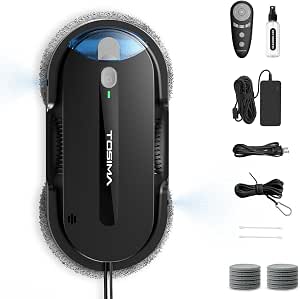 | Best for Larger Tank Capacity | Brand: Tosima | Model: X1 | Water tank capacity: 85 ml | VIEW LATEST PRICE | See Our Full Breakdown |
| Hunsib X3 Window Cleaning Robot with Dual Spray, Black |  | Best for Repeat Cleaning | Surface recommendation: Glass | Spray system: Ultrasonic dual spray with two directional nozzles | Water tank capacity: 85 mL | VIEW LATEST PRICE | See Our Full Breakdown |
| ECOVACS WINBOT W2 PRO Omni Window Cleaning Robot with Multifunction Station |  | Best for Extended Cleaning Sessions | Brand: ECOVACS | Model: WINBOT W2 PRO Omni | Power modes: Battery and plugged-in | VIEW LATEST PRICE | See Our Full Breakdown |
| robotic window cleaning robot | Cleaning modes |
|---|---|
| BOJUK Window Cleaning Robot wi | Top-Down, Left-Down, Right-Down |
| TOSIMA WA9C Pro Window Cleanin | N-shape, Z-shape, manual |
| ECOVACS WINBOT MINI 2 Window C | Fast, Thorough, Deep, Spot, Edge Clean |
| AOQUFUL YW160S Window Cleaning | 2 |
| ECOVACS WINBOT W2S PRO Window | Fast, Thorough, Edge, Heavy-Duty, Deep, Zone |
| Robo Clean Window Cleaning Rob | Fast, Thorough, Spot |
| WISEBOT Window Cleaning Robot | Fast, intensive, spot cleaning |
| ECOVACS WINBOT W3 OMNI Robot W | Fast, Intensive, Zone |
| Automatic Window Cleaning Robo | 3 |
| HUTT H10 Window Cleaning Robot | — |
| Automatic Window Cleaning Robo | 3 automatic modes and manual control |
| KADSKAN HCR-10 Window Cleaning | 3 automatic modes; manual directional control |
| Tosima X1 Window Cleaning Robo | — |
| Hunsib X3 Window Cleaning Robo | Spot cleaning, cleaning twice, and manual control |
| ECOVACS WINBOT W2 PRO Omni Win | — |
More Details on Our Top Picks
BOJUK Window Cleaning Robot with 6500Pa Suction, 3 Cleaning Modes and Dual Spray
The BOJUK suits households that want to choose a cleaning path for different window layouts. Its three directional modes and remote control give more route flexibility than the TOSIMA WA9C Pro’s N-shaped, Z-shaped, and manual options. With 6500Pa suction, edge detection, and a five-meter safety rope, it is equipped for framed or frameless glass, doors, and mirrors. The dual spray helps loosen everyday dust and smudges, though stubborn marks may need pre-cleaning or extra passes. Its 60ml tank is smaller than the AOQUFUL YW160S’s 70ml capacity, so larger cleaning sessions may call for a refill. I’d choose it for routine maintenance across varied glass surfaces, rather than for neglected windows that need heavy stain removal.
Pros:- Three cleaning paths offer flexibility for different window layouts.
- Edge and obstacle detection supports use on framed and frameless windows.
- Dual spray helps loosen light dirt during routine cleaning.
- Five-meter safety rope and 25-minute UPS backup add safeguards.
Cons:- The 60ml tank may need refilling during extended cleaning.
- Stubborn stains may require pre-cleaning or additional cycles.
Best for: Households with several types of glass surfaces that want remote control and a choice of cleaning paths.
Not ideal for: People cleaning large areas in one session or tackling baked-on grime, since the tank is modest and stubborn stains may need extra work.
- Suction:6500Pa
- Cleaning modes:Top-Down, Left-Down, Right-Down
- Water tank:60ml
- Cleaning path width:8 inches
- Safety rope:5 meters
- UPS backup:25 minutes
- Control:Remote control
- Included pads:10 cleaning pads
Our verdict“Choose the BOJUK for flexible, routine cleaning across multiple glass surfaces, provided you can work around its smaller tank and limited stain-removal ability.”
TOSIMA WA9C Pro Window Cleaning Robot with Dual Spray and Remote Control
Four spray nozzles make the TOSIMA WA9C Pro a strong fit for buyers who want water distributed across the cleaning surface. Its N-shaped, Z-shaped, and manual modes offer route choices, while suction and drop sensors help it stay attached as it moves. Compared with the BOJUK, it has more nozzles but a lower stated suction range of 2600–3200 Pa; buyers prioritizing suction strength may prefer the BOJUK’s 6500Pa rating. The up-to-25-minute backup battery and included safety rope add support during indoor use, though the rope still needs a reliable anchor. The kit also includes four mops and replacement nozzles. I’d pick it for routine glass cleaning where spray coverage matters more than maximum stated suction.
Pros:- Four spray nozzles distribute water across the cleaning surface.
- N-shaped, Z-shaped, and manual modes provide route flexibility.
- Suction and drop sensors support attachment during operation.
- Includes a remote, four mops, replacement nozzles, and safety rope.
Cons:- Its stated suction force is lower than the BOJUK’s 6500Pa rating.
- The safety rope requires a reliable anchor for overhead cleaning.
Best for: Indoor glass-cleaning buyers who value multiple spray points, remote operation, and distinct route modes.
Not ideal for: People who prioritize a high stated suction rating or cannot anchor a safety rope securely for overhead work.
- Suction force:2600–3200 Pa
- Spray nozzles:4
- Cleaning modes:N-shape, Z-shape, manual
- Backup battery:Up to 25 minutes
- Cleaning path width:8 inches
- Control:Remote control
- Usage:Indoor glass windows
- Included mops:4 cleaning mops
Our verdict“Choose the TOSIMA WA9C Pro if spray coverage and route options matter more to you than maximum stated suction.”
ECOVACS WINBOT MINI 2 Window Cleaning Robot
The WINBOT MINI 2 is the clearest choice here for small or narrow glass areas. At 8.46 inches square, with a stated minimum window size of 8.66 by 9.84 inches, it can suit panes that larger-format options may not fit. Its five modes include Edge Clean, and corner brushes and thin side wings help it work close to frames. Compared with the AOQUFUL YW160S, which offers app and remote control plus a 70ml tank, the MINI 2 emphasizes compact access and edge coverage; its moisture capacity is just 15g. App and Bluetooth directional control provide route input, while backup attachment protection and a safety rope add safeguards. I’d favor it for tight glass spaces, but skip it if you need a larger tank or use beyond indoor glass.
Pros:- Compact dimensions and a stated minimum window size suit narrow glass areas.
- Five modes include a dedicated Edge Clean setting.
- Corner brushes and thin side wings help reach near frames.
- App control, Bluetooth direction control, and attachment safeguards are included.
Cons:- The 15g moisture capacity is limited compared with the AOQUFUL’s 70ml tank.
- The stated surface recommendation is glass, limiting its versatility.
Best for: Apartment dwellers and homeowners with small panes, narrow glass sections, or mirrors that need edge-focused cleaning.
Not ideal for: Buyers cleaning broad expanses of glass or smooth surfaces beyond the stated glass recommendation.
- Dimensions:8.46 x 8.46 x 2.17 in
- Minimum window size:8.66 x 9.84 in
- Suction:8000 Pa
- Cleaning pressure:14 N
- Moisture capacity:15 g
- Cleaning modes:Fast, Thorough, Deep, Spot, Edge Clean
- Noise level:65 dB
- Control:ECOVACS HOME App and Bluetooth directional control
Our verdict“Pick the WINBOT MINI 2 for compact panes and edge-focused cleaning, especially when larger robots may not fit.”
AOQUFUL YW160S Window Cleaning Robot with Dual Water Spray and App Control
The AOQUFUL YW160S brings together app and remote control with a 70ml tank, spot cleaning, and a resume function. That combination makes it a practical option for buyers who want to manage a cleaning session from different controls or continue after an interruption. Its 6400Pa suction is close to the BOJUK’s 6500Pa, while its tank is larger than the BOJUK’s 60ml capacity. The tradeoff is that it has just two cleaning modes, fewer than the ECOVACS WINBOT MINI 2’s five, and the AOQUFUL requires corded power. Smart navigation and edge detection help it handle smooth surfaces, and 12 washable microfiber cloths provide a generous supply for upkeep. I’d choose it for controlled routine cleaning, but not for people seeking a cordless setup or many preset modes.
Pros:- App and remote control provide two ways to operate it.
- The 70ml tank holds more than the BOJUK’s 60ml capacity.
- Spot cleaning and resume functions support targeted or interrupted sessions.
- Includes 12 washable microfiber cloths and a four-meter safety rope.
Cons:- Corded electric power limits placement and movement.
- Two cleaning modes offer fewer presets than the WINBOT MINI 2’s five.
Best for: Glass-cleaning users who want both app and remote control, a larger tank, and washable cloths.
Not ideal for: People who need cordless operation or want a wide selection of preset cleaning modes.
- Suction power:6400 Pa
- Water tank:70 ml
- Cleaning modes:2
- Control:Remote control and app
- Power source:Corded electric
- Battery backup:20–30 minutes during power outages
- Safety rope:4 meters
- Included cloths:12 washable microfiber cloths
Our verdict“Choose the AOQUFUL YW160S for app-and-remote flexibility and a larger tank, if corded operation and two modes suit your routine.”
ECOVACS WINBOT W2S PRO Window Cleaning Robot
The WINBOT W2S PRO is the feature-rich pick for buyers who want several cleaning approaches in one glass-focused robot. Its 10,000Pa suction, triple-spray wet wiping, and TruEdge 2.0 brushes combine attachment strength with attention to corners and frames. Six modes, including Heavy-Duty, Deep, and Zone, give it more task-specific options than the BOJUK’s three directional paths. WIN-SLAM 4.0 route planning and a 10-stage safety system add structure to operation, though the available description does not detail each safety stage. The tradeoffs are a corded power source and glass-only surface recommendation; the WINBOT MINI 2 is a more compact alternative for narrow panes. I’d choose this model for varied cleaning needs across glass windows, provided its corded setup fits the space.
Pros:- 10,000Pa suction is the highest stated rating among these five options.
- Triple spray and a microfiber pad support wet wiping.
- TruEdge 2.0 brushes help reach near window edges and corners.
- Six modes and WIN-SLAM 4.0 route planning suit varied cleaning tasks.
Cons:- Corded electric power limits where and how it can be used.
- The stated surface recommendation is glass.
Best for: Buyers with multiple glass windows who want high stated suction, edge brushes, and modes for different cleaning tasks.
Not ideal for: People who need a compact robot for narrow panes or want to clean surfaces beyond glass.
- Suction power:10,000 Pa
- Cleaning modes:Fast, Thorough, Edge, Heavy-Duty, Deep, Zone
- Power source:Corded electric
- Control:App control
- Water capacity:4.1 fluid ounces
- Battery life:30 minutes
- Filter:Washable
- Surface recommendation:Glass
Our verdict“Choose the WINBOT W2S PRO for a broad set of glass-cleaning modes and edge tools if its corded setup fits your windows.”
Robo Clean Window Cleaning Robot with Dual Ultrasonic Spray
The dual ultrasonic spray sets Robo Clean apart for buyers who want a fine mist across glass without relying on a large reservoir. Its three modes and manual directional control give more flexibility for quick passes or focused spots than the simpler three-mode setup on the Automatic Window Cleaning Robot with 6400 Pa Suction. The 85 ml tank is modest, though, so large or heavily soiled panes may call for refills. Robo Clean also works on tiles and marble, which broadens its use beyond windows, but it still needs a smooth surface and a plug-in connection while operating. A 5 m tether and adhesion support for up to 20 minutes during power loss add reassurance for elevated glass. This is a practical pick for varied smooth surfaces, not a cordless cleaner.
Pros:- Dual ultrasonic spray is designed to distribute a fine mist with less water
- Fast, Thorough, and Spot modes plus manual directional control
- Safety tether and up to 20 minutes of adhesion support during power loss
- Includes 10 reusable cloths and two replacement nozzles
Cons:- Must remain plugged in during operation
- The 85 ml tank may need refilling during larger cleaning jobs
- Use is limited to smooth compatible surfaces
Best for: Homeowners who want fine-mist cleaning for windows and other smooth surfaces and can work near a power outlet
Not ideal for: People cleaning large windows far from outlets or surfaces with texture, fabric, or uneven finishes
- Maximum suction:6400 Pa
- Water tank:85 ml
- Cleaning modes:Fast, Thorough, Spot
- Power:Plug-in operation
- Compatible surfaces:Glass, tiles, marble, glass curtain walls
- Compatible glass thickness:6–19 mm
- Safety tether:5 m
- Included cloths:10 reusable cleaning cloths
Our verdict“Choose Robo Clean for low-water misting and flexible controls across smooth surfaces if a corded setup suits your windows.”
WISEBOT Window Cleaning Robot with AI Navigation, Triple Spray, and Square Edge Design
WISEBOT is aimed at broad panes where route coverage and corner access matter more than fitting into compact spaces. Its square body, dedicated edge mode, and four round corner pads give it a different cleaning approach from the round-square two-stage pads on the HUTT H10, which focus on wet lifting followed by dry polishing. The 200 ml tank and triple-spray setup also support longer wet-cleaning runs than the 80 ml HUTT reservoir. AI route planning, obstacle detection, and frameless-glass detection help it adapt to varied window layouts, while app and remote controls offer choice. The tradeoff is size: WISEBOT requires glass of at least 16 × 16 inches, and its safety rope and power connection still need attention at height.
Pros:- Square body and edge mode are designed to reach corners and frame areas
- 200 ml tank and triple spray support wet cleaning over wider areas
- AI navigation includes edge, frameless-glass, and obstacle detection
- Includes washable microfiber cloths, app control, and remote control
Cons:- Requires a glass surface at least 16 × 16 inches
- High-window cleaning still requires attention to the safety rope and power connection
- App control may be unnecessary for buyers who prefer simple onboard controls
Best for: Owners of large windows with corners or frames who want app or remote control and a larger water tank
Not ideal for: People with small panes, narrow glass sections, or high windows where managing a rope and power lead is difficult
- Minimum glass size:16 × 16 in
- Water tank:200 ml
- Spray system:Dual water pumps with triple spray nozzles on both sides
- Cleaning modes:Fast, intensive, spot cleaning
- Body design:Square body with four round corner cleaning pads
- Controls:Remote control and app
- Safety features:Safety rope, anti-fall sensors, power failure alarm, UPS backup battery
- Cleaning cloths:Washable, reusable microfiber
Our verdict“Pick WISEBOT for larger, cornered panes where its square layout and 200 ml tank are more useful than the HUTT H10’s two-stage pad system.”
ECOVACS WINBOT W3 OMNI Robot Window Cleaner with Self-Cleaning Station
The WINBOT W3 OMNI stands apart from the more hands-on Robo Clean and HUTT H10 through its self-cleaning station, which washes the mop pads with 16 high-pressure nozzles. That can reduce the cleanup work after a session, especially for households cleaning multiple glass panels. On the window, Win-SLAM 5.0 navigation, obstacle avoidance, and Fast, Intensive, and Zone modes help manage different layouts; a triple-nozzle spray and TruEdge cleaning target dirt near edges. The station and app-based setup make this the most system-oriented option in this group, but its 12.22 kg listed weight and glass-only recommendation make it less appealing for buyers seeking a lightweight, multi-surface robot. It suits people who value pad maintenance automation and are comfortable using app control.
Pros:- Station automatically washes mop pads using 16 high-pressure nozzles
- Win-SLAM 5.0 navigation includes dynamic obstacle avoidance
- TruEdge cleaning and triple-nozzle spray target edges and loosen dirt
- Fast, Intensive, and Zone modes accommodate different glass layouts
Cons:- Listed weight of 12.22 kg makes the system cumbersome to move
- Recommended for glass and indoor use, limiting surface versatility
- App control is the listed control method
Best for: Households with several indoor glass surfaces that want automatic mop-pad washing between or after cleaning runs
Not ideal for: Buyers seeking a lightweight cleaner, non-glass surface use, or controls that do not depend on an app
- Model:WINBOT W3 OMNI
- Recommended surface:Glass
- Cleaning modes:Fast, Intensive, Zone
- Navigation:Win-SLAM 5.0 with dynamic obstacle avoidance
- Spray system:Triple-nozzle wide-angle spray
- Station:Automatic mop-pad washing with 16 high-pressure nozzles
- Battery life:130 minutes
- Dimensions:10.63 × 2.99 × 10.63 in
- Weight:12.22 kg
Our verdict“Choose the W3 OMNI if automatic pad washing is worth a heavier, app-controlled system dedicated to indoor glass.”
Automatic Window Cleaning Robot with 6400 Pa Suction, Dual Spray, Edge Detection, and Remote Control
This model makes a straightforward case for buyers who prioritize fall-protection features and a supply of replacement pads. Its backup battery, air-pressure sensor, and 178-inch safety rope add layers of support for elevated glass; Robo Clean also offers power-off adhesion, but lists a shorter 5 m tether. Three cleaning modes and dual-direction spray cover the basics, while edge and corner detection help guide coverage. The 10 replacement microfiber pads are useful for regular cleaning, though they need to be dampened before use. The instructions also call for putting cleaning solution on the glass rather than in the machine, adding a preparation step compared with the more self-contained spray approach on the HUTT H10. This is a practical safety-minded pick, with some hands-on setup.
Pros:- 178-inch safety rope, backup battery, and air-pressure sensor support elevated use
- Three modes and dual-direction automatic spray
- Edge and corner detection help guide surface coverage
- Includes 10 replacement microfiber pads
Cons:- Pads must be dampened before use
- Cleaning solution must be applied to the glass to avoid clogging nozzles
- Surface compatibility is limited to glass, tile, and marble
Best for: People cleaning elevated glass who want a long safety rope, backup battery, and extra microfiber pads
Not ideal for: Buyers who want minimal preparation or need cleaning beyond glass, tile, and marble
- Maximum suction:6400 Pa
- Water tank:85 ml
- Safety rope:178 in
- Cleaning modes:3
- Spray system:Dual-direction automatic spray
- Safety features:Backup battery, air-pressure sensor, safety rope
- Surface compatibility:Glass, tile, marble
- Included pads:10 replacement microfiber pads
Our verdict“Choose this model for its longer listed safety rope and backup battery if you are comfortable preparing the pads and applying solution by hand.”
HUTT H10 Window Cleaning Robot, 6500 Pa, Round-Square Dual-Stage Cleaning
HUTT H10 earns its place through a round wet-lifting pad and square dry-polishing pad, a two-stage approach that distinguishes it from the WISEBOT’s corner-oriented square layout. The wet pad is intended to lift grime, while the dry pad polishes the glass, giving buyers a clearer reason to choose this design over robots that rely on one pad style. NAVI 7.0 planning and 14 sensors support route guidance and edge detection, and the UPS battery maintains adhesion for up to 30 minutes during a power interruption. Its 80 ml tank is smaller than WISEBOT’s 200 ml reservoir, though the stated coverage is up to 60 m² per refill. Corded operation and advice to use purified water with careful pad preparation make it less convenient for spontaneous cleaning.
Pros:- Round wet-lifting and square dry-polishing pads provide distinct cleaning stages
- NAVI 7.0 planning and 14 sensors support route guidance and edge detection
- UPS battery maintains adhesion for up to 30 minutes during power interruptions
- Compatible with windows, mirrors, shower doors, and sliding glass doors
Cons:- Requires a corded power connection during normal operation
- Cleaning liquid is not included, and purified water and careful pad preparation are recommended
- Minimum surface size is 30 × 30 cm
Best for: Homeowners who want separate wet-lifting and dry-polishing stages for windows, mirrors, or shower doors
Not ideal for: People who need cordless operation, minimal pad preparation, or a robot for panes smaller than 30 × 30 cm
- Suction:Up to 6500 Pa
- Cleaning pressure:Up to 55 N (12.3 lbs)
- Water tank:80 ml
- Coverage per refill:Up to 60 m² (646 sq ft)
- Battery backup:Up to 30 minutes
- Minimum surface size:30 × 30 cm
- Sensors:14
- Noise level:65 dB
- Weight:1.3 kg
Our verdict“Pick the HUTT H10 for its two-stage pad system and broad glass-surface compatibility if you can manage its cord and preparation routine.”
Automatic Window Cleaning Robot with Dual Spray and Remote Control
The Anminto Automatic Window Cleaning Robot makes sense for buyers who want automated navigation with a way to correct its course by hand. AI path planning and edge detection guide it around frames, while the infrared remote offers three automatic modes and manual control. Its dual nozzles and double-helix cleaning heads pair with microfiber pads to address routine smudges. Compared with the KADSKAN HCR-10, it has a larger 50 ml tank, though KADSKAN lists a stronger 5600 Pa suction figure and includes multiple spare pads. Anminto’s 3200 Pa suction and small tank make it a better fit for moderate jobs than extended sessions across many large panes. Its up to 30-minute backup operation and safety rope add safeguards during use, but do not remove the need to plan around power and refills.
Pros:- AI path planning and edge detection help guide the robot around frames and obstacles.
- Dual water nozzles and double-helix heads work with microfiber pads.
- Infrared remote supports three automatic modes and manual control.
- Backup operation and a safety rope add safeguards during cleaning.
Cons:- The 50 ml water capacity may require refills during larger jobs.
- Listed suction force is 3200 Pa, below the KADSKAN HCR-10’s 5600 Pa figure.
Best for: Homeowners with framed glass doors or several medium-sized windows who want automatic routes and remote corrections.
Not ideal for: People cleaning many large panes in one session, since the 50 ml tank may need refilling and the listed suction is lower than KADSKAN HCR-10’s.
- Brand:Anminto
- Model:US-ANM-06-260714-S1
- Surface recommendation:Glass
- Suction force:3200 Pa
- Water capacity:50 ml
- Control:Infrared remote control
- Cleaning modes:3 automatic modes and manual control
- Backup operation:Up to 30 minutes during power outages
Our verdict“Choose Anminto for guided cleaning and hands-on remote adjustments on moderate glass jobs, but look to a higher-suction option for more demanding sessions.”
KADSKAN HCR-10 Window Cleaning Robot with Water Spray and Remote Control
The KADSKAN HCR-10 earns its place for buyers who value cleaning supplies and spray flexibility alongside the robot. It includes 10 cleaning pads and four cleaning rings, plus automatic and manual water spraying, so owners can tailor how much water reaches smooth glass. Its listed 5600 Pa suction exceeds the Anminto model’s 3200 Pa, but KADSKAN’s 30 ml tank is smaller, which can mean more interruptions on broad windows. Three automatic modes and manual directional control give it useful hands-on options; frame and obstacle detection help guide the double-spiral head. Compared with the Tosima X1, KADSKAN provides a fuller pad bundle, while Tosima has an 85 ml tank and a stated S-shaped route. Its corded power and smooth-surface focus limit where and how it can be used.
Pros:- Includes 10 cleaning pads and four cleaning rings.
- Supports both automatic and manual water spraying.
- Three automatic modes plus manual directional control offer route flexibility.
- Lists 5600 Pa suction and includes a safety rope rated for a 300 lb load.
Cons:- The 30 ml tank is smaller than the Anminto and Tosima X1 tanks.
- Designed for smooth surfaces, limiting its suitable cleaning surfaces.
- Corded power and a listed 30-minute battery life constrain use away from an outlet.
Best for: People with multiple smooth glass panes who want spare pads included and the option to control water spraying manually.
Not ideal for: Anyone seeking cordless operation or long stretches between refills, given its corded power and 30 ml water capacity.
- Model:HCR-10
- Suction power:5600 Pa
- Water capacity:30 ml
- Cleaning path width:5.7 inches
- Cleaning modes:3 automatic modes; manual directional control
- Water spray:Automatic and manual
- Power source:Corded electric
- Safety rope load capacity:300 lbs
- Included pads:10 cleaning pads and 4 cleaning rings
Our verdict“Pick the KADSKAN HCR-10 if a generous pad bundle and adjustable spraying matter more than a larger tank or cordless convenience.”
Tosima X1 Window Cleaning Robot
The Tosima X1 is a practical match for buyers who want fewer water refills during a window-cleaning session. Its 85 ml tank with a viewing window holds more than the Anminto’s 50 ml and KADSKAN HCR-10’s 30 ml, and dual ultrasonic nozzles distribute spray along an S-shaped cleaning path. That capacity helps on larger glass panes, though it still needs a corded power source. Remote control allows manual direction adjustments, while edge cleaning and a stated 30 × 30 cm minimum surface size define where it can operate. Compared with the Hunsib X3, Tosima lists a two-year warranty, but Hunsib specifies spot and repeat-cleaning modes and includes 10 washable mops. Tosima’s 25-minute backup battery and safety tether support attachment during outages; they do not make it cordless.
Pros:- The 85 ml tank is larger than the Anminto and KADSKAN tanks.
- A viewing window makes the water level easy to check.
- Dual ultrasonic spray nozzles pair with an S-shaped cleaning path.
- Includes a safety tether and lists a two-year warranty.
Cons:- Requires a corded power source for operation.
- Limited to glass surfaces at least 30 × 30 cm.
- Backup battery supports attachment for about 25 minutes during an outage, rather than cordless cleaning.
Best for: People cleaning larger glass panes who want a visible, higher-capacity tank and remote route adjustments.
Not ideal for: Buyers who need a cordless cleaner or want to use a robot on small glass sections below 30 × 30 cm.
- Brand:Tosima
- Model:X1
- Water tank capacity:85 ml
- Cleaning path:S-shaped
- Minimum window size:30 × 30 cm
- Backup battery runtime:About 25 minutes during a power outage
- Power source:Corded electric
- Noise level:65 dB
- Warranty:2 years
Our verdict“Choose the Tosima X1 for a larger, visible water tank and guided glass cleaning if corded operation suits your setup.”
Hunsib X3 Window Cleaning Robot with Dual Spray, Black
The Hunsib X3 suits owners who want a choice between a quick spot pass and repeating a full cleaning cycle. Its remote includes spot cleaning, cleaning twice, and manual control, while S-shaped navigation and spinning mop holders support wet or dry wiping. The 85 ml visible tank matches the Tosima X1’s stated capacity, but Tosima specifies an S-shaped route and a two-year warranty; Hunsib instead highlights repeat-cleaning modes and includes 10 washable microfiber mops. A 25-minute UPS backup and safety rope help keep the unit attached during an outage. Its glass-only design and 300 × 300 mm minimum pane size rule out small sections, and the tank may still need refilling across several windows. The listed battery-powered setup is also distinct from Tosima’s explicitly corded power source.
Pros:- Remote offers spot cleaning, repeat cleaning, and manual control.
- Dual directional spray and spinning mop holders support wet and dry wiping.
- Includes 10 washable microfiber mops and a safety rope.
- Lists up to 25 minutes of UPS backup suction during a power outage.
Cons:- Designed for glass at least 300 × 300 mm.
- The 85 ml tank may need refilling during multi-window sessions.
- Backup suction lasts up to 25 minutes during an outage.
Best for: Glass-door and window owners who want to run a spot pass or repeat a cleaning cycle from the remote.
Not ideal for: People with small panes under 300 × 300 mm or broad cleaning jobs that require more than an 85 ml tank.
- Surface recommendation:Glass
- Spray system:Ultrasonic dual spray with two directional nozzles
- Water tank capacity:85 mL
- Path planning:S-shaped
- Cleaning modes:Spot cleaning, cleaning twice, and manual control
- Minimum glass size:300 × 300 mm
- UPS backup:Up to 25 minutes
- Included mops:10 washable microfiber mops
Our verdict“Pick the Hunsib X3 if repeat and spot-cleaning controls are priorities and your windows meet its minimum glass size.”
ECOVACS WINBOT W2 PRO Omni Window Cleaning Robot with Multifunction Station
The ECOVACS WINBOT W2 PRO Omni stands apart for buyers who need to clean many panes without relying on battery power for the entire job. Its up to 110 minutes of battery cleaning is the longest stated cordless runtime in this group, and plugged-in mode allows continuous operation. That gives it a clear session-length advantage over the Tosima X1 and Hunsib X3, whose backup runtimes are specified for keeping suction during an outage. A multifunction station, three-nozzle wide-angle sprayer, and WIN-SLAM 4.0 path planning target a range of glass window types, while the 12-stage protection system adds another layer of operational safeguards. The tradeoff is a glass-focused design and battery coverage capped at up to 55 square meters per charge. App control may also be less direct for buyers who prefer a simple remote.
Pros:- Up to 110 minutes of battery cleaning supports longer sessions than the other listed models.
- Plugged-in mode allows continuous operation.
- Three-nozzle wide-angle spraying and WIN-SLAM 4.0 path planning support window cleaning.
- Multifunction station and 12-stage protection system are included in the design.
Cons:- Battery mode coverage is limited to up to 55 square meters per full charge.
- Designed for glass surfaces, limiting use beyond window cleaning.
- App control may not suit buyers seeking a dedicated remote.
Best for: Owners of homes with many glass windows who want long battery sessions plus the option to plug in for continuous cleaning.
Not ideal for: People who need a cleaner for non-glass surfaces or prefer physical remote controls over app operation.
- Brand:ECOVACS
- Model:WINBOT W2 PRO Omni
- Power modes:Battery and plugged-in
- Battery cleaning time:Up to 110 minutes
- Battery mode coverage:Up to 55 square meters per full charge
- Sprayer:Three-nozzle wide-angle spray
- Path planning:WIN-SLAM 4.0
- Protection:12-stage protection
- Controller:App control
Our verdict“Choose the WINBOT W2 PRO Omni for extended multi-window sessions, especially if you value both battery and continuous plugged-in operation.”

How We Picked
I compared the 15 listed models on factors that change the day-to-day experience: cleaning and spray design, navigation and edge handling, controls, safety-related features named in the listings, and the maintenance routine implied by each setup. A suction figure or added spray nozzle can be useful context, but neither alone tells me how well a robot will suit a particular window or how much work the owner will still need to do.
The ranking favors options with a clear practical advantage and a feature mix that fits common household needs. The ECOVACS models with multifunction stations rank well for buyers seeking a more managed routine, while simpler remote-control models may suit straightforward jobs with fewer setup preferences. Specialized designs such as the HUTT H10’s dual-stage approach and WISEBOT’s square edge design earn consideration for shape-specific needs. Where a listing gives limited detail, I avoid treating headline claims as proof of superior cleaning and recommend checking compatibility, accessories, and ongoing pad availability before choosing.
Factors to Consider When Choosing Robotic Window Cleaning Robots
Before choosing a robot, I’d start with the glass and the cleaning routine you actually have. A model with extra automation can be a poor fit if it cannot reach your windows or work with their frames. These factors help separate useful features from ones that may not matter in your home.
Match the robot to window shape and access
Measure the usable glass area and note how close it sits to frames, handles, dividers, and corners. A design that emphasizes square edge coverage may make sense for windows where edge access matters, while a dual-stage cleaning path could appeal if you want a different approach to coverage. Do not assume that a robot can clean every pane just because it can attach to glass. Check the product’s stated window and frame compatibility, including whether it needs a clear margin near edges. Also think about how you will place and retrieve the unit on exterior windows. Reach and safe access can matter more than a navigation feature you may rarely use.
Treat spray and pad care as one system
Spray features only help when the water reaches the glass in a useful pattern and the cleaning pads stay in good condition. Dual or triple spray can reduce manual wetting, but it does not tell you how often you will need to refill the tank or wash the pads. Check what cleaning solution the maker allows and whether replacement pads are easy to obtain. A common mistake is to focus on nozzle count and overlook the time needed to prep and clean the accessories. If you have many windows, that maintenance can shape the whole routine. For occasional use, a simpler spray setup may be easier to manage.
Look beyond a suction number
Listings that quote suction in pascals give one specification, not a complete measure of cleaning performance or suitability. Compare the safety instructions, backup power or tether arrangements, and supported glass types alongside that figure. These details matter especially for high, exterior, or hard-to-reach windows. Check whether the robot needs to remain plugged in and how much cord reach your layout requires. Avoid assuming that a higher listed suction value makes the unit compatible with every surface. The right choice is the one whose full operating requirements fit your windows and access plan.
Choose controls for the way you work
Remote controls offer direct input from nearby, while app controls may be more convenient if you prefer managing settings from a phone. AI navigation claims can sound appealing, but the useful question is what the robot does when it encounters an edge, obstacle, or unusual pane layout. Look for clearly described modes and instructions for starting, pausing, and retrieving the unit. Beginners may value fewer settings and a clear setup routine more than a long feature list. If your windows are simple and uniform, extra control options may not change much. For varied panes, flexible modes can be more useful.
Decide whether a station earns its space
A multifunction or self-cleaning station can help with accessory upkeep, but it adds another item to store and manage. Before paying attention to station features, consider where it will sit and which parts of cleaning it actually handles. A station does not remove the need to place the robot on the glass, check the water supply, or maintain pads unless the maker explicitly says so. If you clean many panes in one session, a more integrated setup may reduce repeated chores. For a few windows at a time, a compact robot without a station may fit your routine better. Compare the station’s stated functions with the tasks you find most inconvenient.
Plan for the full ownership routine
Think through setup, cleaning, storage, and replacement supplies before deciding between similar models. A robot may save reaching and wiping while still requiring frequent pad washing, refills, or careful cord management. Confirm what comes in the box and whether consumables are sold separately. Check the warranty and support terms in your region, particularly for models with less familiar brand names. Noise and cycle time can also affect whether you will use the robot regularly, so look for reliable specifications rather than guessing from feature labels. The best fit is a device whose upkeep you will accept after the novelty wears off.
Frequently Asked Questions
Can one window cleaning robot work on both interior and exterior windows?
That depends on the model’s supported surfaces, safety instructions, and how you can reach the outside glass. Check whether the maker permits exterior use and what tether or backup measures it requires. Also consider window type: screens, deep frames, divided panes, and handles can limit where a robot can travel. Even a compatible robot may not solve access problems on upper floors or windows that do not open safely. Confirm those details before buying rather than relying on a general claim that the device cleans windows.
Do higher suction figures mean a robot will clean better?
No single suction specification tells you how clean the glass will be. It describes one part of how the unit attaches, while pad condition, water delivery, navigation, and the type of dirt all affect the result. Figures are most useful when comparing models that provide them under similar conditions. I would also check the safety guidance and surface compatibility instead of ranking devices by pascals alone. Treat the number as a specification to verify, not a guarantee of cleaning quality.
Is a self-cleaning or multifunction station worth choosing?
A station can make sense if it handles a maintenance task you repeat often and you have room to store it. Check exactly what it cleans or manages; the label alone does not say whether it washes pads, handles water, or performs another task. You will still need to set the robot on the window and follow its operating instructions. For a small number of panes, a station may add storage and setup without changing your routine much. For larger cleaning sessions, its specific functions may save time between windows.
What should I check before using a robot on framed or divided windows?
Read the model’s compatibility guidance for frames, narrow panes, and obstacles, then compare it with the exact layout of your windows. Measure each pane and note muntins, handles, seals, and gaps that could interrupt the robot’s path. Edge detection or a square design does not automatically mean the device can cross every divider or reach every corner. If a window is unusual, look for a clear manufacturer answer before relying on it. A quick compatibility check can prevent choosing a robot that only suits your largest, simplest pane.
Are app controls better than a remote for a first-time buyer?
Neither control type is automatically easier; it depends on how you want to operate the robot. A remote can be direct when you are standing near the window, while an app may offer convenient access to modes or status. For a first purchase, prioritize clear setup instructions, predictable navigation, and an easy way to pause or retrieve the unit. Check whether an app requires an account or a network connection if that would complicate use at home. A simpler control system may be the better fit when you mainly want routine cleaning of standard panes.
Conclusion
I’d choose the ECOVACS WINBOT W2S PRO as the best overall option for buyers seeking a balanced feature set. The BOJUK is a potential best value fit for shoppers who want dual spray, multiple modes, and a stated 6500Pa suction figure, provided its compatibility and support details check out. For a premium, station-focused setup, compare the WINBOT W3 OMNI with the WINBOT W2 PRO Omni and choose based on the station functions you will use. Beginners with straightforward windows may prefer a clearly documented remote-control model such as the TOSIMA WA9C Pro. For specialized edge or cleaning-path needs, consider WISEBOT for its square edge design or the HUTT H10 for dual-stage cleaning; match either to your window layout before deciding.