For most home bakers, the Greater Goods Digital Food Scale is my best overall pick because its 22-pound capacity suits everyday recipes and larger mixing bowls. The BOMATA Precision Digital Food Scale is a better match for small, precise portions, while the Etekcity Rechargeable Digital Kitchen Scale adds water resistance for kitchens where spills are common. The main tradeoffs are capacity versus fine measurement, compactness versus weighing space, and rechargeable convenience versus simple battery operation. A high maximum capacity does not automatically make a scale more useful for baking if it cannot handle small quantities well. Read on for the full comparison and recommendations by baking style.

Get home appliances delivered free with Prime
- Fast, free delivery on millions of items
- Prime Video, Amazon Music and more included
- Member-only deals all year
Complete the kit


Key Takeaways
- Greater Goods is the most balanced choice: its 22-pound capacity gives room for large bowls and batches without making high capacity the only selling point.
- BOMATA’s 13-pound precision model suits small quantities: its role is fine portioning, while the 20 kg stainless-steel-and-glass model is aimed at unusually heavy loads.
- Water resistance is a practical differentiator: the IPX6 Etekcity and IPX7 0.1 g scale are more suited to splash-prone workspaces than models without a stated water rating.
- High-capacity models address specialized tasks: the Yoncon‘s 66-pound limit and the 44-pound scale can handle bulky loads, but that capacity may be unnecessary for routine bread and pastry recipes.
- Rechargeable designs trade battery simplicity for convenience: several picks offer rechargeable power, so buyers should weigh charging habits and spill protection alongside capacity and precision.
| Greater Goods Digital Food Scale for Kitchen and Baking, 22 lb Capacity |  | Best Overall | Maximum capacity: 22 lb (10 kg) | Precision: 1 g increments | Measurement units: g, oz, lb:oz, ml | VIEW ON AMAZON | See Our Full Breakdown |
| Mik-Nana Digital Kitchen Scale, 10 kg/22 lb |  | Best for Unit Flexibility | Capacity: 10 kg / 22 lb | Resolution: 1 g / 0.1 oz | Measurement units: g, kg, lb, oz, ml, milk ml | VIEW ON AMAZON | See Our Full Breakdown |
| Ultrean Digital Kitchen Scale with LCD Display |  | Best for Everyday Baking | Maximum capacity: 11 lb | Material: 304 stainless steel | Measurement units: g, kg, lb, oz, ml, milk ml | VIEW ON AMAZON | See Our Full Breakdown |
| Amazon Basics Digital Kitchen Scale with LCD Display |  | Best for Straightforward Recipes | Maximum capacity: 11 lb (about 5000 g) | Minimum weight: 2 g | Readout accuracy: 1 g | VIEW ON AMAZON | See Our Full Breakdown |
| BOMATA Precision Digital Food Scale, 13 lb | 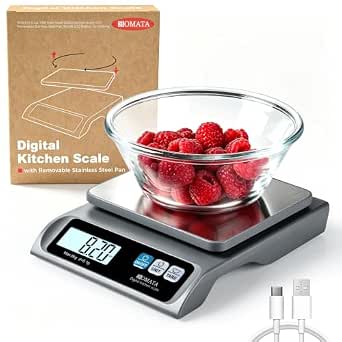 | Best for Small Ingredients | Maximum capacity: 13 lb (6 kg) | Measurement range: 0.5 g to 6 kg | Readout accuracy: 0.1 g / 0.01 oz | VIEW ON AMAZON | See Our Full Breakdown |
| Digital Kitchen Scale, 44 lb/20 kg, Stainless Steel and Tempered Glass | 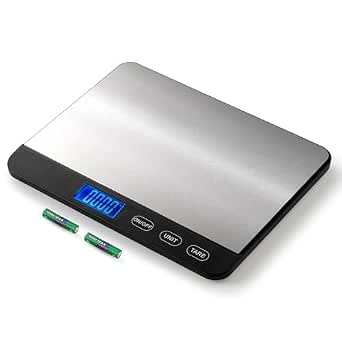 | Best for Large Baking Batches | Maximum capacity: 44 lb (20 kg) | Readout accuracy: 2.86 g | Platform size: 11.6 × 9.45 in | VIEW ON AMAZON | See Our Full Breakdown |
| IPX7 Waterproof Rechargeable Kitchen Scale, 0.1 g Precision, 10 kg/22 lb |  | Best for Fine Ingredient Precision | Measurement range: 0.5 g to 10 kg (22 lb) | Readability: 0.1 g | Units: g, tl, ct, fl oz, lb oz, lb, oz, milk ml, ml, kg | VIEW ON AMAZON | See Our Full Breakdown |
| Rechargeable Digital Kitchen Food Scale, 33 lb |  | Best for High-Capacity Everyday Baking | Capacity: 3 g to 15 kg (0.1 oz to 33 lb) | Graduation: 1 g | Measurement units: g, kg, lb:oz, oz, ml | VIEW ON AMAZON | See Our Full Breakdown |
| BOMATA High-Precision Kitchen Scale, 11 lb |  | Best for Baker’s Percentages | Maximum capacity: 11 lb (5 kg) | Readout accuracy: 0.1 g | Platform size: 7.2 × 7.2 in | VIEW ON AMAZON | See Our Full Breakdown |
| Etekcity Rechargeable Digital Kitchen Scale, 22 lb, IPX6 Waterproof |  | Best for Easy Cleanup | Weight capacity: 2 g to 22 lb (10 kg) | Measurement increments: 1 g | Units: g, oz, lb:oz, ml (milk and water), fl oz (milk and water) | VIEW ON AMAZON | See Our Full Breakdown |
| Yoncon Digital Kitchen Food Scale, 66 lb Capacity |  | Best for Oversized Baking Batches | Capacity: 5 g to 66 lb | Increments: 1 g | Platform: 6.22 × 7.95 in | VIEW ON AMAZON | See Our Full Breakdown |
| Etekcity Digital Kitchen Food Scale, 11 lb |  | Best Compact Everyday Pick | Capacity: 2 g to 11 lb (5 kg) | Increments: 1 g | Units: g, oz, lb:oz, mL, fl oz | VIEW ON AMAZON | See Our Full Breakdown |
| Nicewell Digital Kitchen Food Scale, 22 lb |  | Best for Flexible Unit Switching | Measuring range: 3 g to 22 lb (10 kg) | Increments: 1 g or 0.1 oz | Platform: 9 × 6.3 in | VIEW ON AMAZON | See Our Full Breakdown |
| digital kitchen scales for baking | Display | Power | Dimensions | Measurement units |
|---|---|---|---|---|
| Greater Goods Digital Food Sca | Bright Hi-Def LCD | 3 AAA batteries included | 7.6 x 5.6 x 1.3 in | g, oz, lb:oz, ml |
| Mik-Nana Digital Kitchen Scale | Bright LCD | — | 7.4 x 5.5 x 0.6 in | g, kg, lb, oz, ml, milk ml |
| Ultrean Digital Kitchen Scale | Backlit LCD | Batteries included | — | g, kg, lb, oz, ml, milk ml |
| Amazon Basics Digital Kitchen | LCD | 2 AAA batteries included | 8.3 x 7 x 1.3 in | lb, oz, g, fl oz, ml |
| BOMATA Precision Digital Food | Backlit LCD | USB rechargeable lithium battery or 2 AAA batteries | 7.5 x 5.9 in | g, lb, oz, ml |
| Digital Kitchen Scale | — | 2 AAA batteries included | — | g, kg, lb:oz, fl oz, ml |
| IPX7 Waterproof Rechargeable K | Backlit LCD | Built-in lithium battery with USB-C charging; two AAA batteries included | 8.75 × 6.5 × 1.45 in | — |
| Rechargeable Digital Kitchen F | LCD | Rechargeable | — | g, kg, lb:oz, oz, ml |
| BOMATA High-Precision Kitchen | Backlit LCD | Built-in rechargeable lithium battery or 2 AAA batteries | — | — |
| Etekcity Rechargeable Digital | — | — | 9.1 × 6.7 × 1.1 in | — |
| Yoncon Digital Kitchen Food Sc | Backlit LCD | Two AA batteries or 5 V DC adapter | 8.9 × 8.1 × 1.97 in | — |
| Etekcity Digital Kitchen Food | Backlit LCD | Two AAA batteries | 7.3 × 5.7 × 0.6 in | — |
| Nicewell Digital Kitchen Food | Large LCD | Two AAA batteries included | — | — |
More Details on Our Top Picks
Greater Goods Digital Food Scale for Kitchen and Baking, 22 lb Capacity
For bakers who want one scale for dough batches and everyday ingredient weighing, the Greater Goods Digital Food Scale offers a useful balance of capacity and readable controls. Its 22 lb limit accommodates heavier mixing bowls or larger batches, while 1 g increments suit most flour, sugar, and liquid measurements. Compared with the Amazon Basics Digital Kitchen Scale, it has more than twice the stated capacity and a hold function that keeps a reading visible for up to five minutes, which can help when a bowl obscures the display. The tradeoff is its 2-minute auto shutoff, shorter than the Mik-Nana’s three minutes, so pauses during prep may require switching it back on. It also does not offer the 0.1 g increments of the BOMATA Precision scale, making it less suited to very small quantities.
Pros:- 22 lb capacity handles larger bowls and batches
- 1 g increments and four units cover common baking measurements
- Display extends beyond the platform and hold keeps readings visible
- Stainless steel platform and slim profile are practical for regular kitchen use
Cons:- Auto shutoff after two minutes may interrupt slower measuring sessions
- 1 g increments are less precise for very small ingredient quantities
Best for: Home bakers who weigh large dough batches or use deep mixing bowls and want a clear display with standard 1 g precision
Not ideal for: Bakers measuring tiny amounts of yeast or spices who need 0.1 g increments, or anyone who often pauses longer than two minutes between additions
- Maximum capacity:22 lb (10 kg)
- Precision:1 g increments
- Measurement units:g, oz, lb:oz, ml
- Platform material:Stainless steel
- Display:Bright Hi-Def LCD
- Functions:Tare, hold up to 5 minutes, auto shutoff after 2 minutes
- Power:3 AAA batteries included
- Dimensions:7.6 x 5.6 x 1.3 in
- Warranty:5-year limited warranty
Our verdict“Choose the Greater Goods if you want a readable, high-capacity scale for routine baking and large batches.”
Mik-Nana Digital Kitchen Scale, 10 kg/22 lb
The Mik-Nana suits bakers who switch between recipes and want the scale to handle several ways of expressing liquid and dry quantities. Its six units include kilograms and milk milliliters, giving it more conversion options than the Greater Goods scale, which lists four units. The 304 stainless steel platform also offers a wipe-clean surface after flour or sticky ingredients land on it. Capacity is a full 22 lb, matching Greater Goods, but the supplied details list no hold function or battery type, so its appeal rests on straightforward weighing and unit choice rather than extra workflow features. Its 3-minute auto-off gives a little more time between additions than the Greater Goods’ 2-minute setting. Still, its 1 g resolution is a standard baking level, not the fine measurement offered by the BOMATA Precision scale.
Pros:- Six units include kilograms and milk milliliters
- 22 lb capacity supports large bowls and batches
- 304 stainless steel surface is easy to clean
- Three-minute auto-off allows more pause time than the Greater Goods scale
Cons:- 1 g resolution is not intended for very small ingredient amounts
- No hold function is listed for keeping an obscured reading visible
Best for: Recipe-following home bakers who frequently work from metric, imperial, and milk-volume measurements
Not ideal for: Bakers who need a hold function for readings hidden by large bowls or who measure tiny ingredients in tenths of a gram
- Capacity:10 kg / 22 lb
- Resolution:1 g / 0.1 oz
- Measurement units:g, kg, lb, oz, ml, milk ml
- Platform material:Food-grade 304 stainless steel
- Display:Bright LCD
- Functions:Tare, auto-off after 3 minutes
- Dimensions:7.4 x 5.5 x 0.6 in
Our verdict“Pick the Mik-Nana if recipe unit flexibility matters more to you than fine precision or extra display functions.”
Ultrean Digital Kitchen Scale with LCD Display
The Ultrean is a sensible fit for regular home baking where a simple, wipe-clean surface and easy-to-read results matter more than unusually high capacity. Its 11 lb limit covers most cake, bread, and cookie recipes, while the backlit LCD is easier to read in a crowded kitchen than an unlit display. Compared with the Greater Goods Digital Food Scale, it gives up half the capacity and the hold function, but offers the same broad range of six units as the Mik-Nana, including milk milliliters. That makes it adaptable when a recipe gives liquid quantities in volume. The listing does not state a precise increment, so I would not choose it over the BOMATA Precision for weighing small amounts that call for 0.1 g resolution. One setup detail is easy to miss: the plastic wrapping must be removed from the batteries before first use.
Pros:- Backlit LCD helps with readability
- Six measurement units include milk milliliters
- 304 stainless steel surface is easy to clean
- Batteries are included
Cons:- 11 lb capacity is below the 22 lb Greater Goods and Mik-Nana scales
- Precision increment is not specified in the supplied product data
- Battery wrapping must be removed before first use
Best for: Home bakers making standard-sized recipes who want a backlit display and several unit options
Not ideal for: People weighing heavy dough batches or bakers who need documented 1 g or 0.1 g resolution for precise small quantities
- Maximum capacity:11 lb
- Material:304 stainless steel
- Measurement units:g, kg, lb, oz, ml, milk ml
- Display:Backlit LCD
- Functions:Tare, automatic shutoff
- Power:Batteries included
Our verdict“Choose the Ultrean for everyday recipes if its 11 lb capacity fits your bowls and you value a backlit readout.”
Amazon Basics Digital Kitchen Scale with LCD Display
For a baker who wants basic weighing without extra modes, the Amazon Basics scale covers the core tasks: tare, 1 g readout accuracy, and a stainless steel platform. It measures from 2 g and supports fluid ounces and milliliters, so it can follow recipes that list liquid volume as well as weight. Compared with the Greater Goods and Mik-Nana, its 11 lb ceiling is lower, which makes it a better match for ordinary home batches than large bread mixes or heavy bowls. Its 8.3-inch width gives ingredients room on the platform, though the scale itself takes more counter or drawer space than the narrower Mik-Nana. Two included AAA batteries make it ready to power, but it offers fewer listed unit options than the six-unit Mik-Nana and no stated hold feature for a hidden display reading.
Pros:- 1 g readout accuracy and tare cover core baking needs
- Measures fluid ounces and milliliters as well as weight units
- Stainless steel platform with a wide LCD
- Two AAA batteries are included
Cons:- 11 lb capacity is lower than the 22 lb Greater Goods and Mik-Nana models
- Wider footprint takes more storage space than the Mik-Nana
- Requires AAA batteries
Best for: New or occasional bakers who want a basic tare scale for standard recipes and common liquid measurements
Not ideal for: Bakers who weigh large batches, need a hold function, or want a particularly compact scale for a crowded drawer
- Maximum capacity:11 lb (about 5000 g)
- Minimum weight:2 g
- Readout accuracy:1 g
- Measurement units:lb, oz, g, fl oz, ml
- Platform material:Stainless steel
- Display:LCD
- Power:2 AAA batteries included
- Dimensions:8.3 x 7 x 1.3 in
Our verdict“The Amazon Basics scale fits occasional bakers who need reliable basic weighing for standard batches.”
BOMATA Precision Digital Food Scale, 13 lb
When a baking recipe calls for small additions, the BOMATA’s 0.1 g increments make it the most specialized choice in this group. It can register from 0.5 g, which gives bakers more control over small amounts of yeast, salt, or leavening than the 1 g Greater Goods, Mik-Nana, and Amazon Basics scales. Its removable stainless steel pan catches ingredients and lifts off for cleaning, while USB recharging provides an alternative to the two AAA batteries it can also use. The compromise is a 13 lb maximum, well below the 22 lb Greater Goods and Mik-Nana models, so it is less suited to heavy bowls and large dough batches. The pan also occupies part of the weighing area, making it a more focused precision tool than a broad, flat platform for oversized containers.
Pros:- 0.1 g increments suit small ingredient measurements
- Measures from 0.5 g
- Detachable stainless steel pan simplifies cleanup
- USB rechargeable with AAA battery option
Cons:- 13 lb capacity is lower than the 22 lb Greater Goods and Mik-Nana scales
- AAA batteries are not included
- Smaller pan is less convenient for oversized bowls
Best for: Bakers who regularly measure small quantities of yeast, salt, or other ingredients where tenths of a gram matter
Not ideal for: People weighing large dough batches or using oversized mixing bowls that need more than 13 lb capacity
- Maximum capacity:13 lb (6 kg)
- Measurement range:0.5 g to 6 kg
- Readout accuracy:0.1 g / 0.01 oz
- Measurement units:g, lb, oz, ml
- Pan:Detachable stainless steel
- Display:Backlit LCD
- Power:USB rechargeable lithium battery or 2 AAA batteries
- Dimensions:7.5 x 5.9 in
- Warranty:12 months
Our verdict“Choose the BOMATA Precision when fine measurements matter more to your baking than maximum capacity.”
Digital Kitchen Scale, 44 lb/20 kg, Stainless Steel and Tempered Glass
I’d choose this scale when baking involves oversized mixing bowls, sheet pans, or dough batches that push past the limits of a standard kitchen scale. Its 44 lb capacity and 11.6 × 9.45-inch platform give it more room than the Etekcity Rechargeable Digital Kitchen Scale, while 1 g increments remain practical for weighing flour, sugar, and other common ingredients. The tare function and six listed measurement units make switching between a bowl and ingredients straightforward. That generous platform comes with a tradeoff: it takes more counter space than compact baking scales, and its AAA batteries need replacing rather than recharging. I’d rank it for batch size and workspace over fine-ingredient precision; bakers measuring tiny amounts should look to the BOMATA High-Precision Kitchen Scale instead.
Pros:- 44 lb capacity accommodates unusually large ingredient loads
- Wide platform fits bowls, trays, and plates
- Tare function and multiple measurement units support everyday baking
- Two AAA batteries and a 2-year warranty are included
Cons:- Uses disposable AAA batteries instead of rechargeable power
- 1 g increments are less suited to weighing very small ingredients
- Large platform takes more storage and counter space than compact models
Best for: Home bakers who regularly weigh large dough batches or place wide bowls and trays on the scale
Not ideal for: Bakers with limited counter space or those who need fine precision for yeast, salt, or other small quantities
- Maximum capacity:44 lb (20 kg)
- Readout accuracy:2.86 g
- Platform size:11.6 × 9.45 in
- Profile thickness:0.6 in
- Measurement units:g, kg, lb:oz, fl oz, ml
- Materials:Stainless steel and tempered glass
- Power:2 AAA batteries included
- Warranty:2 years
Our verdict“Choose it for large baking batches and wide bowls; pick the BOMATA High-Precision Kitchen Scale for small, precise measurements.”
IPX7 Waterproof Rechargeable Kitchen Scale, 0.1 g Precision, 10 kg/22 lb
For baking where a small error in yeast, salt, or leavening can change a batch, I’d put this scale ahead of the 1 g Etekcity Rechargeable Digital Kitchen Scale. Its 0.1 g readability gives more detail for small amounts, while a 10 kg capacity still covers most mixing bowls and bread dough. The USB-C rechargeable battery reduces reliance on disposables, and the stainless steel platform can be rinsed according to the description. There is a data caveat: the title says IPX7, but the description only calls the scale washable, so I wouldn’t treat the exact water-resistance rating as settled. Its stated minimum is also 0.5 g, and that precision is unnecessary for routine flour weighing. Choose it for small ingredients and cleanup convenience; choose the Etekcity for simpler 1 g measurements.
Pros:- 0.1 g readability helps with small baking ingredients
- Stainless steel platform and washable design simplify cleanup
- USB-C rechargeable battery with AAA batteries also included
- Tare, counting, calibration, and multiple unit options
Cons:- Waterproof rating is inconsistent between the title and description
- Minimum stated measurement is 0.5 g
- Fine readability adds complexity that routine batch baking may not need
Best for: Bread and pastry bakers who weigh yeast, salt, spices, or other small ingredients and want USB-C charging
Not ideal for: Bakers who mainly weigh flour and sugar, or who need a clearly documented waterproof rating
- Measurement range:0.5 g to 10 kg (22 lb)
- Readability:0.1 g
- Units:g, tl, ct, fl oz, lb oz, lb, oz, milk ml, ml, kg
- Platform material:Stainless steel
- Display:Backlit LCD
- Dimensions:8.75 × 6.5 × 1.45 in
- Power:Built-in lithium battery with USB-C charging; two AAA batteries included
- Included accessories:USB-C cable, 50 g calibration weight, two AAA batteries, user manual
Our verdict“Pick it for small-ingredient precision and rechargeable convenience, provided the unclear water-resistance rating is acceptable.”
Rechargeable Digital Kitchen Food Scale, 33 lb
This scale bridges the gap between a basic baking model and the 44 lb Digital Kitchen Scale in this roundup. Its 33 lb capacity is generous for mixing bowls and larger dough batches, while the 1 g graduation suits standard ingredient weighing. The stainless steel panel, tare function, and five units cover routine recipes without the extra fine-measurement functions of the BOMATA High-Precision Kitchen Scale. I’d favor this one for a baker who wants more headroom than a 22 lb model but doesn’t need 0.1 g readability. The tradeoffs are practical: the two-minute auto-off may interrupt a slower weighing session, and no charging details are provided, making battery planning harder. Its 7.5 × 5.5-inch panel is also less roomy than the 44 lb model’s platform.
Pros:- 33 lb capacity gives more headroom than common 22 lb scales
- 1 g graduation is suitable for routine ingredient weighing
- Tare function and five units cover common baking needs
- Non-slip feet and alerts add practical kitchen safeguards
Cons:- Two-minute auto-off may interrupt longer weighing sessions
- Charging method and battery runtime are not specified
- Panel is smaller than the large platform on the 44 lb scale
Best for: Home bakers who want extra capacity for large bowls and dough while keeping standard 1 g readability
Not ideal for: Bakers who need a large tray-sized platform, fine 0.1 g readings, or clear charging and runtime details
- Capacity:3 g to 15 kg (0.1 oz to 33 lb)
- Graduation:1 g
- Measurement units:g, kg, lb:oz, oz, ml
- Panel:7.5 × 5.5 in stainless steel
- Display:LCD
- Auto-off:2 minutes
- Power:Rechargeable
- Features:Tare, low-battery alert, overload alert, hanging hook, non-slip feet
Our verdict“Choose it for standard baking with extra capacity, but look elsewhere if you need fine precision or documented charging details.”
BOMATA High-Precision Kitchen Scale, 11 lb
The percentage function gives this BOMATA a specific baking advantage: it can help scale a formula from one ingredient weight to the next, a useful workflow for bread and pastry recipes. Its 0.1 g accuracy also suits small quantities better than the 1 g Etekcity Rechargeable Digital Kitchen Scale, and the 7.2-inch square platform provides more room than many precision-focused scales. Capacity tops out at 11 lb, though, so this model is less forgiving with a heavy bowl or a large batch than the 22 lb Etekcity. It can run on its rechargeable battery or two AAA batteries, but the AAA batteries must be removed before charging. I’d rank it for recipe scaling and precision rather than all-purpose capacity; bakers who rarely use percentages may prefer a simpler, higher-capacity scale.
Pros:- 0.1 g accuracy supports small ingredient measurements
- Percentage function can help scale baking formulas
- 7.2 × 7.2-inch platform gives useful room for bowls
- Rechargeable power or AAA battery operation
Cons:- 11 lb capacity is lower than the 22 lb Etekcity scale
- AAA batteries must be removed before charging
- Percentage and counting functions may go unused in basic baking
Best for: Bread and pastry bakers who use baker’s percentages and weigh small ingredients alongside moderate batches
Not ideal for: Bakers who routinely weigh heavy bowls or large dough batches, or want uncomplicated charging
- Maximum capacity:11 lb (5 kg)
- Readout accuracy:0.1 g
- Platform size:7.2 × 7.2 in
- Material:Stainless steel
- Display:Backlit LCD
- Power:Built-in rechargeable lithium battery or 2 AAA batteries
- Functions:Tare, hold, percentage, counting, unit conversion, auto-off, calibration
- Included accessories:100 g calibration weight, transparent box, USB cable, 2 trial AAA batteries
Our verdict“Choose it for precise measurements and baker’s percentage workflows, unless your bowls or batches need more than 11 lb capacity.”
Etekcity Rechargeable Digital Kitchen Scale, 22 lb, IPX6 Waterproof
For everyday baking, this Etekcity keeps the essential weighing range broad and the care routine simple. It reads from 2 g to 22 lb in 1 g increments, which is a practical fit for flour, sugar, and most mixing bowls. Its IPX6 water resistance and stainless steel surface make wiping away flour or batter less fussy than on a scale without a stated water-resistance rating, such as the BOMATA High-Precision Kitchen Scale. Tare and hold functions cover common recipe steps, while USB-C charging avoids regular battery swaps. The sealed, non-removable battery is the main compromise: it can’t be replaced separately, and the charging-port cover must be in place before washing. Compared with the 33 lb rechargeable scale, this one offers clearer charging and water-resistance details but less capacity.
Pros:- 1 g increments cover routine baking measurements
- IPX6 water resistance and stainless steel aid cleanup
- USB-C charging with five listed measurement units
- Tare and hold functions support common weighing steps
Cons:- Sealed battery is non-removable
- Charging-port cover must be in place before washing
- 1 g increments are less suited to very small ingredients than the BOMATA
Best for: Frequent home bakers who want a wipe-clean scale with USB-C charging and enough capacity for standard bowls
Not ideal for: Bakers who need a replaceable battery, very fine readings, or capacity beyond 22 lb
- Weight capacity:2 g to 22 lb (10 kg)
- Measurement increments:1 g
- Units:g, oz, lb:oz, ml (milk and water), fl oz (milk and water)
- Water resistance:IPX6
- Battery and charging:Sealed, non-removable rechargeable battery; USB-C
- Auto-off:3 minutes
- Dimensions:9.1 × 6.7 × 1.1 in
- Material and display:Stainless steel; backlit LED
Our verdict“Choose it for a rechargeable, easy-clean scale for everyday batches, but select a precision model for tiny ingredients.”
Yoncon Digital Kitchen Food Scale, 66 lb Capacity
The 66 lb capacity and 6.22 × 7.95-inch platform make this Yoncon the practical choice when a mixing bowl or bulk ingredient would overwhelm an ordinary baking scale. Its 1 g increments suit routine weighing, while the hold function can preserve a reading when a large container obscures the display. Compared with the Nicewell Digital Kitchen Food Scale, Yoncon handles much heavier loads, but Nicewell offers finer fractional-ounce increments for cooks who measure in ounces. Yoncon’s six units and tare function cover common baking workflows, and it can run on batteries or the included adapter. The tradeoff is its larger footprint and a minimum measurement of 5 g, which makes it less suited to tiny quantities such as a small amount of yeast.
Pros:- 66 lb capacity accommodates unusually large baking batches and containers
- Wide platform gives oversized bowls and ingredients more room
- Tare and hold functions help with sequential weighing and hard-to-see readings
- Six units and battery or adapter power offer flexible use
Cons:- 5 g minimum measurement is less suitable for small amounts of yeast or salt
- Larger platform takes more counter and storage space than the Etekcity 11 lb scale
- The 5 V adapter powers the scale but does not recharge batteries
Best for: Home bakers who regularly weigh large dough batches, bulky bowls, or ingredients in bulk
Not ideal for: Bakers who measure tiny quantities or need a compact scale for a crowded counter
- Capacity:5 g to 66 lb
- Increments:1 g
- Platform:6.22 × 7.95 in
- Units:lb, lb:oz, oz, g, kg:g, kg
- Display:Backlit LCD
- Functions:Tare and hold
- Power:Two AA batteries or 5 V DC adapter
- Dimensions:8.9 × 8.1 × 1.97 in
Our verdict“Choose Yoncon for oversized baking loads and large bowls, and skip it if you mostly weigh small ingredients or need a compact scale.”
Etekcity Digital Kitchen Food Scale, 11 lb
For everyday baking in a small kitchen, this Etekcity keeps the setup simple: it weighs up to 11 lb in 1 g increments and has a slim body that is easy to store between uses. The wipe-clean stainless steel surface is useful when flour or sticky ingredients land on the platform, and five units include milliliters and fluid ounces for recipes that mix weights and volumes. Compared with the much larger Yoncon Digital Kitchen Food Scale, Etekcity is easier to tuck away, but its capacity is far lower for large dough batches. Its 2 g minimum also means it is not the right tool for measuring the smallest pinches, and the display shuts off after two minutes of inactivity. That suits occasional use, though bakers who pause often may need to wake it again.
Pros:- Slim 0.6-inch profile stores easily in a drawer
- 1 g increments and 11 lb capacity cover most home baking jobs
- Five units include milliliters and fluid ounces
- Stainless steel surface wipes clean after messy ingredients
Cons:- 2 g minimum leaves very small ingredient amounts outside its stated range
- Two-minute auto-off can interrupt recipes that involve longer pauses
- Lower capacity than the Yoncon and Nicewell scales limits use with large batches
Best for: Apartment bakers who want a slim scale for standard recipes and straightforward cleanup
Not ideal for: Bakers weighing large dough batches or measuring very small quantities below 2 g
- Capacity:2 g to 11 lb (5 kg)
- Increments:1 g
- Units:g, oz, lb:oz, mL, fl oz
- Material:304 food-grade stainless steel
- Display:Backlit LCD
- Functions:Tare and auto-off
- Auto-off time:2 minutes
- Dimensions:7.3 × 5.7 × 0.6 in
- Power:Two AAA batteries
Our verdict“Pick this Etekcity for compact, routine baking use, but choose a higher-capacity scale for large batches or a different tool for sub-2 g measurements.”
Nicewell Digital Kitchen Food Scale, 22 lb
The Nicewell’s 22 lb capacity gives it more headroom than the compact Etekcity 11 lb scale, while its platform remains suited to ordinary bowls and baking ingredients. Its standout detail is the choice of 1 g or 0.1 oz increments, which gives bakers a direct option for recipes written in either system. The large LCD and tare function make weighing successive ingredients into one bowl straightforward; the attached storage hook also helps when drawer space is tight. Compared with the Yoncon Digital Kitchen Food Scale, Nicewell is easier to store and offers finer ounce increments, but it cannot handle Yoncon’s exceptionally heavy loads. The tempered glass and stainless steel surface is easy to wipe, though glass can be less reassuring than a simpler metal platform around heavy cookware. It also relies on AAA batteries.
Pros:- 22 lb capacity handles larger bowls and batches than the Etekcity 11 lb scale
- Selectable 1 g and 0.1 oz increments suit recipes in different measurement systems
- Tare function simplifies adding multiple ingredients to one bowl
- Attached storage hook offers an alternative to drawer storage
Cons:- Requires two AAA batteries rather than rechargeable or adapter power
- Tempered glass surface may be less confidence-inspiring with heavy cookware than a metal platform
- Does not match the Yoncon’s 66 lb capacity for exceptionally large loads
Best for: Bakers who switch between metric and ounce-based recipes and want more capacity than a basic compact scale
Not ideal for: Bakers who need extreme load capacity, rechargeable power, or a platform designed for very heavy cookware
- Measuring range:3 g to 22 lb (10 kg)
- Increments:1 g or 0.1 oz
- Platform:9 × 6.3 in
- Units:g, kg, lb:oz, fl oz, mL
- Display:Large LCD
- Functions:Tare function
- Materials:Tempered glass and stainless steel
- Power:Two AAA batteries included
- Storage:Attached storage hook
Our verdict“Choose Nicewell if you want a versatile 22 lb scale with both gram and fractional-ounce increments, and skip it if you need heavy-duty capacity.”

How We Picked
I ranked these scales by how well their stated features serve baking tasks: weighing flour and sugar into bowls, portioning small amounts, measuring larger dough batches, and keeping a readable display during prep. Capacity and precision both mattered, but neither earned a high place on its own; a very high weight limit is less useful to a pastry baker than suitable small-quantity measurement, and fine resolution cannot compensate for a cramped work surface or unclear controls.
I also considered usability and upkeep, including display layout, platform materials, rechargeable power, and stated water-resistance ratings. The Greater Goods scale leads as a balanced everyday option, while the precision-focused BOMATA and water-resistant Etekcity models rise for narrower needs. Large-capacity models rank lower for general baking because many home recipes do not call for their extra range, and the product descriptions do not establish that every scale offers the same degree of precision.
| digital kitchen scales for baking | Measurement units | Display |
|---|---|---|
| Greater Goods Digital Food Sca | g, oz, lb:oz, ml | Bright Hi-Def LCD |
| Mik-Nana Digital Kitchen Scale | g, kg, lb, oz, ml, milk ml | Bright LCD |
| Ultrean Digital Kitchen Scale | g, kg, lb, oz, ml, milk ml | Backlit LCD |
| Amazon Basics Digital Kitchen | lb, oz, g, fl oz, ml | LCD |
| BOMATA Precision Digital Food | g, lb, oz, ml | Backlit LCD |
| Digital Kitchen Scale | g, kg, lb:oz, fl oz, ml | — |
| IPX7 Waterproof Rechargeable K | — | Backlit LCD |
| Rechargeable Digital Kitchen F | g, kg, lb:oz, oz, ml | LCD |
| BOMATA High-Precision Kitchen | — | Backlit LCD |
| Etekcity Rechargeable Digital | — | — |
| Yoncon Digital Kitchen Food Sc | — | Backlit LCD |
| Etekcity Digital Kitchen Food | — | Backlit LCD |
| Nicewell Digital Kitchen Food | — | Large LCD |
Factors to Consider When Choosing Digital Kitchen Scales For Baking
Choosing a baking scale is less about collecting the most features and more about matching its measurement range and working surface to your recipes. I would start with how you bake, then check whether the display, controls, power source, and cleanup needs fit the way you work.
Match Capacity to Your Largest Batch
Think about the combined weight of your ingredients, mixing bowl, and any container you place on the platform. A scale’s maximum capacity includes the vessel, so a large bowl can use up more of the range than expected. For ordinary cakes and loaves, a 10 to 22 pound class scale will usually offer ample headroom. If you routinely make large dough batches or weigh bulky pantry items, higher capacity may be worthwhile. Buyers sometimes focus on the maximum number and overlook the minimum increment, which matters more when portioning yeast or salt. Pick a range that covers your real heaviest task without treating extra capacity as a substitute for precision.
Check the Smallest Amount You Need to Weigh
Baking accuracy depends on the quantities at both ends of your recipes. A scale that handles a large bowl may still be awkward for a few grams of leavener, spices, or yeast. Look for a clearly stated resolution and consider whether the scale registers consistently at low weights; maximum capacity alone tells you nothing about that. Some recipes are forgiving when measuring flour, while delicate formulas can be affected by small changes in salt or leavening. If tiny portions are frequent, favor a precision-focused model or keep a separate compact scale for them. This can be more useful than paying for high capacity you rarely use.
Make Sure Your Bowls Fit the Platform
Platform size affects stability and readability once a mixing bowl is on the scale. A wide or tall bowl can cover the display or make controls difficult to reach, so consider your usual equipment before choosing a compact footprint. Tare lets you reset the reading after adding a container, but the bowl still needs to sit securely and leave the display visible. Stainless steel and glass surfaces can be simple to wipe, though glass calls for care around heavy or sharp cookware. If you often weigh ingredients directly into a large bowl, prioritize a layout that keeps the screen in view. For storage in a crowded drawer, a smaller platform may be the more practical tradeoff.
Treat Water Resistance as a Cleanup Feature
Flour dust and sugar are routine; splashes, wet hands, and sticky spills are where cleanup design matters more. A stated IP water-resistance rating can help a scale tolerate specific exposure, but it does not mean every model can be submerged or washed under a tap. Check the manufacturer’s cleaning directions before using a damp cloth around buttons, ports, or seams. Rechargeable models need particular care around charging connections, even when the body has some water protection. For a dry, tidy baking station, easy-to-wipe materials may be enough. If you regularly work with liquids or clean as you go, water resistance can justify choosing a model with a lower capacity or fewer extra features.
Choose Power and Controls You Will Actually Use
Battery-powered scales are straightforward to keep ready, while rechargeable versions reduce disposable battery changes but add a charging routine. Consider whether you can leave a scale accessible near an outlet or remember to charge it between baking sessions. Backlit displays can help in dim kitchens, but screen placement and button responsiveness matter more when a bowl is already on the platform. Unit conversion is helpful when you move between grams, ounces, and milliliters, though volume conversions depend on the ingredient and should not replace weight-based recipes. Before choosing based on a long feature list, check that the basic tasks are easy: switch units, tare a bowl, and read the result. Simple controls can save more time than functions you rarely use.
Frequently Asked Questions
Is a 22-pound scale more useful for baking than an 11-pound scale?
For most home baking, an 11-pound limit can cover individual ingredient additions and many dough batches, while 22 pounds gives extra room for a heavy bowl and larger quantities. The useful range depends on the weight of your container as well as the recipe. If you make large batches or weigh ingredients in a substantial mixing bowl, the added headroom can prevent capacity limits from interrupting your workflow. If your recipes are modest, prioritize clear low-weight performance and a readable display instead. A higher maximum does not by itself indicate better baking accuracy.
Can I use a kitchen scale to measure yeast and other small ingredients?
That depends on the scale’s stated resolution and how reliably it responds at low weights. A scale designed for larger loads may not show small changes as clearly as a precision model. Check the smallest increment in the specifications and compare it with the quantities in your recipes. For very small amounts, weighing a larger batch and dividing it, or using a suitable dedicated precision scale, can be more dependable than relying on a coarse reading. Keep in mind that resolution describes displayed increments, not a guarantee of overall accuracy.
Does an IPX6 or IPX7 rating mean I can wash the scale under a tap?
No: a water-resistance rating should not be treated as permission to rinse or submerge a scale unless its manual explicitly allows that. Ratings describe performance under defined conditions, and charging ports, seams, or controls may still need careful handling. Wipe the platform and body according to the maker’s cleaning instructions, especially after sticky ingredients or liquid spills. On rechargeable models, keep the charging area dry before connecting a cable. Water resistance is useful protection for a busy kitchen, but it does not remove the need for careful cleanup.
Should I buy a rechargeable scale or one that uses replaceable batteries?
Rechargeable power suits someone who uses a scale often and can keep it charged between baking sessions. Replaceable batteries may suit an occasional baker who wants to store the scale and have it ready without tracking a charging cycle. Either choice can become inconvenient if the scale is out of power when a recipe is underway, so check how you prefer to manage kitchen devices. Also consider where the charging port sits if spills are common. Power choice matters less than readable measurements and a range that fits your baking.
Do I need a 0.1 g scale for bread and pastry recipes?
Most everyday baking recipes do not require every ingredient to be weighed to a tenth of a gram, but fine resolution can help with small amounts of yeast, salt, or specialty ingredients. It is more useful for small test batches and precise formula work than for weighing several hundred grams of flour. A 0.1 g display does not guarantee that every reading is accurate to that level, so check the manufacturer’s accuracy information as well. If you mainly bake standard cakes and loaves, a balanced general-purpose scale may be easier to use. Choose fine resolution when your recipes and batch sizes make that detail valuable.
Conclusion
For a single scale to cover everyday cakes, bread, and larger bowls, I recommend the Greater Goods Digital Food Scale as the best overall choice. The Amazon Basics Digital Kitchen Scale is the straightforward value pick for buyers who want a simple setup, while the rechargeable, water-resistant Etekcity suits a kitchen where spills are a regular concern. Beginners should start with an easy-to-read general-purpose model and learn to tare between additions before paying for specialized precision. For small, exact portions, choose the BOMATA Precision; for unusually heavy loads, look at the 44-pound or 66-pound options. Match the scale to your typical bowl, batch size, and smallest measured ingredient, and the right choice becomes much clearer.