For most basements, I’d start with the Kesnos 30-Pint Energy Star Dehumidifier: its listed 36 dB operation gives buyers a useful noise reference alongside a capacity suited to moderate spaces. The Frigidaire 50-Pint Wi-Fi Dehumidifier is a stronger fit when remote control and higher moisture-removal capacity matter, while the BEDRED 95 oz model suits a small, localized damp area rather than a whole basement. The main tradeoff is that higher-capacity units can handle heavier moisture loads, but published coverage and sound claims do not tell the whole story about real basement conditions. I compare capacity, drainage, controls, and the available noise information across all 15 options below. Continue reading for the full breakdown and advice on matching a unit to your basement.

Get home appliances delivered free with Prime
- Fast, free delivery on millions of items
- Prime Video, Amazon Music and more included
- Member-only deals all year
Complete the kit


Key Takeaways
Kesnos is the clearest noise-led pick: it is the only listed model with a specific sound figure, 36 dB, though real-world noise may vary by setting and placement.
Drainage changes daily convenience: several larger models include or mention a drain hose, which can reduce bucket emptying if the basement has a suitable gravity-drain location.
Capacity claims span very different jobs: the lineup ranges from a 95 oz compact unit to a 120-pint model, so these products are not interchangeable choices for a whole basement.
Coverage figures are not a guarantee: labels ranging from 1,000 to 6,000 square feet should be weighed against dampness, temperature, room layout, and the manufacturer’s conditions.
Some listings are near-duplicates: Waykar 34-pint and Kesnos 30-pint models appear twice, with the latter pair distinguished by a drain hose; compare exact configurations before choosing.
| Waykar 34-Pint Dehumidifier for Spaces up to 2,000 Sq. Ft. |  | Best for Mid-Sized Basements | Moisture removal: Up to 34 pints per day at 95°F and 90% RH | Coverage: Up to 2,000 sq. ft. | Humidity setting range: 30%–80% RH | VIEW ON AMAZON | See Our Full Breakdown |
| OWAAE Dehumidifier for Home, Up to 1,000 Sq. Ft., with Auto Shut-Off and Sleep Mode |  | Best Compact Pick for Quiet Zones | Coverage: Up to 1,000 sq. ft. | Sleep-mode noise: Under 30 dB | Safety shutoff: Automatic shutoff when tank is full or improperly positioned | VIEW ON AMAZON | See Our Full Breakdown |
| Dehumidifier for Up to 4,500 Sq. Ft. with Drain Hose |  | Best for Large Basements | Coverage: Up to 4,500 sq. ft. | Dehumidification capacity: Up to 80 pints per day | Water tank: 1.72 gallons | VIEW ON AMAZON | See Our Full Breakdown |
| BANABIE 32-Pint Dehumidifier for Areas up to 2,500 Sq. Ft. |  | Best for Flexible Everyday Control | Coverage: Up to 2,500 sq. ft. | Moisture removal: Up to 32 pints per day at 95°F and 90% RH | Water tank: 2.5 L | VIEW ON AMAZON | See Our Full Breakdown |
| Dehumidifier for Spaces up to 4,500 Sq. Ft. with Drain Hose |  | Best High-Capacity Mode Choice | Coverage: Up to 4,500 sq. ft. | Dehumidification capacity: 45–80 pints | Noise level: 40 dB in sleep mode | VIEW ON AMAZON | See Our Full Breakdown |
| Waykar 120-Pint Dehumidifier for Spaces up to 6,000 Sq. Ft. |  | Best for High-Capacity Basement Drying | Coverage area: 6,000 sq. ft. | Dehumidification capacity: Up to 120 pints per day | Noise level: 40 dB on low | VIEW ON AMAZON | See Our Full Breakdown |
| AEOCKY 50-Pint Dehumidifier with Drain Hose |  | Best for Mid-Size Basements | Model: BOREAS-001 | Daily capacity: 50 pints | Coverage area: 3,500 sq. ft. | VIEW ON AMAZON | See Our Full Breakdown |
| Kesnos 30-Pint Energy Star Dehumidifier for Home, 2,500 Sq. Ft., 36 dB |  | Best for Quiet, Smaller Basements | Dehumidification capacity: Up to 30 pints per day | Coverage area: Up to 2,500 sq. ft. | Noise level: 36 dB | VIEW ON AMAZON | See Our Full Breakdown |
| VEAGASO 36-Pint Dehumidifier for Spaces up to 2,800 Sq. Ft. |  | Best for Programmable Basement Controls | Model: VG380 | Dehumidification capacity: 36 pints per day | Recommended floor area: 2,800 sq. ft. | VIEW ON AMAZON | See Our Full Breakdown |
| AEOCKY RHEA-001 80-Pint Dehumidifier for 5,500 Sq. Ft. |  | Best for Energy-Conscious Large Basements | Coverage area: Up to 5,500 sq. ft. | Capacity at 95°F and 95% RH: Up to 80 pints per day | Capacity at 86°F and 80% RH: 56 pints per day | VIEW ON AMAZON | See Our Full Breakdown |
| Frigidaire 50-Pint Wi-Fi Dehumidifier |  | Best for Connected Humidity Control | Moisture removal capacity: 50 pints | Connectivity: Wi-Fi | Filter: Washable | VIEW ON AMAZON | See Our Full Breakdown |
| Waykar 34-Pint Dehumidifier for Spaces up to 2,000 Sq. Ft. | 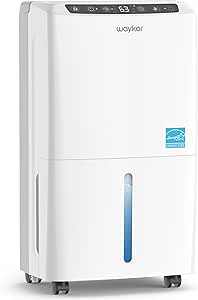 | Best for Quiet, Mid-Size Basements | Dehumidification capacity: 34 pints per day | Coverage area: Up to 2,000 sq. ft. | Water tank capacity: 0.62 gallons | VIEW ON AMAZON | See Our Full Breakdown |
| 50-Pint Dehumidifier for Large Rooms and Basements, Up to 4,500 Sq. Ft. |  | Best for Large Basement Coverage | Capacity: Up to 50 pints per day | Coverage: Up to 4,500 sq. ft. | Humidity control: 30%–80% | VIEW ON AMAZON | See Our Full Breakdown |
| Kesnos 30-Pint Energy Star Dehumidifier for 2,500 Sq. Ft. with Drain Hose |  | Quietest Specified Pick | Moisture removal: Up to 30 pints per day | Coverage area: Up to 2,500 sq. ft. | Humidity range: Down to 30% RH | VIEW ON AMAZON | See Our Full Breakdown |
| BEDRED Dehumidifier for Home, 95 oz, with Auto Shutoff and 7-Color Ambient Light |  | Best Compact Pick for Mild Dampness | Type: Thermoelectric dehumidifier | Water tank capacity: 95 oz | Coverage area: Up to 1,000 sq. ft. | VIEW ON AMAZON | See Our Full Breakdown |
| quiet dehumidifiers for basement | Noise level |
|---|---|
| Waykar 34-Pint Dehumidifier fo | — |
| OWAAE Dehumidifier for Home | — |
| Dehumidifier for Up to 4,500 S | 40 dB |
| BANABIE 32-Pint Dehumidifier f | As low as 32 dB under specified conditions |
| Dehumidifier for Spaces up to | 40 dB in sleep mode |
| Waykar 120-Pint Dehumidifier f | 40 dB on low |
| AEOCKY 50-Pint Dehumidifier wi | 40 dB |
| Kesnos 30-Pint Energy Star Deh | 36 dB |
| VEAGASO 36-Pint Dehumidifier f | 40 dB on low |
| AEOCKY RHEA-001 80-Pint Dehumi | 44 dB at lowest fan speed |
| Frigidaire 50-Pint Wi-Fi Dehum | Not specified |
| Waykar 34-Pint Dehumidifier fo | As low as 38 dB |
| 50-Pint Dehumidifier for Large | Approximately 40 dB |
| Kesnos 30-Pint Energy Star Deh | 36 dB |
| BEDRED Dehumidifier for Home | — |
More Details on Our Top Picks
Waykar 34-Pint Dehumidifier for Spaces up to 2,000 Sq. Ft.
The Waykar 34-Pint is a practical fit for a basement where steady moisture control matters more than a very high extraction rate. Its stated coverage reaches 2,000 square feet, and two fan speeds plus a 30%–80% humidity range give buyers room to adjust operation to the space. Compared with the BANABIE 32-Pint, it offers slightly higher stated daily removal, while BANABIE lists a lower noise figure and broader coverage. Neither listing gives this Waykar a noise rating, so I would not choose it for a basement directly beside a bedroom on quiet claims alone. The 2.5 L tank is small for heavy dampness; the included hose is the better route for sustained use. Manual airflow adjustment also means less convenience than automatic controls.
Pros:- Rated to remove up to 34 pints per day under stated test conditions
- Coverage rating of up to 2,000 square feet
- Includes continuous hose drainage as well as a removable tank
- Two fan speeds and adjustable humidity settings
Cons:- No noise level is specified for judging basement use near living areas
- The 2.5 L tank can fill quickly during heavy use
- Airflow direction must be adjusted manually
Best for: Homeowners with a mid-sized basement who can route the included hose to a drain and want adjustable humidity settings.
Not ideal for: People prioritizing verified low-noise operation or relying on the tank during heavy moisture removal, since no noise figure is provided and the 2.5 L tank may need frequent emptying.
- Moisture removal:Up to 34 pints per day at 95°F and 90% RH
- Coverage:Up to 2,000 sq. ft.
- Humidity setting range:30%–80% RH
- Water tank:2.5 L (0.66 gal)
- Drainage:Removable tank or continuous drainage hose
- Fan speeds:2
- Timer:24-hour
- Certification:ENERGY STAR
Our verdict“Choose the Waykar for a mid-sized basement with a drain nearby, but favor a model with a stated noise level if sound is your deciding factor.”
OWAAE Dehumidifier for Home, Up to 1,000 Sq. Ft., with Auto Shut-Off and Sleep Mode
The OWAAE is the most directly quiet-focused option in this group: its sleep mode is listed at under 30 dB, making it more suited to a small finished basement near a bedroom than the larger models with stated levels around 40 dB. Its compact build and handle also make it easier to move between a basement, bathroom, or closet. The tradeoff is capacity information: the listing gives no moisture removal rate or tank size, so I cannot compare its drying workload with the Waykar 34-Pint or the larger 80-pint models. Its coverage claim of up to 1,000 square feet is also best treated as a fit for smaller spaces, not a large, persistently damp basement. The color lighting adds little to moisture control and may not suit buyers seeking a dark sleep environment.
Pros:- Sleep mode is specified at under 30 dB
- Compact, lightweight design with a built-in handle
- Automatic shutoff when the tank is full or misplaced
- Rated for spaces up to 1,000 sq. ft.
Cons:- No moisture removal capacity is provided
- Tank size and continuous drainage details are not provided
- Seven-color lighting may be distracting in a dark sleeping area
Best for: People with a small, finished basement or adjoining utility area who prioritize low listed sleep-mode noise and portability.
Not ideal for: Owners of large or persistently damp basements who need a documented extraction rate, tank capacity, or continuous drain option.
- Coverage:Up to 1,000 sq. ft.
- Sleep-mode noise:Under 30 dB
- Safety shutoff:Automatic shutoff when tank is full or improperly positioned
- Lighting:Seven-color LED
- Portability:Compact, lightweight design with built-in handle
- Intended environments:Bedrooms, bathrooms, closets, and RVs
Our verdict“Pick the OWAAE for a smaller basement where quiet sleep-mode operation matters more than documented high-capacity moisture removal.”
Dehumidifier for Up to 4,500 Sq. Ft. with Drain Hose
For a large basement, this model pairs a substantial 80-pint daily capacity with a 4,500-square-foot coverage claim and a listed 40 dB noise level. That makes it a stronger fit for broad damp areas than the Waykar 34-Pint, while the OWAAE is aimed at much smaller spaces and provides no extraction figure. Quiet and sleep modes offer some choice over operation, but 40 dB is not a silent-running promise; I would place the unit away from a bedroom or seating area if sound carries through the house. The included hose can reduce tank-emptying trips during continuous operation, and the 1.72-gallon tank provides a backup. One concern is the listed 10 lb weight, which seems difficult to reconcile with the stated size and capacity, so I would not rely on it when planning frequent moves.
Pros:- Rated for up to 80 pints per day and coverage up to 4,500 sq. ft.
- Listed 40 dB noise level with quiet and sleep modes
- Continuous drainage hose reduces manual tank emptying
- Includes adjustable humidity control and auto defrost
Cons:- A 40 dB listing may still be noticeable near bedrooms or quiet rooms
- The listed 10 lb weight appears inconsistent with the stated dimensions and capacity
- Plastic construction is specified, with no durability details provided
Best for: Owners of large basements who need high stated moisture capacity, continuous drainage, and can position the unit away from quiet living areas.
Not ideal for: People with small basements, strict nighttime noise requirements, or plans to move the unit often based on the listed weight.
- Coverage:Up to 4,500 sq. ft.
- Dehumidification capacity:Up to 80 pints per day
- Water tank:1.72 gallons
- Noise level:40 dB
- Humidity adjustment:30%–80%
- Dimensions:8.6 × 14.6 × 23.8 in.
- Drainage:Tank or included drain hose
- Certification:ENERGY STAR
Our verdict“Choose this model for a large basement needing high stated capacity and hose drainage, provided its 40 dB operation suits your layout.”
BANABIE 32-Pint Dehumidifier for Areas up to 2,500 Sq. Ft.
The BANABIE 32-Pint suits buyers who want more operating choices in a medium-sized basement. Its 32 dB figure is lower than the 40 dB listed for the 4,500-square-foot model, while its stated coverage extends to 2,500 square feet—more than the Waykar 34-Pint. The difference is a modestly lower removal rating than Waykar’s 34 pints per day, so I would weigh the broader coverage and listed noise level against the extra stated capacity. Auto, Continuous, and Custom modes, plus humidity settings from 30% to 90%, let owners adapt operation to changing conditions. The 2.5 L tank is small for a damp basement, which makes the included hose useful if a drain is accessible. The 32 dB claim applies under specified conditions, so it does not establish the noise level in every mode.
Pros:- Coverage rating of up to 2,500 sq. ft.
- Listed noise level as low as 32 dB under specified conditions
- Auto, Continuous, and Custom modes with 30%–90% humidity settings
- Includes hose drainage, caster wheels, and built-in handles
Cons:- The 2.5 L tank may need frequent emptying in a damp basement
- The 32 dB figure applies only under specified conditions
- Rated removal of 32 pints per day is slightly below the Waykar 34-Pint
Best for: Homeowners with a medium-sized basement who want several operating modes, broad humidity settings, and can use continuous drainage.
Not ideal for: People who need a large tank for unattended use or a noise guarantee that applies across every operating mode.
- Coverage:Up to 2,500 sq. ft.
- Moisture removal:Up to 32 pints per day at 95°F and 90% RH
- Water tank:2.5 L
- Noise level:As low as 32 dB under specified conditions
- Operating modes:Auto, Continuous, and Custom
- Humidity setting range:30%–90% RH
- Drain hose:3.28 ft
- Timer:24-hour
Our verdict“The BANABIE is a good match for a medium-sized basement where flexible controls and a lower listed noise figure outweigh a small tank.”
Dehumidifier for Spaces up to 4,500 Sq. Ft. with Drain Hose
This 4,500-square-foot model is aimed at large basements where owners want several ways to tune operation, not just a high extraction ceiling. The listing gives a 45–80-pint capacity range, five modes, humidity sensing, and a 40 dB sleep mode. That makes its controls more elaborate than the large-basement 80-pint model, which lists quiet and sleep modes but fewer operating details. The tradeoff is that the 40 dB figure is tied to sleep mode, so buyers should not assume every setting runs at that level. Hose drainage is available for continuous operation; without it, the removable tank still needs emptying. Auto-defrost and shutoff add practical protection, while the child lock may help in busy households. The ENERGY STAR 2026 claim is part of the supplied product data; other performance details are not independently specified.
Pros:- Coverage listed up to 4,500 sq. ft. with a 45–80-pint capacity range
- Five operating modes and a humidity sensor
- 40 dB sleep mode is specified
- Includes hose drainage, auto-defrost, auto shutoff, and child lock
Cons:- The 40 dB noise figure applies to sleep mode, not necessarily every setting
- Tank capacity is not provided, making manual-drain intervals hard to judge
- Without continuous drainage, the tank must be emptied
Best for: Households with a large basement that want selectable operating modes, humidity sensing, and continuous hose drainage.
Not ideal for: Buyers seeking a compact unit, an explicitly documented tank capacity, or quiet operation across all five modes.
- Coverage:Up to 4,500 sq. ft.
- Dehumidification capacity:45–80 pints
- Noise level:40 dB in sleep mode
- Operating modes:5
- Timer:24-hour programmable auto on/off
- Drainage:Removable tank or continuous gravity drainage with hose
- Features:Humidity sensor, auto-defrost, auto shutoff, child safety lock
- Certification:ENERGY STAR 2026
Our verdict“Choose this large-space model if its five modes and humidity sensing suit your needs and you can use the hose for ongoing drainage.”
Waykar 120-Pint Dehumidifier for Spaces up to 6,000 Sq. Ft.
The 120-pint daily capacity and stated 6,000-square-foot coverage make this the strongest match here for a large, persistently damp basement. Its low setting is listed at 40 dB, quieter on paper than the larger AEOCKY RHEA-001’s 44 dB rating. That comparison favors the Waykar when sound matters, though the figures may reflect different conditions and are not a direct test. For hands-off use, the included short hose supports continuous drainage; the alternative 1.24-gallon tank can need frequent emptying in damp conditions, and a longer garden hose is not included. Wheels and a handle help when moving it between rooms, but this is a capacity-first choice rather than the smallest unit for a tight corner.
Pros:- Stated capacity of up to 120 pints per day for large moisture loads
- 40 dB listed on the low setting
- Includes a 3.3-foot hose and a removable tank
- Wheels and handle make it easier to reposition
Cons:- The 1.24-gallon tank may need frequent emptying in damp conditions
- A garden hose for extended drainage is not included
- Its larger stated capacity may be more than a smaller basement needs
Best for: Owners of large, very damp basements who want high stated capacity, low-setting noise data, and a choice of tank or hose drainage.
Not ideal for: People with limited floor space or no nearby drain who want to rely on a large tank for long intervals between emptying.
- Coverage area:6,000 sq. ft.
- Dehumidification capacity:Up to 120 pints per day
- Noise level:40 dB on low
- Tank capacity:1.24 gallons
- Drainage:Removable tank or included 3.3-foot hose
- Airflow:230 CFM
- Dimensions:12.21 × 9.02 × 19.69 in
- Weight:28.8 lb
Our verdict“Choose the Waykar when a large basement needs substantial stated moisture removal and you can use a drain hose or manage a small tank.”
AEOCKY 50-Pint Dehumidifier with Drain Hose
The 50-pint capacity and stated coverage of 3,500 square feet put this AEOCKY between the high-capacity Waykar 120-Pint and smaller units such as the Kesnos 30-Pint. That makes its listed scale a plausible fit for a mid-size basement without stepping up to the Waykar’s much larger capacity. Its 40 dB stated noise level suits a space where sound matters, though the listing provides no fan-speed context, so it is hard to compare that figure directly with the Kesnos’s 36 dB rating. An included drain hose can reduce tank-emptying chores when a drain is available. The supplied information does not state tank capacity, dimensions, or independent performance details, so buyers have fewer practical details to judge before choosing it.
Pros:- Stated 50-pint daily capacity
- Coverage listed up to 3,500 sq. ft.
- Drain hose is included for continuous drainage
- Listed noise level of 40 dB
Cons:- The provided product data does not specify tank capacity
- No dimensions or weight are provided for planning placement
- The noise figure has no stated fan-speed context
Best for: Homeowners with a mid-size basement and a nearby drain who want a stated 50-pint capacity with a hose included.
Not ideal for: Buyers who need detailed tank, size, or operating information before deciding how the unit will fit their basement.
- Model:BOREAS-001
- Daily capacity:50 pints
- Coverage area:3,500 sq. ft.
- Noise level:40 dB
- Drainage:Drain hose included
- ASIN:B0FRQVWSS4
Our verdict“Pick this AEOCKY for a mid-size basement with a drain nearby, provided its limited published operating details meet your needs.”
Kesnos 30-Pint Energy Star Dehumidifier for Home, 2,500 Sq. Ft., 36 dB
At a listed 36 dB, the Kesnos has the lowest stated noise level among these five picks, making it the clearest fit when the basement is near a bedroom or workspace. Its 30-pint capacity and 2,500-square-foot coverage are also more modest than the AEOCKY 50-Pint, which may suit a less demanding space while avoiding a larger-capacity unit. Four modes, including Comfort and Turbo, give buyers some flexibility between routine humidity control and faster drying. The tradeoff is its very small 0.39-gallon tank; continuous drainage avoids repeated emptying, but requires a suitable drain and a 3.3-foot hose reach. Its compact footprint and casters help with placement, though the low noise figure alone cannot establish how it will sound in every basement.
Pros:- Lowest stated noise level in this group at 36 dB
- 2025 ENERGY STAR certified
- Four operating modes for different drying needs
- Compact body with caster wheels and hidden handle
Cons:- The 0.39-gallon tank is small and may require frequent emptying
- Continuous drainage depends on a suitable drain within hose reach
- 30-pint capacity is below the larger Waykar and AEOCKY options
Best for: People with a smaller, moderately damp basement near living or sleeping areas who value a low stated noise level and can place it near a drain.
Not ideal for: Owners of large or heavily damp basements who need greater stated capacity, or anyone relying on a tank without frequent emptying.
- Dehumidification capacity:Up to 30 pints per day
- Coverage area:Up to 2,500 sq. ft.
- Noise level:36 dB
- Certification:2025 ENERGY STAR certified
- Operating modes:Comfort, Dry, Continuous, Turbo
- Water tank capacity:0.39 gallons
- Drain hose:3.3 ft
- Dimensions:11.02 × 7.68 × 15.20 in
Our verdict“Choose the Kesnos for a smaller basement where quiet operation and compact placement matter more than high moisture-removal capacity.”
VEAGASO 36-Pint Dehumidifier for Spaces up to 2,800 Sq. Ft.
The VEAGASO VG380 pairs 36-pint capacity with controls that are more developed than the basic details supplied for the AEOCKY 50-Pint: it has a timer, digital humidity display, child lock, and power-off memory. Those features make scheduled operation and day-to-day adjustments easier to manage. Its stated 2,800-square-foot coverage is below the Kesnos’s 2,500 only by a modest margin, while the listed 40 dB low setting is louder on paper than the Kesnos’s 36 dB. Continuous hose drainage is useful near a basement drain, but the listing conflicts on tank size, reporting both 0.53 gallons and 2 gallons. That uncertainty complicates planning for portable use, so I would favor hose drainage unless the seller confirms the tank specification.
Pros:- 36-pint daily capacity and stated coverage up to 2,800 sq. ft.
- Timer, digital humidity display, and power-off memory
- Includes a hose for continuous drainage
- Caster wheels and multiple operating modes
Cons:- Tank capacity is inconsistent in the listing: 0.53 gallons versus 2 gallons
- 40 dB low setting is higher than the Kesnos’s stated 36 dB
- The supplied data does not explain the listed watt-hours rating
Best for: Basement owners who want a timer, visible humidity readings, child lock, and power-off memory in a mid-size unit.
Not ideal for: Buyers who depend on the tank for unattended operation and need a confirmed capacity, or those prioritizing the lowest stated noise level.
- Model:VG380
- Dehumidification capacity:36 pints per day
- Recommended floor area:2,800 sq. ft.
- Noise level:40 dB on low
- Tank capacity:Conflicting listing: 0.53 gallons in description; 2 gallons in specifications
- Operating modes:Auto, Continuous, Sleep
- Airflow:150 CFM
- Dimensions:19.4 × 10 × 12.48 in (D × W × H)
Our verdict“Choose the VEAGASO if programmable controls matter and you can use its hose, but confirm the tank capacity before relying on reservoir drainage.”
AEOCKY RHEA-001 80-Pint Dehumidifier for 5,500 Sq. Ft.
For a large basement where energy certification and substantial moisture removal both matter, the RHEA-001 brings a 2025 ENERGY STAR Most Efficient designation and capacity figures that spell out their testing conditions. It reaches up to 80 pints per day at 95°F and 95% RH, but the stated figure drops to 56 pints at 86°F and 80% RH. That context makes its capacity easier to interpret than the Waykar 120-Pint’s single headline figure, though the Waykar lists a lower low-setting noise level: 40 dB versus this model’s 44 dB at lowest fan speed. Defrost operation for low temperatures and power-off memory suit basement use, but the supplied data omits tank size and drainage details. Confirm drainage arrangements before choosing it for unattended operation.
Pros:- ENERGY STAR Most Efficient 2025 certification
- Capacity figures are supplied for two temperature and humidity conditions
- Low-temperature defrost operation is suited to cooler spaces
- Power-off memory supports restart after a power interruption
Cons:- Lowest fan speed is listed at 44 dB, above the Waykar 120-Pint’s 40 dB low setting
- 80-pint capacity applies to very humid conditions and falls to 56 pints under the second stated condition
- Tank capacity and drainage options are not provided
Best for: Owners of large basements who want an ENERGY STAR Most Efficient certified compressor unit and capacity figures tied to stated humidity conditions.
Not ideal for: Buyers who need confirmed tank and drainage details before purchase, or who prioritize the lowest stated noise level.
- Coverage area:Up to 5,500 sq. ft.
- Capacity at 95°F and 95% RH:Up to 80 pints per day
- Capacity at 86°F and 80% RH:56 pints per day
- Certification:ENERGY STAR Most Efficient 2025
- Noise level:44 dB at lowest fan speed
- Dimensions:14.45 × 8.66 × 24.09 in
- Weight:31 lb
- Key features:Humidity control, power-off memory, low-temperature defrost
Our verdict“Choose the RHEA-001 for a large basement where its efficiency certification and stated operating conditions matter more than quietest operation or documented drainage.”
Frigidaire 50-Pint Wi-Fi Dehumidifier
The Frigidaire pairs 50-pint capacity with Wi-Fi and customizable humidity control, giving basement owners a way to adjust the target without relying on a fixed setting. That makes it a stronger fit for someone who wants app-connected control than the Waykar 34-Pint, whose supplied details emphasize drainage and everyday safety features instead. The washable filter can be cleaned and reused, which helps keep routine upkeep simple. The tradeoff is that the product information gives no noise figure, tank size, coverage area, or drainage details. Since quiet operation is the focus here, I can’t rank it ahead of models with stated sound levels, such as the Kesnos at 36 dB. Choose it for its capacity and connectivity, but verify its sound and drainage setup before committing it to a lived-in basement.
Pros:- 50-pint moisture removal capacity
- Wi-Fi connectivity
- Customizable humidity control
- Washable filter captures dust
Cons:- No noise level is provided, making quiet performance hard to compare
- Tank capacity, drainage options, and coverage area are not specified
Best for: Basement owners who want Wi-Fi access and adjustable humidity targets, and can confirm the unit’s noise level and drainage fit their space.
Not ideal for: Buyers who need a documented noise level or confirmed tank and hose details before choosing a dehumidifier for a bedroom-adjacent basement.
- Moisture removal capacity:50 pints
- Connectivity:Wi-Fi
- Filter:Washable
- Humidity control:Customizable
- Noise level:Not specified
- Drainage options:Not specified
Our verdict“Pick the Frigidaire if Wi-Fi control and 50-pint capacity matter most, but confirm its sound level and drainage details for your basement.”
Waykar 34-Pint Dehumidifier for Spaces up to 2,000 Sq. Ft.
With a stated noise level as low as 38 dB, the Waykar gives buyers a concrete quiet-operation figure alongside capacity suited to spaces up to 2,000 square feet. It removes less moisture than the 50-pint Frigidaire, so it makes more sense for a moderately damp basement than a large, persistently wet one. Its tank or hose drainage adds flexibility, though the tank holds just 0.62 gallons and may need frequent emptying; the drain-pipe switch also needs tightening when using the tank to prevent leaks. Three modes, two fan speeds, automatic defrost, and child lock round out a practical feature set. I’d favor it over the compact BEDRED for substantial basement moisture, but the small tank means hose drainage is the better choice for unattended operation.
Pros:- Specified noise level as low as 38 dB
- Rated for spaces up to 2,000 sq. ft.
- Tank and included-hose drainage options
- Automatic shutoff, defrost, and child lock
Cons:- 0.62-gallon tank may need frequent emptying
- Drain-pipe switch must be tightened in tank mode to prevent leaks
Best for: Owners of moderately damp basements up to 2,000 square feet who want a stated low-noise figure and can use hose drainage.
Not ideal for: People managing a large or heavily damp basement, or anyone who wants a large tank for less frequent emptying.
- Dehumidification capacity:34 pints per day
- Coverage area:Up to 2,000 sq. ft.
- Water tank capacity:0.62 gallons
- Drainage options:Tank or included 3.3 ft hose
- Operating modes:Dehumidifying, drying, continuous
- Fan speeds:2
- Humidity range:30% to 80%
- Noise level:As low as 38 dB
- Dimensions and weight:10.87 × 8.39 × 19.3 in; 22.1 lb
Our verdict“Choose the Waykar for a mid-size basement where its stated 38 dB operation and hose drainage suit your setup.”
50-Pint Dehumidifier for Large Rooms and Basements, Up to 4,500 Sq. Ft.
For a large basement, this model combines up to 50 pints per day with a stated coverage area of up to 4,500 square feet. It offers more listed reach than the Waykar 34-Pint, while the Waykar supplies a lower stated noise figure of 38 dB; this unit is rated at approximately 40 dB. DEHU, DRY, and SLEEP modes let buyers tailor operation, and continuous hose drainage can reduce tank-emptying trips. Without a hose, the 1.06-gallon tank may fill often during damp conditions. The product description also notes that capacity is measured under specific high-temperature, high-humidity conditions, so the 50-pint figure should not be treated as a guarantee for every basement. It suits broad coverage better than quiet-first placement beside a sleeping area.
Pros:- Up to 50 pints per day with listed coverage up to 4,500 sq. ft.
- Continuous hose drainage or auto-shutoff tank operation
- DEHU, DRY, and SLEEP modes plus a 24-hour timer
- Wheels and built-in handle ease repositioning
Cons:- Approximately 40 dB is louder on paper than the Kesnos 36 dB rating
- 1.06-gallon tank may require frequent emptying without hose drainage
- Capacity rating is measured under specific high-temperature, high-humidity conditions
Best for: Owners of large, damp basements who need higher stated capacity, broad coverage, and access to a floor drain or hose outlet.
Not ideal for: People placing a unit near a bedroom or prioritizing the lowest specified noise level; the Kesnos is rated quieter at 36 dB.
- Capacity:Up to 50 pints per day
- Coverage:Up to 4,500 sq. ft.
- Humidity control:30%–80%
- Water tank capacity:1.06 gallons (4 L)
- Noise level:Approximately 40 dB
- Modes:DEHU, DRY, and SLEEP
- Timer:24 hours
- Drainage:Tank with auto shut-off or continuous drain hose
- Features:360° wheels, built-in handle, child lock, humidity indicator, washable filter
Our verdict“Choose this model for a large basement where coverage and hose drainage outweigh the quieter published figure of the Kesnos.”
Kesnos 30-Pint Energy Star Dehumidifier for 2,500 Sq. Ft. with Drain Hose
The Kesnos is the quiet-first choice in this group, with a stated 36 dB noise level and capacity of up to 30 pints per day. That lower capacity makes it a more measured fit for a moderately damp basement than the 50-pint model rated for 4,500 square feet, but its listed coverage still reaches 2,500 square feet. Four modes, including Comfort and Turbo, offer a way to adapt operation to conditions; continuous drainage helps offset the very small 0.39-gallon tank. For quiet operation, it has a clearer case than the Frigidaire, which has no noise figure in the provided details. One setup catch: the included drain hose is short, and a half-inch garden hose for continuous drainage is not included. I’d shortlist it for a basement near living space, with a drain plan in place.
Pros:- Stated 36 dB operation
- Rated for coverage up to 2,500 sq. ft.
- Four modes and humidity control
- Caster wheels and hidden handle simplify moving
Cons:- 0.39-gallon tank can require frequent emptying
- Half-inch garden hose for continuous drainage is not included
Best for: Households with a moderately damp basement near living or sleeping areas that value a stated low noise level and can arrange continuous drainage.
Not ideal for: Owners of heavily damp, very large basements who need greater than 30-pint daily capacity, or buyers expecting a garden hose in the box.
- Moisture removal:Up to 30 pints per day
- Coverage area:Up to 2,500 sq. ft.
- Humidity range:Down to 30% RH
- Water tank capacity:0.39 gallons
- Drainage:Auto-stop tank or continuous drainage
- Included drain hose:3.3 ft, 0.5 in diameter
- Operating modes:Comfort, Dry, Continuous, Turbo
- Noise level:36 dB
- Certification:2025 ENERGY STAR, ETL, CEC, DOE
Our verdict“Choose the Kesnos for a quieter, moderately sized basement when its small tank can be bypassed with suitable drainage.”
BEDRED Dehumidifier for Home, 95 oz, with Auto Shutoff and 7-Color Ambient Light
The BEDRED is the compact option for a small, mildly damp basement nook, with a 95 oz tank, full-tank auto shutoff, and sleep mode that switches off the ambient lights and reduces noise. Its thermoelectric design sets it apart from compressor-style picks such as the Waykar 34-Pint, which provides a daily moisture-removal figure and hose drainage for more demanding spaces. BEDRED lists coverage up to 1,000 square feet, but does not specify moisture removal capacity, so buyers can’t tell how quickly it will dry a damp basement. Sleep mode addresses light and noise, though no decibel level is supplied. I’d treat the seven-color light as a minor convenience, not a reason to choose it. For persistent basement dampness, the documented capacity and drainage of the Waykar are more reassuring.
Pros:- 95 oz water tank with automatic full-tank shutoff
- Sleep mode turns off lights and reduces noise
- Compact design can fit different rooms
- Seven ambient light color options
Cons:- Moisture removal capacity is not specified
- Thermoelectric design may be less suitable for larger spaces
- No decibel rating or drainage hose details are provided
Best for: People seeking a compact unit for a small basement area with mild dampness, who value a dark sleep mode and automatic shutoff.
Not ideal for: Owners tackling persistent or widespread basement moisture who need a known daily capacity, a stated noise level, or continuous drainage.
- Type:Thermoelectric dehumidifier
- Water tank capacity:95 oz
- Coverage area:Up to 1,000 sq. ft.
- Moisture removal capacity:Not specified
- Auto shutoff:Yes, when the tank is full
- Ambient light:7 colors
- Sleep mode:Turns off lights and reduces noise
- Color:Black
Our verdict“Pick the BEDRED for a compact corner with mild dampness, but choose a rated compressor model like the Waykar for serious basement moisture.”

How We Picked
I ranked these models around the job implied by the search: lowering basement humidity without making the space unpleasantly loud or burdensome to maintain. I gave more weight to clearly stated noise information, a capacity that could plausibly suit a basement, and practical features such as continuous drainage, auto shutoff, and usable controls. The Kesnos 30-pint model leads because it pairs a stated 36 dB figure with a midrange capacity; the Frigidaire and higher-capacity AEOCKY and Waykar units serve buyers with more demanding moisture loads or added control needs.
Where a listing gives no sound rating, I treat quiet operation as unverified rather than assuming a product is quiet. I also treat square-foot coverage as a manufacturer claim, not a guarantee, because basement temperature, air movement, and moisture sources affect performance. Compact capacity and ambient lighting make the BEDRED a niche choice, not a whole-basement contender. Duplicate and closely described listings rank by the details supplied, so buyers should confirm the exact model and included drainage parts before purchasing.
Factors to Consider When Choosing Quiet Dehumidifiers For Basements
I would choose a basement dehumidifier by matching its workload and placement to the room first, then weighing noise and maintenance. These checks help prevent a common mismatch: buying around a large coverage number while overlooking cold conditions, drainage access, or where the unit will sit.
Match Capacity to Moisture, Not Just Floor Area
Square footage is only a rough starting point because a cool, enclosed basement can behave differently from a warm open room of the same size. Look for signs such as persistent condensation, musty odors, laundry drying, or water entering after rain; these point to moisture load, not simply room size. A larger pint rating can remove more water under specified test conditions, but those conditions may not match a cool basement. Oversizing can add bulk and stronger fan or compressor sounds without fixing the source of dampness. If the basement has separate rooms, place the unit where air can circulate and keep doors open when practical. Address leaks and seepage separately, since a dehumidifier cannot stop water intrusion.
Treat Noise Claims as One Part of the Picture
A decibel figure is useful for comparing claims, but it does not describe every sound a unit makes. Compressor cycling, fan tone, vibration, and the way sound carries through a stairwell can matter as much as the headline number. Ask whether the quoted level applies to a particular fan setting and whether the manufacturer identifies a measurement distance. A quiet mode may reduce disturbance while also slowing moisture removal, so it may not be the right setting during a very damp spell. A solid, level floor and clearance from shared walls can limit rattling and transmitted vibration. If the basement doubles as an office or bedroom, prioritize documented noise information and flexible fan controls over a broad coverage claim.
Plan Drainage Before the Unit Arrives
Bucket drainage works when someone can empty the tank regularly, but it can interrupt unattended operation once the tank fills. A hose connection can reduce that chore, provided the hose can run continuously downhill to a floor drain or other approved outlet. Check whether the hose is included, what fitting it needs, and whether the manual permits the intended drainage setup. A pump-assisted drain is a different feature from gravity drainage and may be needed when water must travel upward. Keep hose routing away from walkways and check for kinks, since a blocked or poorly sloped hose can leave water in the tank. For a basement where nobody visits daily, drainage setup can matter more than a small difference in stated capacity.
Check How the Unit Handles Cooler Basements
Many basements stay cooler than the living areas above them, and some compressor dehumidifiers lose efficiency or pause defrost cycles at lower temperatures. Check the operating temperature range and defrost behavior in the model’s manual before relying on a listing’s room-coverage figure. A unit that fits the floor area may still be a poor match if its permitted temperature range excludes winter conditions in your basement. Measure the room at the coldest time of year rather than using a summer reading. If temperatures regularly fall below the stated range, look for a model designed for low-temperature use or consider whether another moisture-control approach is needed. This check can prevent repeated shutdowns that buyers might mistake for a capacity problem.
Choose Controls That Fit Your Routine
A humidistat lets the unit cycle toward a selected humidity level instead of running continuously, which can reduce noise and unnecessary operation once the room is dry enough. Auto shutoff is useful with a bucket, while a timer or restart behavior matters if the unit is connected to a switched outlet or loses power. Wi-Fi control can help when the basement is remote, but it adds little if you already pass the unit often and can use its panel. Sleep mode may lower light or fan activity, yet the product description should clarify what changes. Before paying more for connected features, decide whether you need remote status, schedule changes, or simply dependable automatic operation. Favor controls you will use over a longer feature list.
Leave Room for Maintenance and Airflow
A dehumidifier needs open space around its intake and outlet, so a tight corner can hurt airflow even when the unit physically fits. Measure the intended location, including the room needed to pull out a tank or reach the filter. Dusty basements may call for more frequent filter cleaning, and a clogged filter can add strain and noise. Check how the filter is removed and whether the tank handle is practical when full. Keep the unit level and avoid placing it where vibration will reach a desk or sleeping area. The easiest model to live with is often the one that can be cleaned, drained, and checked without moving stored boxes.
Frequently Asked Questions
Is the Kesnos 36 dB figure enough to tell me it will be quiet in my basement?
It gives you a comparison point that most listings in this group do not provide, but it cannot predict the sound in your room by itself. Noise can change with fan setting, compressor cycles, distance, and how the floor transmits vibration. Check the manual or manufacturer details for the conditions used to obtain the figure. If the unit will sit near a workspace, leave room to move it farther away and test it on a stable surface during the return window. I would treat the figure as evidence to investigate, not a promise of silence.
Should I choose a 30-pint model or a 50-pint model for a basement?
Start with how damp the space gets and how often you can empty or drain the unit, rather than using floor area alone. A 30-pint class model may make sense for a moderate, consistently managed space, while a 50-pint option has more headroom for heavier moisture loads. The stated pint capacity depends on test conditions, and cool basement air can affect a compressor unit’s output. If the room is only mildly damp, a larger model may add cost, size, and noise without solving a larger problem. Persistent water entry calls for fixing the source as well as dehumidifying.
Do I need a drain hose if the dehumidifier has auto shutoff?
Auto shutoff prevents continued operation when a bucket fills, but it does not keep the unit running while you are away. A hose can provide continuous drainage if the outlet is lower than the unit and the hose is routed correctly. If there is no nearby drain, the bucket may be the only practical choice unless the model supports a pump setup. Check whether the hose is supplied or requires a separate fitting. For an unattended basement, drainage access can be more useful than a small increase in tank capacity.
Can a 95 oz compact dehumidifier control humidity across a whole basement?
I would not treat a 95 oz capacity listing as equivalent to the pint-per-day ratings on the larger models in this roundup. A compact unit is better suited to a small enclosed area, such as a closet or a localized damp spot, than to circulating air through a large basement. Its tank may also need frequent attention depending on the moisture load. For whole-room control, check for a documented extraction capacity and coverage guidance that match the space. If you choose a compact model, use a hygrometer elsewhere in the basement to see whether it affects the wider area.
Does Wi-Fi control justify choosing the Frigidaire over a simpler model?
It can be useful when the basement is hard to reach or you want to check and adjust operation remotely. It does not by itself show that the unit is quieter or more effective than a non-connected model. Compare its capacity, drainage options, sound information, and operating temperature range with the simpler alternatives first. If you visit the basement regularly and can set a target humidity at the panel, connected controls may not change your routine. I would choose Wi-Fi for remote access that solves a real inconvenience, not as a substitute for checking the basic fit.
Conclusion
For a balance of stated noise information and basement-sized capacity, I’d choose the Kesnos 30-Pint Energy Star Dehumidifier as best overall, and the hose-equipped Kesnos listing as best value if continuous drainage fits your setup. The Frigidaire 50-Pint Wi-Fi is my premium pick for buyers who will use remote control and need more capacity; it is less compelling if connectivity will sit unused. For beginners, I’d favor a mid-capacity model with auto shutoff and straightforward controls, such as the OWAAE, while checking its noise details before purchase. For a very damp, larger basement, compare the AEOCKY 80-pint and Waykar 120-pint against temperature limits, sound information, and drainage needs. Choose the BEDRED only for a small localized space, and confirm the exact version when listings repeat the same model description.