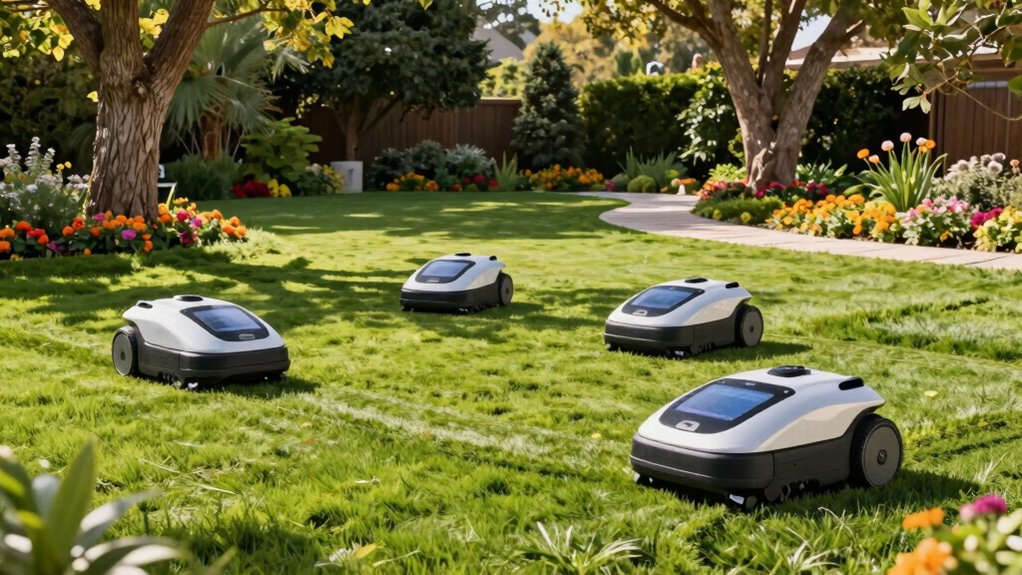

Large yards expose the weak points of most robotic lawn mowers: limited coverage, slow charging cycles, navigation that breaks down on uneven terrain, and perimeter wire that takes a weekend to install. For this roundup I focused on models designed to cover three-quarters of an acre or more, and the DREAME A3 AWD Pro earns the best overall spot for its combination of all-wheel drive, LiDAR mapping without boundary wire, and a practical 0.87-acre capacity at a competitive price point. If your property is genuinely massive, the YARBO Y40 Core covers up to 6 acres and doubles as a four-season yard machine, while the Mammotion LUBA 3 AWD offers a compelling all-wheel-drive package with a self-cleaning stand that cuts maintenance time. The main tradeoff you’ll face in this category is between coverage capacity and smart features versus cost and setup complexity. Read on for the full breakdown.

Get home appliances delivered free with Prime
- Fast, free delivery on millions of items
- Prime Video, Amazon Music and more included
- Member-only deals all year
Complete the kit


Key Takeaways
- All six models in this lineup use wire-free LiDAR or 3D navigation, which means the old hassle of burying perimeter cable across a large property is no longer the price of admission for big-yard coverage.
- Capacity spread is dramatic: the Neomow X SE tops out around 0.75 acres while the YARBO Y40 Core handles up to 6 acres, so paying for more mower than your lot needs wastes money on features you’ll never stress.
- All-wheel drive (DREAME A3, Mammotion LUBA 3, YARBO Y40) proved to be the real differentiator for large yards specifically, because big properties almost always include slopes, drainage swales, or uneven ground that two-wheel robots handle poorly.
- Dual LiDAR systems on the ECOVACS Goat A2000 and A3000 improve obstacle detection at speed, which matters more on large yards where the mower runs longer per session and encounters more hazards.
- Accessory ecosystems are the hidden cost: the LUBA 3’s cleaning stand and the YARBO’s four-season attachments change long-term ownership math in ways the sticker price doesn’t reveal.
| DREAME A3 AWD Pro 3500 Wire-Free LiDAR Robot Lawn Mower |  | Best for Steep, Uneven Terrain | Coverage: 0.87 acre | Drive System: 4WD hub motors | Slope Capability: Up to 38.7° / 80% grade | VIEW ON AMAZON | See Our Full Breakdown |
| Mammotion LUBA 3 AWD 3000 Robot Lawn Mower with Cleaning Stand |  | Best Overall | Coverage Rate: 5,400 sq ft/h | Slope Capability: Up to 80% (38.6°) | Navigation: 360° LiDAR + NetRTK + AI Vision (Tri-Fusion) | VIEW ON AMAZON | See Our Full Breakdown |
| YARBO Y40 Core Robotic Lawn Mower Pro, Wire-Free, 6 Acres |  | Best for Very Large Properties | Coverage Area: 6 acres | Cutting Height: 0.8–4.0 in | Motor: 300W dual-motor | VIEW ON AMAZON | See Our Full Breakdown |
| ECOVACS Goat A2000 LiDAR Pro Robot Lawn Mower |  | Best for Edge-to-Edge Finish | Navigation: HoloScope 360° Dual LiDAR, wire-free | Positioning Accuracy: 2 cm | Edge Trimming: Integrated TruEdge trimmer | VIEW ON AMAZON | See Our Full Breakdown |
| ECOVACS Goat A3000 LiDAR PRO Robotic Lawn Mower | | Best for Shaded, Tree-Filled Yards | Navigation: HoloScope 360° Dual-LiDAR, wire-free | Positioning Accuracy: 2 cm | Voltage: 32 V | VIEW ON AMAZON | See Our Full Breakdown |
| Neomow X SE 360° 3D LiDAR Navigation Robot Lawn Mower, 0.75 Acre |  | Best Wire-Free LiDAR Pick for Obstacle-Rich Lawns Up to 0.75 Acre | Model: Neomow X SE | Maximum Lawn Area: 0.75 acre (32,670 sq ft / 3,000 m²) | Navigation System: 360° 3D LiDAR + AI Vision fusion | VIEW ON AMAZON | See Our Full Breakdown |
| robotic lawn mowers for large yard | Navigation | Cutting Height |
|---|---|---|
| DREAME A3 AWD Pro 3500 Wire-Fr | OmniSense 3.0 LiDAR + binocular AI vision | 1–4 in |
| Mammotion LUBA 3 AWD 3000 Robo | 360° LiDAR + NetRTK + AI Vision (Tri-Fusion) | 1.0–2.7 in |
| YARBO Y40 Core Robotic Lawn Mo | RTK-GPS, binocular vision, multi-sensor PPVS | 0.8–4.0 in |
| ECOVACS Goat A2000 LiDAR Pro R | HoloScope 360° Dual LiDAR, wire-free | — |
| ECOVACS Goat A3000 LiDAR PRO R | HoloScope 360° Dual-LiDAR, wire-free | — |
| Neomow X SE 360° 3D LiDAR Navi | — | — |
More Details on Our Top Picks
DREAME A3 AWD Pro 3500 Wire-Free LiDAR Robot Lawn Mower
Where most robotic mowers struggle with anything beyond gentle contours, this option leans into rough ground. Its 4WD hub motors and off-road wheels climb slopes up to 38.7 degrees, which edges out even the YARBO Y40’s 35-degree rating and makes damp, rutted lawns workable rather than a minefield. The OmniSense 3.0 LiDAR with binocular AI vision detects over 300 obstacle types across a 240 ft range, so a sprawling yard littered with toys, trees, and garden furniture stays manageable. Compared with the ECOVACS Goat A2000, the A3 trades the built-in edge trimmer for a wider 15.8-inch dual cutting deck and the EdgeMaster system that reduces uncut strips. The tradeoff is ceiling: 0.87 acre is modest for a “large yard” mower, and owners of truly big properties should look at the LUBA 3 or Y40 instead. App-dependent setup also adds friction for less tech-inclined buyers.
Pros:- 4WD hub motors handle slopes, ruts, and damp grass that stop two-wheel competitors
- Wire-free LiDAR and AI vision map complex yards and avoid 300+ obstacle types
- 15.8-inch dual floating discs with EdgeMaster 2.0 minimize uncut strips
- App supports 100 zones, no-go areas, and GPS/4G security tracking
Cons:- Coverage tops out at 0.87 acre, limiting appeal for genuinely large properties
- Smart features hinge on app setup and mobile control, a hurdle for hands-off users
Best for: Homeowners with hilly, uneven yards under an acre who want wire-free navigation that won’t get stuck on slopes
Not ideal for: Owners of multi-acre estates — the 0.87 acre coverage cap will leave large sections unmowed
- Coverage:0.87 acre
- Drive System:4WD hub motors
- Slope Capability:Up to 38.7° / 80% grade
- Navigation:OmniSense 3.0 LiDAR + binocular AI vision
- Cutting Width:15.8 in
- Cutting Height:1–4 in
- Mowing Speed:Up to 8,611 sq ft/hour
- Zones:100 zones, 100 no-go areas
- Security:GPS, 4G tracking, human detection alerts
Our verdict“This pick makes the most sense for buyers whose biggest problem isn’t yard size but yard difficulty — steep grades and rough ground under an acre.”
Mammotion LUBA 3 AWD 3000 Robot Lawn Mower with Cleaning Stand
This model earns the top spot because it balances the widest range of large-yard demands without an obvious weak point. Its Tri-Fusion navigation layers 360° LiDAR, NetRTK, and dual-camera AI vision, giving it redundant positioning where single-system rivals falter — the DREAME A3 relies on LiDAR and vision alone, while the YARBO Y40 depends on a clear sky view for its RTK-GPS. Four independent AWD motors tackle 80% slopes, and 175 minutes of runtime with adaptive dual 165W cutting motors means dense, fast-growing grass doesn’t force constant recharge breaks. Multiple mowing patterns and 30 zones give owners real flexibility for sprawling, multi-use properties. The compromises are real: this is a premium investment, the cleaning stand arrives in a separate shipment, and the feature depth demands a patient initial setup compared with simpler app-only mowers like the Goat A2000.
Pros:- Tri-Fusion navigation provides redundant, wire-free positioning that resists GPS dead zones
- All-wheel drive with independent motors handles 80% slopes and rough terrain
- 175-minute runtime with power that adapts to grass density
- Four mowing patterns and 30 configurable zones suit complex properties
Cons:- Premium price point makes it one of the most expensive options here
- Cleaning stand ships separately, meaning two deliveries
- Deep feature set involves a real learning curve during setup
Best for: Owners of large, mixed-terrain properties who want top-tier navigation, slope handling, and long runtime in one package
Not ideal for: Budget-conscious buyers or anyone wanting a plug-and-play experience — the price and setup complexity are both high
- Coverage Rate:5,400 sq ft/h
- Slope Capability:Up to 80% (38.6°)
- Navigation:360° LiDAR + NetRTK + AI Vision (Tri-Fusion)
- Cutting Motors:Dual 165W with 6-blade discs
- Runtime:Up to 175 minutes per charge
- Cutting Height:1.0–2.7 in
- Mowing Zones:Up to 30 with no-go areas
- Obstacle Recognition:300+ types
Our verdict“If yard size, slope, and navigation reliability all matter equally, this is the most complete all-rounder in the lineup despite its cost.”
YARBO Y40 Core Robotic Lawn Mower Pro, Wire-Free, 6 Acres
Nothing else in this roundup comes close on raw coverage: 6 acres versus roughly an acre for the DREAME A3 and less for the Neomow X SE. That makes this model the default choice for estate-sized lawns, small golf courses, and commercial landscapes where other mowers would spend their lives recharging. The 300W dual-motor system with interchangeable razor and straight blades powers through thick or damp grass, and the 0.8 to 4.0 inch cutting range supports four-season care that lighter-duty rivals can’t match. Its RTK-GPS plus binocular vision navigation is capable, but it needs a 120° unobstructed sky view — heavily wooded properties may frustrate it, and the LUBA 3’s sensor fusion handles shade better. Practical friction adds up too: at roughly 210 lbs, assembly is a two-person job, and the remote control costs extra.
Pros:- 6-acre coverage dwarfs every other pick in this roundup
- 300W dual-motor system with two blade options cuts thick and damp grass
- Handles slopes up to 35° with multi-sensor obstacle avoidance
- Wide 0.8–4.0 inch cutting range supports four-season mowing
Cons:- Requires 120° unobstructed sky view for the Data Center Set, limiting wooded lots
- 210 lb weight makes assembly and relocation a two-person task
- Remote control sold separately adds to the total cost
Best for: Estate owners and commercial operators managing multi-acre lawns who need serious cutting power and all-season capability
Not ideal for: Wooded properties without a clear sky view for the RTK system, or anyone wanting a light mower they can move alone
- Coverage Area:6 acres
- Cutting Height:0.8–4.0 in
- Motor:300W dual-motor
- Navigation:RTK-GPS, binocular vision, multi-sensor PPVS
- Max Slope:70% (35°)
- Blade Options:Razor blades and straight blades
- Weight:Approx. 210 lbs
- Warranty:2 years
Our verdict“For buyers whose "large yard" is measured in acres rather than square feet, this is the only option here with the range and power to keep up.”
ECOVACS Goat A2000 LiDAR Pro Robot Lawn Mower
This option differentiates itself with something most robotic mowers quietly ignore: borders. The integrated TruEdge trimmer trims as it mows, cutting down on the manual string-trimming that otherwise undercuts the whole point of automation. Compared with the DREAME A3, which uses a wide deck and EdgeMaster discs but still leaves fence lines and beds to you, this model attacks the problem directly. Its HoloScope 360° dual LiDAR needs neither perimeter wire nor an RTK antenna — unlike the YARBO Y40, there’s no sky-view requirement — and 2 cm positioning accuracy keeps it on track along sidewalks. The 32V dual-blade system is built for thick grasses like Bermuda and Zoysia, and a ~50-minute recharge keeps downtime short. Just know the trimmer line is a consumable you’ll replace regularly, and its “medium to large” yard rating sits below the true big-property players here.
Pros:- Built-in TruEdge trimmer handles borders most robotic mowers leave behind
- Dual LiDAR works wire-free with no RTK antenna or sky-view requirement
- 32V dual-blade disc powers through thick, fast-growing grass
- Fast ~50-minute recharge minimizes mid-job downtime
Cons:- Trimmer line is a consumable requiring ongoing replacement
- Yard size rating falls short of the large-property leaders in this lineup
- Zone setup through the app takes more initial configuration than basic mowers
Best for: Homeowners with medium-to-large lawns who hate hand-trimming edges more than they hate mowing
Not ideal for: Multi-acre property owners — this model is sized below the YARBO Y40’s 6-acre class
- Navigation:HoloScope 360° Dual LiDAR, wire-free
- Positioning Accuracy:2 cm
- Edge Trimming:Integrated TruEdge trimmer
- Motor Voltage:32 V
- Cutting System:Dual-blade disc
- Battery:3.0 Ah
- Recharge Time:About 50 minutes
- Compatible Grass:Bermuda, Zoysia, Fescue, St. Augustine
Our verdict“Buy this if crisp, trimmed borders with zero string-trimming matter more than maximum acreage coverage.”
ECOVACS Goat A3000 LiDAR PRO Robotic Lawn Mower
This model takes the Goat A2000 formula and upgrades the parts that matter for demanding large yards: a 7,500 mAh battery with 189W fast charging that replenishes in about 70 minutes, versus the A2000’s smaller 3.0 Ah pack. The standout trait it shares with its sibling is dual-LiDAR positioning that holds 2 cm accuracy under tree cover — precisely where the YARBO Y40’s RTK-GPS can degrade and the LUBA 3 leans on its extra sensor layer. No perimeter wire, no RTK antenna, no sky-view demands. The TruEdge trimmer carries over for fence lines and sidewalks, and the 32V dual-blade platform handles thick southern grasses. Two gripes hold it back: it commands a premium price that puts it near the LUBA 3’s territory without matching that machine’s slope or runtime specs, and cutting height is app-adjusted only, which will annoy anyone who prefers a physical dial.
Pros:- Dual-LiDAR keeps 2 cm accuracy under tree cover where GPS-based rivals falter
- 7,500 mAh battery recharges in about 70 minutes with 189W fast charging
- TruEdge trimmer eliminates most manual edging along walks and fences
- No perimeter wire or RTK antenna required for setup
Cons:- Premium pricing approaches the LUBA 3 without matching its slope or runtime
- Cutting height adjustment is app-only, frustrating fans of physical controls
Best for: Owners of large, heavily shaded lawns with mature trees where GPS-based mowers lose accuracy
Not ideal for: Buyers who want physical controls for cutting height, or slope-heavy yards better served by the DREAME A3’s 4WD
- Navigation:HoloScope 360° Dual-LiDAR, wire-free
- Positioning Accuracy:2 cm
- Voltage:32 V
- Cutting System:Dual-blade disc + TruEdge trimmer
- Battery:7,500 mAh
- Charging:189W fast charge, ~70 minutes full
- Control:ECOVACS app (zones, no-go areas, schedules)
Our verdict“For tree-dense large yards where GPS mowers drift, this option’s LiDAR-only precision and quick recharge make it the strongest fit.”
Neomow X SE 360° 3D LiDAR Navigation Robot Lawn Mower, 0.75 Acre
I see the Neomow X SE as a strong fit for large, obstacle-rich lawns that stop near the three-quarter-acre mark. Its 360° 3D LiDAR + AI vision fusion avoids boundary wires and RTK stations, which matters when trees, fences, or shaded corners make satellite-based setups finicky. Compared with the DREAME A3 AWD Pro 3500, it gives up a bit of total acreage, but it gains very precise mapping, with under 0.8 in positioning error and support for 40 custom areas. The tradeoff is pace: 2 hours of runtime and 0.17 acre per charge mean it may need to recharge before finishing the largest zones. For buyers with complex landscaping rather than open turf, that structured approach feels more useful than raw coverage alone.
Pros:- Wire-free 3D LiDAR and AI vision navigation avoids boundary wires and RTK stations, simplifying setup on complicated lawns.
- Detects 200+ obstacle types and supports up to 40 custom areas, useful for beds, play zones, and narrow passages.
- WiFi, Bluetooth, and 4G connectivity support scheduling, mapping, and breakpoint resume from the app.
- Quiet operation, adjustable cutting height, and all-terrain wheels help with varied lawn conditions.
Cons:- The 0.75-acre maximum area is limiting next to larger rivals in this roundup.
- Coverage of about 0.17 acre per charge can force recharge breaks on bigger or more demanding zones.
- 4G control depends on the included 1GB data allowance, which may matter if WiFi is not nearby.
Best for: Homeowners with obstacle-heavy lawns up to 0.75 acre who want wire-free mapping without installing boundary wires or relying on an RTK station.
Not ideal for: Owners of larger, open properties who need longer continuous coverage and higher total acreage capacity than 0.75 acre.
- Model:Neomow X SE
- Maximum Lawn Area:0.75 acre (32,670 sq ft / 3,000 m²)
- Navigation System:360° 3D LiDAR + AI Vision fusion
- Positioning Error:Under 0.8 in (2 cm)
- Minimum Passage Width:2.53 ft (77 cm)
- Obstacle Detection:Detects objects as small as 5.9 in high and 0.4 in wide; recognizes 200+ obstacle types
- Cutting Width:11 in (280 mm)
- Runtime:Up to 2 hours per charge; covers about 0.17 acre per charge
Our verdict“Choose the Neomow X SE if your large yard is obstacle-heavy and under 0.75 acre, and skip it if you need broader one-charge coverage.”

How We Picked
Since “large yard” coverage is the whole point of this roundup, I started by filtering for rated capacity of at least three-quarters of an acre and wire-free navigation. Any robot that still requires perimeter wire was excluded, because installing hundreds of feet of cable across a big property undermines the convenience these machines are supposed to deliver. From there, I compared traction systems, since large properties rarely stay flat — all-wheel-drive models got credit for handling slopes and damp grass that stop two-wheel rivals.
I then weighed navigation sophistication, cutting performance, and total ownership burden — including app quality, blade maintenance, and accessory requirements. Models were ranked by how well their strengths match the realities of a large property: long runtime needs, varied terrain, and more obstacles per mowing session. Price-to-capacity ratio separated the value picks from the premium ones, and genuinely useful extras like self-cleaning stands or multi-season attachments factored into final positioning rather than serving as tiebreakers alone.
Factors to Consider When Choosing Robotic Lawn Mowers For Large Yards
Before committing to any of these six mowers, it helps to understand what actually drives satisfaction on large properties — because the mistakes buyers make with big yards are different from the ones that plague small-lawn owners.Buy Capacity With a Margin, Not a Ceiling
The most common mistake I see is buying a mower rated at exactly the lot size on the deed. Rated acreage assumes ideal conditions: dry grass, mild slopes, and a dock placed centrally. Add a lawn that’s wet in spring, a shed the mower must navigate around, or a dock at the far corner of the property, and effective coverage drops. A good rule of thumb is to buy 20–30% more rated capacity than your actual grass area, subtracting house footprint, driveway, and beds from your lot size first. This is why the jump from the 0.75-acre Neomow X SE to the 0.87-acre DREAME A3 matters more than the numbers suggest — that margin is the difference between finishing in one pass and needing mid-day recharge cycles all season.
Traction Matters More Than You Think
On paper, a cutting deck is a cutting deck. In practice, large yards almost always include terrain variety — a side slope, a drainage ditch, a patch where rain collects. Two-wheel robots spin out, scalp high spots, or simply refuse to mow steep sections, leaving you finishing by hand exactly the way you hoped to avoid. All-wheel-drive models like the DREAME A3, LUBA 3, and YARBO Y40 cost more, but they convert that cost into consistent coverage. Check the maximum slope rating against your actual yard, and remember that slope ratings apply to the robot’s ability to drive, not necessarily to cut evenly — a mower might climb a 45% grade but leave an uneven cut above 30%.
Navigation Type Shapes Your Daily Experience
Single LiDAR, dual LiDAR, and 360° 3D LiDAR all eliminate boundary wire, but they differ in how well they handle fast-moving obstacles and complex layouts. Dual LiDAR systems like the ECOVACS Goat A2000 and A3000 detect obstacles at greater range, which matters on large properties where the mower travels at higher speeds and covers more ground per hour. If your yard has kids, pets, or wildlife traffic, stronger obstacle detection reduces the chance of a damaged blade housing or a stranded robot. Mapping quality also affects how the mower handles zones — large properties often benefit from dividing grass into sections mowed on different schedules, and not every app makes that easy.
Account for Maintenance Time and Accessories
More acreage means more blade wear, more grass debris packed into the chassis, and more dock cleaning. Some models address this directly — the LUBA 3’s cleaning stand automates the grimiest chore in robotic mower ownership, which compounds in value as coverage grows. Others leave maintenance entirely manual, which is fine at 0.75 acres but tedious at 3. Check blade type and replacement cost before buying: pivoting razor blades cut finer but need frequent swaps, while fixed steel blades last longer but tear grass when dull. Also verify that replacement parts ship quickly to your region, because a mower that sits broken for three weeks in peak growing season defeats the purpose.
Multi-Season Versatility Can Change the Math
The YARBO Y40’s four-season attachments represent a broader trend: modular yard robots that mow in summer and clear snow or leaves the rest of the year. For buyers in four-season climates, this effectively spreads the purchase price across 12 months of use instead of 5. The tradeoff is that modular systems tend to be heavier, more expensive upfront, and more complex to maintain than dedicated mowers. If your mower would otherwise sit idle from October to April and you currently pay for snow removal or leaf cleanup, versatility is worth serious weight in your decision. If you live somewhere with a year-round growing season, skip it and put that budget toward capacity instead.
Charging Strategy and Runtime on Big Properties
Large yards expose a physics problem small-lawn owners never face: a mower that covers an acre will need multiple recharge cycles per full cut, and dock placement determines total mowing efficiency. A centrally located dock minimizes dead travel time; a dock stuck behind the garage can add hours to each cycle. Check whether the model supports zone-based scheduling so it can mow sections to completion rather than wandering back and forth. Also consider whether partial mowing bothers you — some owners prefer a robot that finishes one zone cleanly today and the next zone tomorrow, while others want the whole lawn cut in a single day. The apps on these six models handle this differently, and it’s a legitimate reason to pick one over another.
Frequently Asked Questions
How much acreage do I actually need before a robotic mower makes sense over a riding mower?
The crossover point sits around one acre for most buyers, but it depends on how you value your time. Below an acre, a robotic mower is almost always the better lifestyle choice — the mowing happens invisibly while you do other things. Between one and three acres, the decision gets interesting: a good riding mower finishes faster in one session, while a robot keeps the lawn at a consistent height all week, which actually produces a healthier lawn. Above three acres, only the YARBO Y40 in this lineup is rated for the job, and you should confirm your property doesn’t exceed its practical limits before abandoning the riding mower entirely.
Are wire-free LiDAR mowers as reliable as wired perimeter models on large properties?
Wire-free navigation has matured quickly, and for most large yards it’s now the more reliable option — not because the technology never glitches, but because perimeter wire degrades over time. On a two-acre property, a nicked wire can take hours to locate and repair, and wire shifts as soil moves. LiDAR models do have their own failure modes: reflective surfaces, low-hanging branches, and heavy fog can confuse some units. The dual LiDAR setups on the ECOVACS models and the 3D systems on the Neomow X SE handle these edge cases better than entry-level single-sensor robots. My honest take is that wire-free is the right default in 2026 unless your yard has unusual reflective features like extensive glass fencing.
Do all-wheel-drive robotic mowers actually handle wet grass and slopes?
All-wheel drive genuinely improves performance on slopes and damp turf — the DREAME A3, LUBA 3, and YARBO Y40 all climb grades that stop two-wheel models. That said, “handles” doesn’t mean “cuts perfectly.” Wet grass clumps under any deck, dulls blades faster, and leaves a rougher cut regardless of traction. Most manufacturers recommend mowing when grass is dry even on AWD models, so the real benefit is tolerance for morning dew, shaded damp patches, and slopes — not permission to mow in the rain. If your property has sustained slopes above roughly 35%, verify the specific slope rating for cutting, not just driving, before you buy.
What does installation actually involve for a wire-free mower on a large yard?
Expect an afternoon rather than a weekend, but not zero effort. You’ll walk the perimeter with the app or drive the robot on a guided boundary run, mark no-go zones like pools and flower beds, and choose a dock location with good access and weather protection. On a large property, the mapping drive itself takes time — walking or remote-driving an acre or more of boundary isn’t a five-minute task. Dock placement deserves real thought: central placement cuts total mowing time noticeably on multi-acre lots. Most buyers report the whole process takes two to four hours the first time, with refinements over the following week as the mower learns the terrain.
Is it worth paying more for a higher-capacity model than my yard strictly needs?
Usually yes, up to a point. A mower running at 60% of its rated capacity finishes faster, recharges less often, and experiences less motor and blade stress than one running at its limit — which translates to a longer service life and better cut quality. The break point is when you’re paying double for capacity you’ll never approach; a 6-acre YARBO Y40 on a one-acre lawn is money spent on versatility and build quality you could get cheaper elsewhere in this lineup. The sweet spot for most buyers is a mower rated about 1.5 times their actual grass area. That margin also protects you if you expand a lawn bed area or the mower’s effective coverage drops in heavy growth season.
Conclusion
For most large-yard owners, the DREAME A3 AWD Pro is the best overall pick — its all-wheel drive, wire-free LiDAR navigation, and 0.87-acre rating hit the sweet spot of capability and cost for the typical big suburban lot. If budget leads your decision, the ECOVACS Goat A2000 delivers dual LiDAR navigation and solid large-yard coverage at the value end of this lineup. On the other end, the YARBO Y40 Core is the premium choice, and the only option here for genuinely massive properties up to 6 acres — plus its four-season attachments justify the spend if you’ll use them year-round. Buyers who want a low-friction introduction to robotic mowing should look at the Neomow X SE, whose 0.75-acre capacity and 3D LiDAR make it the simplest entry point for a yard at the smaller end of “large.” For specific needs: the Mammotion LUBA 3 suits owners who hate maintenance chores thanks to its self-cleaning stand and AWD traction, while the ECOVACS Goat A3000 makes sense when obstacle-heavy yards demand the strongest object detection at speed. Match the mower to your actual acreage and terrain, and any of these six will outperform the perimeter-wire robots of just a few years ago.