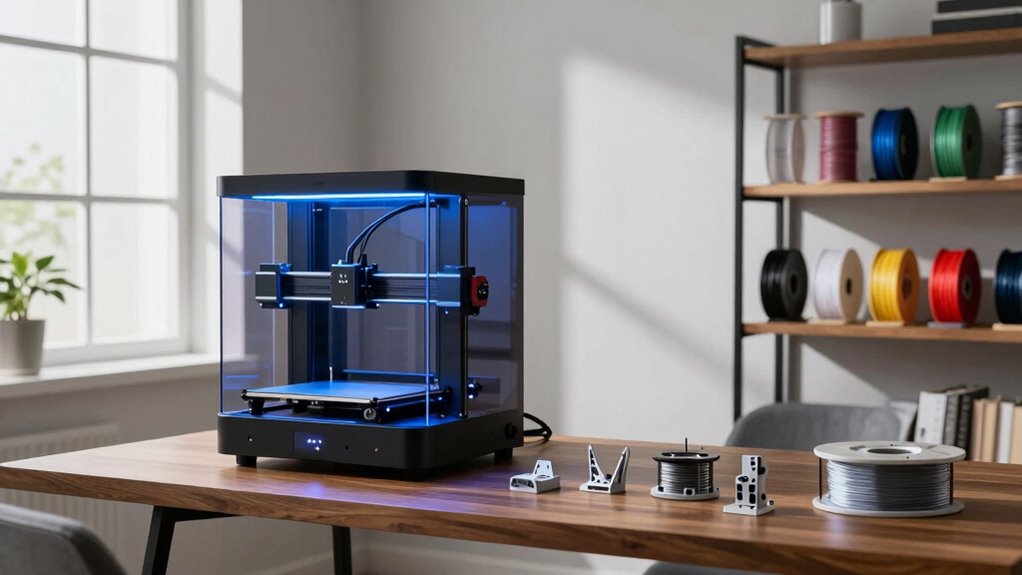
You’ve seen 3D printers move from industrial tools to stylish, user-friendly devices in home workspaces. Advances in materials, like metals and biodegradable plastics, let you create detailed, durable items easily. Modern printers are faster, more precise, and connect wirelessly for convenience. Smart features and automation make designing simpler. If you keep exploring, you’ll discover how these innovations turn your home into a creative hub with endless possibilities.
Open a free Amazon Business account
Business pricing, bulk buying and tax-exempt orders.
As an affiliate, we earn on qualifying purchases.
Key Takeaways
- Advances in technology have made 3D printers more reliable, precise, and user-friendly for home environments.
- Material innovations enable high-quality, durable prints that mimic real-world materials, suitable for personal use.
- Modern printers feature faster, multi-material, and high-resolution capabilities, elevating their creative potential at home.
- Connectivity and remote control functionalities integrate 3D printers seamlessly into home workflows.
- Ongoing research and automation streamline processes, making 3D printing an accessible and practical creative tool in premium home spaces.

3D printers are transforming home workspaces by making innovation and customization more accessible than ever. No longer confined to industrial settings, these machines have found a foothold in premium home environments, offering a blend of advanced technology and personal creativity. The secret behind this shift lies in recent material innovations and improved printing technologies that make 3D printing more reliable, versatile, and user-friendly.
Material innovations play a vital role in elevating the capabilities of 3D printers. Today, you can choose from a wide range of filaments and resins that mimic real-world materials—metal, wood, flexible plastics, even biodegradable options. These new materials expand what you can create, from intricate jewelry to functional household items. The progress in material science guarantees that your prints are not only visually appealing but also durable and suitable for everyday use. As these materials become easier to handle and more affordable, you’re encouraged to experiment and push creative boundaries without worrying about costly failures. Additionally, these advancements foster a sustainable approach to 3D printing, reducing waste and environmental impact.
Innovative materials like metal, wood, and biodegradable options enable durable, customizable, and visually stunning 3D printed creations.
Meanwhile, advancements in printing technologies have made 3D printers faster, more precise, and easier to operate. High-resolution printing means your designs come out with sharp detail, making complex prototypes or artistic pieces look polished. Multi-material and multi-color printing capabilities enable you to produce more sophisticated objects without the need for post-processing or assembly. Faster printing speeds save you time, turning what used to be a multi-hour process into something more manageable, even in a busy home environment. Many machines now feature intuitive interfaces and automation features, so you don’t need to be a tech expert to get started. These innovations lower the barrier to entry, allowing anyone with a creative idea to bring it to life.
The integration of smarter printing technologies also means you can monitor and control your prints remotely, guaranteeing better success rates and reducing waste. Wireless connectivity, cloud-based slicing, and real-time updates keep you in command, no matter where you are. This seamless integration makes 3D printing a practical addition to your home workspace, rather than a cumbersome hobby. As these technologies continue to evolve, you’re likely to see even more user-friendly features that make designing, customizing, and producing parts or art effortless. Additionally, contrast ratio in projectors influences how vibrant and detailed your images appear, just as advanced printing technologies enhance the quality of your 3D prints.
Furthermore, incorporating material handling solutions can streamline your workflow and reduce errors, making your 3D printing experience even more efficient. These improvements are supported by ongoing research in material science, which continually introduces new options suitable for various applications. All these advancements make 3D printers a natural fit for a premium home workspace, blending innovation, customization, and practicality. You don’t need a workshop or industrial setup—just a dedicated corner and the desire to create. With material innovations and cutting-edge printing technologies working in your favor, your home workspace transforms into a hub of endless possibilities, where ideas become tangible objects faster and easier than ever before.
As an affiliate, we earn on qualifying purchases.
Frequently Asked Questions
What Are the Initial Costs of Setting up a Home 3D Printer?
Setting up a home 3D printer typically costs between $200 and $1,000, depending on features. You’ll need to budget for filament selection, which varies in price based on material, and for tools to guarantee proper print bed calibration. Additional expenses might include replacement parts or upgrades. Overall, initial costs cover the printer itself, filament, calibration tools, and some basic accessories, making it an accessible investment for hobbyists.
How Much Space Is Needed for a 3D Printer in a Home Office?
Think of your home office as a cozy nook, needing about the size of a small bookshelf for a 3D printer. You’ll want enough space for design customization and easy access, with room to manage noise levels comfortably. Typically, a 24×24 inch area suffices, but larger models may require more room. Keep in mind, quieter printers let you work without distraction, fitting seamlessly into your workspace.
What Safety Precautions Should Be Taken With Home 3D Printers?
You should prioritize filament safety by storing materials properly and avoiding inhaling fumes. Guarantee good ventilation requirements in your workspace to prevent buildup of potentially harmful fumes from heated filaments. Always keep a fire extinguisher nearby, and never leave the printer unattended during operation. Regularly check for any signs of overheating or electrical issues. By following these safety precautions, you’ll create a safer environment for your 3D printing hobby.
Can a 3D Printer Be Used for Food or Medical Items?
Yes, you can use 3D printers for food or medical items, but with caution. For food safety, only use food-grade, non-toxic, and FDA-approved materials, and guarantee thorough cleaning to prevent contamination. In medical applications, specialized printers and biocompatible materials are essential for safe, precise results. Always follow strict safety standards and regulations to avoid risks, especially when printing items intended for ingestion or health use.
How Maintenance-Intensive Are Home 3D Printers?
Home 3D printers aren’t overly demanding, but you’ll need to stay on top of filament compatibility and cleaning. The good news? They generally require regular but straightforward maintenance like nozzle cleaning and software updates. Pay attention to printing speed settings to avoid jams or print failures. With a little routine, you’ll keep your printer running smoothly, *discovering* endless creative possibilities without the hassle.
As an affiliate, we earn on qualifying purchases.
Conclusion
As 3D printers settle into your home workspace, they become the artisans of your imagination, transforming blank canvases into tangible masterpieces. Like a trusty sidekick, they turn your ideas into reality with a flick of technology’s magic wand. Embrace this new chapter where innovation and creativity dance hand in hand, making your home not just a space, but a sanctuary of endless possibilities. Your journey into the future has already begun—are you ready to print your dreams?
As an affiliate, we earn on qualifying purchases.
As an affiliate, we earn on qualifying purchases.
NFL season / tailgating Picks
team gear
As an affiliate, we earn on qualifying purchases.