If you want retro arcade consoles with preloaded games, the biggest decision is form factor: a TV-connected console with wireless controllers like the Retro Gaming Console with 64GB Storage and 25 Emulators offers the deepest game library and couch multiplayer, while the GWALSNTH Pandora Box 60S delivers the most authentic arcade feel with its built-in screen, dual joysticks, and 32,000 titles. For kids or casual players, the P30S Handheld and My Arcade Atari Pocket Player trade library size for simplicity and portability. The core tradeoff in this category is between game count and quality control — the big-library units often include duplicates and obscure filler — and between open emulation boxes and licensed compilations, which differ in build polish and game authenticity. Read on for the full breakdown of all 15 consoles and which one fits your setup.

Get home appliances delivered free with Prime
- Fast, free delivery on millions of items
- Prime Video, Amazon Music and more included
- Member-only deals all year
Complete the kit


Key Takeaways
- The generic 64GB Retro Gaming Console and the LIUWEI 64GB unit stood out as the best overall picks because 25-emulator support plus dual wireless controllers delivers the most flexible living-room experience for the money.
- Massive game counts (20,000–32,000 titles on the Pandora Box 60S, Boltz handheld, and 32,000-in-1 console) came with a shared weakness: cluttered menus, duplicate ROMs, and inconsistent game quality that demand patience to navigate.
- My Arcade’s licensed Atari lineup (Game Station Pro, Pocket Player, Gamestation Go) offers the cleanest menus and authentic titles, but the game libraries are far smaller than unlicensed emulator boxes.
- Kid-focused handhelds like the P30S (220 games) and the 400-game IPS-screen minis are easier to manage but lack TV output and multiplayer, making them poor picks for family game nights.
- Save/load state support — present on the 64GB consoles and Boltz handheld but often missing on budget handhelds — was one of the strongest predictors of long-term satisfaction.






More Details on Our Top Picks
Retro Gaming Console with 64GB Storage, 25 Emulators, Dual Wireless Controllers, HDMI Output, and Save/Load
Broad emulator support and two wireless controllers make this a flexible pick for households that want a preloaded library on the living-room TV. It lists thousands of games across 25 emulators, more emulator systems than the Retro Gaming Console with 20,000 Games, and includes save and load states for picking up where you left off. The plug-and-play HDMI setup also avoids needing an internet connection.
The listing leaves two practical details unclear: it gives both 64GB and 128GB storage, and describes 4K compatibility while also stating 1080p resolution. That makes its capacity and output claims harder to pin down than the clearly listed 720×720 display on the Boltz Retro Handheld. I’d choose this for variety and shared TV play, while buyers who need precise technical specifications should look elsewhere.
Pros:- Thousands of pre-installed games
- Supports 25 emulators
- Includes two wireless controllers with a stated range of up to 10 meters
- Save and load states support pausing and resuming progress
Cons:- Storage is listed as both 64GB and 128GB
- Video output claims mention both 4K compatibility and 1080p resolution
Best for: Households looking for a broad preloaded game selection, multiplayer TV play, and save states without an internet connection
Not ideal for: Buyers who need confirmed storage capacity or a clearly specified video resolution
- Storage:64GB memory card; listing also mentions 128GB
- Emulators:25
- Game library:Thousands of pre-installed games
- Controllers:2 wireless 2.4GHz controllers
- Wireless range:Up to 10 meters
- Video output:HDMI; listing states 4K-compatible and 1080p
- Features:Save/load states; plug and play
- Internet:Not required
Our verdict“Choose it for a varied, two-player TV setup with save states if the unclear storage and resolution details are acceptable.”
WDYQJE Mini Handheld Game Console with 3-Inch IPS Screen, 400 Classic Games, Blue
Pocket-sized play with 400 preloaded games gives this handheld a different job from the TV-focused Retro Gaming Console with 64GB Storage: it is made for solo gaming away from the living room. The 3-inch IPS screen and stated battery life of up to five hours suit commutes or quiet breaks, while its 4.5-inch length makes it easier to pack than the larger Boltz Retro Handheld. Its button controls keep the layout simple for buyers who want a small, self-contained device.
Battery information is inconsistent: the product is described as rechargeable, but its specifications list a D battery. That uncertainty makes it harder to plan for extended travel than with the Boltz, which specifies a rechargeable 3500mAh battery and USB-C charging. I’d pick the WDYQJE for compactness and a modest game library, but skip it if charging details matter to your routine.
Pros:- Compact 4.5-inch-long handheld design
- 3-inch IPS display
- Includes 400 preloaded classic games
- Listed battery life is up to five hours
Cons:- Battery details conflict: the title says rechargeable while specifications list a D battery
- Its 3-inch screen is smaller than the Boltz Retro Handheld’s 3.75-inch display
Best for: Travelers who want a small, single-player handheld with a built-in game selection for short outings
Not ideal for: Buyers who need confirmed rechargeable power or a larger screen for extended play
- Screen:3-inch IPS
- Preloaded games:400
- Battery capacity:1020 mAh
- Battery life:Up to 5 hours
- Power:Battery powered; listing also specifies 1 D battery
- Controls:Button control
- Dimensions:4.5 x 3 x 0.3 inches
- Color:Blue
Our verdict“Pick this for compact solo gaming on short trips if you can resolve the conflicting battery information.”
My Arcade Atari Game Station Pro Retro Console with 200+ Games and Wireless Joysticks
Official Atari games across four named libraries make this the clearest choice for buyers who want a curated Atari-focused console. It includes more than 200 built-in titles associated with the Atari 2600, 5200, 7800, and arcade catalogs, plus two wireless joysticks and save options. Compared with the Retro Gaming Console with 64GB Storage, which emphasizes many emulators and thousands of games, this one offers a more focused collection with recognizable Atari system names.
That focus also limits its appeal: it has fewer listed games than either multi-emulator TV console, and the description specifically notes that Pac-Man and Galaga are absent. The joysticks need four AA batteries that are not included, adding a setup step the plug-and-play console sticks avoid. I’d choose it for Atari-specific play and skip it if breadth across systems is the priority.
Pros:- Officially licensed collection with 200+ built-in games
- Includes titles from Atari 2600, 5200, 7800, and arcade libraries
- Two wireless 2.4 GHz joysticks are included
- HDMI connection and game-save options support TV play
Cons:- Four AA batteries for the joysticks are not included
- Pac-Man and Galaga are not included
- The Atari-focused library is narrower than the multi-emulator console options
Best for: Atari fans who want a TV-connected collection spanning several classic Atari libraries and two wireless joysticks
Not ideal for: Buyers seeking the broadest multi-system library or expecting Pac-Man and Galaga to be included
- Built-in games:200+
- Game libraries:Atari 2600, Atari 5200, Atari 7800, and arcade titles
- Controllers:2 wireless 2.4 GHz joysticks
- Controller batteries:4 AA batteries required; not included
- Connectivity:HDMI
- Power:USB
- Features:Game-save options and RGB lighting
- Console dimensions:7 x 4.19 x 1.19 inches
Our verdict“Choose this for a named, Atari-centered game collection with wireless joysticks, provided its narrower selection fits your tastes.”
Retro Gaming Console with 20,000 Games, 23 Emulators, and Dual Wireless Controllers
20,000 listed games and 23 emulators put library size at the center of this compact TV console. It comes with two wireless controllers and is designed for plug-and-play HDMI setup, so it can support quick two-player sessions without a separate handheld screen. Its game count is much higher than the My Arcade Atari Game Station Pro, which takes a narrower approach with 200+ Atari titles and named libraries.
The tradeoff is uncertainty about what that large number means in practice: the listing gives little information about game selection or compatibility. It also claims 4K support without providing resolution specifications, unlike the Boltz Retro Handheld’s stated 720×720 display. I’d favor this console when a broad advertised library is the draw, but buyers who want identifiable games or well-defined output specs may prefer the Atari collection or another option.
Pros:- Lists 20,000 built-in games
- Supports 23 emulators
- Includes two wireless 2.4 GHz controllers for two-player use
- Designed for HDMI plug-and-play setup
Cons:- Game selection and compatibility details are not specified
- The 4K support claim comes without resolution specifications
- The listing does not identify a machine-specific platform
Best for: TV gamers who want a large advertised preloaded library and two-controller play in a plug-and-play format
Not ideal for: Buyers who want a named game list, clear compatibility details, or confirmed video resolution
- Built-in games:20,000
- Emulators:23
- Controllers:2 wireless 2.4 GHz controllers
- Players:2
- Connectivity:HDMI
- Setup:Plug and play
- Dimensions:4.7 x 3.9 x 5.5 inches
- Included items:Console stick, two controllers, HDMI cable, user guide
Our verdict“Choose it for the appeal of a very large advertised library and simple two-player TV setup if unclear game and video details are acceptable.”
Boltz Retro Handheld Game Console with 20,503 Built-In Games and 3.75-Inch IPS Display
A 3.75-inch square IPS display and dual joysticks give this handheld a more capable control setup than the compact WDYQJE Mini Handheld, which has a 3-inch screen and button controls. It pairs those controls with a listed 20,503 built-in games, a quad-core RK3326 processor, and Linux, making it the most feature-rich portable option in this batch. The 720×720 resolution gives the screen a clearly stated output spec, unlike the TV console claiming 4K without providing resolution details.
Portability still has limits: the rechargeable 3500mAh battery is rated for up to five hours, so long outings may call for a recharge. Its large listed library is also not broken down by game or system in the supplied details, which leaves selection less transparent than the Atari Game Station Pro’s named collections. I’d choose this for varied handheld controls and a sharper-specified screen, not for marathon sessions.
Pros:- Lists 20,503 built-in games with no internet or downloads required
- 3.75-inch IPS display with 720×720 resolution
- Multiple control inputs include dual analog joysticks, a D-pad, and shoulder triggers
- Rechargeable 3500mAh battery with USB-C charging
Cons:- Battery life is rated for up to five hours per charge
- The supplied details do not break down the game library by title or system
Best for: Portable players who want analog sticks, a directional pad, shoulder triggers, and a clearly specified square IPS display
Not ideal for: Travelers needing all-day play between charges or buyers who require a detailed breakdown of included games
- Built-in games:20,503
- Processor:RK3326 quad-core Cortex-A35
- Operating system:Linux
- Display:3.75-inch IPS, 720×720
- Battery:3500mAh; up to 5 hours
- Charging:USB-C
- Controls:Dual analog joysticks, D-pad, shoulder triggers, action buttons
- Audio:Built-in speakers and 3.5mm headphone jack
Our verdict“Choose the Boltz for a feature-rich handheld with versatile controls and a specified display, if five-hour battery life suits your play sessions.”
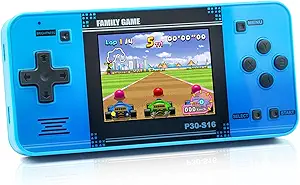
P30S Handheld Game Console for Kids with 220 Retro Games, 3-Inch LCD Screen, and Rechargeable Battery
The P30S suits younger players who want a small handheld library without setting up a TV console. Its 220 games span entertainment, sports, and adventure, giving kids more variety than the Atari-focused My Arcade Atari Pocket Player, though the P30S listing does not identify individual titles. The 3-inch screen and ergonomic design are sized for portable play, while its rechargeable battery avoids the AA replacements required by the Atari handheld. That convenience comes with uncertainty: battery play time is not specified, and the compact display gives less room for game detail than a TV-connected option such as the GameNext Retro Game Console. I’d choose it for a child who values simple, self-contained play, but skip it if screen size or a documented play duration matters most.
Pros:- 220 games cover several genres
- Lightweight ergonomic design is suited to small hands
- Rechargeable battery avoids routine battery replacement
Cons:- The 3-inch screen limits viewing area
- Battery play time is not specified
- The included game titles are not listed
Best for: Parents looking for a lightweight handheld with varied preloaded games for younger children
Not ideal for: Players who want a large screen, named game titles, or a stated battery runtime
- Model:P30S
- Included games:220
- Screen size:3 inches
- Battery capacity:860 mAh
- Battery type:Lithium-ion
- Color:Blue
Our verdict“Choose the P30S for a child who wants varied portable play in a rechargeable handheld, provided the small screen is acceptable.”
My Arcade Atari Pocket Player with 100 Games
For shoppers who want a portable console tied to a recognizable catalog, the Atari Pocket Player offers 100 officially licensed Atari games on a full-color vertical screen. That narrower, named-library appeal separates it from the P30S, which lists more games across broader genres but does not identify its titles. At 2.75 inches, this screen is even smaller than the P30S’s 3-inch display, so neither is ideal for players who prioritize visibility. The Pocket Player adds brightness and volume controls plus a headphone jack, useful for adjusting play in shared spaces. Power is its main compromise: four AA batteries or a separately purchased USB-C cable are required, while the P30S includes a rechargeable battery. I’d pick this for an Atari-minded portable player who values licensed games and audio options.
Pros:- 100 officially licensed Atari games
- Full-color vertical display
- Brightness and volume controls
- 3.5 mm headphone jack for private listening
Cons:- Requires four AA batteries or a separately purchased USB-C cable
- The 2.75-inch display is small
- Power accessories are not included
Best for: Atari fans who want a compact handheld with a defined, officially licensed game collection
Not ideal for: Buyers seeking included rechargeable power, a larger screen, or a broad mix of unidentified games
- Games:100
- Display:2.75-inch full-color vertical screen
- Power:4 AA batteries or USB-C cable
- Headphone jack:3.5 mm
- Dimensions:1.14 in W × 2.8 in H × 5.80 in D
- User guide languages:English, French, Spanish, Italian, Portuguese, German, Dutch, Japanese, Arabic
Our verdict“Pick the Atari Pocket Player if a licensed Atari collection and headphone support matter more than rechargeable power or screen size.”
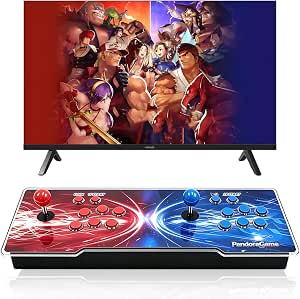
GWALSNTH Pandora Box 60S Arcade Game Console, 32,000 Games, 720p Display, Two Joysticks
The Pandora Box 60S is the most arcade-oriented pick here: it pairs two separate joysticks with support for one to four players and a TV or monitor setup. Its advertised 32,000-game library, including 161 3D games, dwarfs the GameNext console’s 620 titles, while search and classification tools offer ways to browse a much larger collection. Pause, save, and resume functions can also make longer sessions easier to manage. The tradeoff is confidence in what that library contains: specific game titles are not listed, and the broad compatibility claims may require checking against a buyer’s display and connections. It also needs a shared screen and more setup space than a handheld such as the P30S. I’d favor it for players who want joystick-led group sessions and can accept an unclear catalog.
Pros:- Advertises 32,000 games, including 161 3D titles
- Supports one to four players
- Includes two separate joysticks
- Search, classification, pause, save, and resume functions
Cons:- The included game titles are not specified
- Compatibility and video connections may need verification
- Requires a TV, monitor, or other display for play
Best for: Households and arcade fans who want separate joysticks, multiplayer support, and a large TV-based library
Not ideal for: Buyers who need a clearly named game list, portable play, or confirmed compatibility with a particular display
- Installed games:32,000
- 3D games:161
- Display resolution:1280 × 720
- Players:1–4
- Controls:Two separate joysticks
- Functions:Search, game classification, pause, save, resume
- Compatible displays:TV, PC, Xbox 360, PS3, screen, monitor, projector
Our verdict“Choose the Pandora Box 60S for shared joystick play and a very large advertised library if you are comfortable verifying compatibility and browsing an unspecified catalog.”
GameNext Retro Game Console with 620 Built-In Games and 2 Wired Controllers
The GameNext Retro Game Console keeps the proposition simple: 620 built-in games, two wired controllers, and an included AV cable for connecting to a compatible television. Compared with the Pandora Box 60S, its library is far smaller and its listed features do not include search, save, or resume functions; in return, the setup is less dependent on a sprawling catalog or separate joysticks. Select games support two players, which gives families a way to share play, though multiplayer is not promised across the full collection. The key practical limit is AV-only TV output: buyers need a compatible TV, which may rule it out in setups built around newer connections. Unlike the handheld P30S, it also needs a screen and a place for two wired controllers. I’d choose it for a basic shared-room setup where AV compatibility is already covered.
Pros:- 620 preloaded games across several genres
- Two wired controllers are included
- AV cable is included
- Straightforward TV connection
Cons:- Requires a TV with a compatible AV connection
- Two-player play is available only in select games
- Wired controllers limit seating flexibility
Best for: Buyers with an AV-compatible TV who want a simple plug-in console and two included controllers
Not ideal for: People with HDMI-only televisions, players wanting wireless controls, or groups expecting every game to support multiplayer
- Built-in games:620
- Controllers:2 wired controllers
- TV connection:AV output
- Included accessories:AV cable
- Recommended age:15 and up
Our verdict“Pick GameNext for a simple two-controller setup if your TV supports AV and you do not need wireless play or a huge library.”
LIUWEI Retro Gaming Console with Dual Wireless Controllers, 64GB
The LIUWEI Retro Gaming Console combines an HDMI game stick with two 2.4GHz wireless controllers, giving TV and projector setups more room to play than the wired GameNext console. Its advertised 64GB storage and 23 emulators point toward a broad collection, but the game count is inconsistent: the title says 20,000+ while the description claims more than 40,000. That makes library size a less dependable comparison than the Pandora Box 60S’s stated 32,000 games, even though LIUWEI advertises a larger figure. The listing also claims 4K output, but does not resolve the game-count discrepancy or identify update support. I’d treat this as a flexible wireless option for buyers comfortable with some listing uncertainty; those who value clearer catalog details may prefer the named Atari collection or GameNext’s more modest claim.
Pros:- Two 2.4GHz wireless controllers are included
- HDMI connection supports TV, PC, and projector setups
- 64GB storage
- Advertises 23 emulators and 4K output
Cons:- Game count conflicts between the title and description
- Software update support date is listed as unknown
- Specific included games are not identified
Best for: TV and projector owners who want wireless multiplayer controls and a large advertised retro library
Not ideal for: Buyers who need a consistent game count, confirmed update support, or a clearly identified title list
- Storage capacity:64 GB
- Wireless communication:2.4GHz
- Connectivity:HDMI
- Output resolution:4K
- Included controllers:2 wireless controllers
- Advertised game library:More than 40,000 games in description; title says 20,000+
- Emulators:23
- Color:Black
Our verdict“Choose LIUWEI for wireless HDMI play and broad advertised emulator support if the inconsistent game count does not decide your purchase.”
Retro Handheld Game Console with 240 Preloaded Games
Small and rechargeable, this handheld suits solo players who want a ready-to-play game collection without carrying a TV console. Its 3-inch LCD and button controls keep the setup familiar, while the 1200 mAh battery avoids the need to pack disposable batteries. Compared with the My Arcade Go Gamer Classic, it has a larger screen and a stated rechargeable battery, but fewer games and no listed headphone port. The tradeoff is a basic, single-player format: the product data does not identify its game platform or explain the selection beyond broad genres. That makes it a straightforward pick for casual trips, though buyers seeking multiplayer sessions or more detail about the games may prefer a TV-connected console such as the 32,000-in-1 Arcade Game Console.
Pros:- 240 games are preloaded for play without downloads
- Rechargeable 1200 mAh battery is specified
- 3-inch screen is larger than the My Arcade Go Gamer Classic’s 2.5-inch display
- Compact 3.52-ounce design is easy to carry
Cons:- Limited to one player
- Game platform and specific titles are not identified
- No headphone port is listed
Best for: Solo players who want a lightweight, rechargeable handheld for casual gaming during trips
Not ideal for: Buyers who want multiplayer, a known game platform, or detailed information about the included titles
- Preloaded games:240
- Screen:3-inch LCD
- Battery:1200 mAh rechargeable
- Players:1
- Controls:Button control
- Dimensions:5.3 × 2.5 × 0.8 inches
- Weight:3.52 ounces
- Interface:USB
Our verdict“Choose this for simple solo play on a rechargeable handheld, provided the unspecified game lineup suits you.”
My Arcade Go Gamer Classic Portable Handheld Game Console, Purple, 300 Games
The 300 built-in games and offline operation make this a flexible pick for solo players who want variety without setting up a console or connecting to the internet. Its 2.5-inch color LCD is smaller than the 3-inch screen on the Retro Handheld Game Console with 240 Preloaded Games, but this model adds illuminated buttons and a 3.5 mm headphone port for quieter play. Power flexibility comes with a catch: it runs on three AAA batteries or a USB-C cable, and neither is included. That means buyers need to supply a power option before playing. Compared with the rechargeable 400-game pink handheld in this lineup, the Go Gamer Classic offers a listed headphone jack and a specified game count, but its smaller screen and separate power purchase make it less self-contained.
Pros:- 300 built-in games work without internet or downloads
- 3.5 mm headphone port supports private listening
- Illuminated buttons aid play in dim settings
- Can run on AAA batteries or a USB-C cable
Cons:- Three AAA batteries and the USB-C cable are sold separately
- 2.5-inch screen is smaller than several handhelds in this roundup
- Designed for one player
Best for: Solo players who want a broad offline game collection and expect to use headphones
Not ideal for: Buyers who want a larger handheld screen or a rechargeable battery included and ready to use
- Built-in games:300
- Screen:2.5-inch color LCD
- Players:1
- Controls:Button control with illuminated buttons
- Power:Three AAA batteries or USB-C cable; sold separately
- Headphone port:3.5 mm
- Weight:160 g
- Color:Purple
- Warranty:120 days against manufacturer defects
Our verdict“Pick the Go Gamer Classic for offline game variety and headphone listening if you are prepared to provide its power source.”
32,000-in-1 Arcade Game Console with Dual Joysticks, 1–4 Players
For buyers who want a living-room arcade library, the headline difference is scale: this console lists over 32,000 pre-installed games, including 80 enhanced 3D titles, and connects to a TV, monitor, or projector. Its HDMI and VGA outputs give it more display flexibility than the My Arcade Atari Gamestation Go, which is a portable unit with HDMI TV connectivity. Two arcade joysticks are included, so two people can start playing together; reaching the stated four-player capacity requires additional USB gamepads and a separately sold hub. The 720p output and large library favor breadth over a focused collection of named licensed games. Buyers should also be comfortable with a plug-in setup and sorting through a very large catalog rather than choosing a handheld built for quick solo play.
Pros:- Over 32,000 pre-installed games plus 80 enhanced 3D titles
- HDMI and VGA outputs support a range of screens and projectors
- Two arcade joysticks are included for immediate two-player sessions
- Operates without Wi-Fi or downloads
Cons:- Only two controllers are included despite support for up to four players
- Extra USB gamepads and a hub are needed for four-player play
- 720p output is less suited to buyers seeking higher-resolution display
Best for: Households and arcade fans who want a TV-connected system with two included joysticks and room to add players
Not ideal for: Travelers or buyers who prefer a clearly defined, licensed game collection and a ready-made four-player setup
- Pre-installed games:Over 32,000
- Enhanced 3D titles:80
- Resolution:1280 × 720p
- Video outputs:HDMI and VGA
- Players:1–4
- Included controllers:2 arcade joysticks
- Included cables:3 m HDMI cable; 1.5 m VGA cable
- Internet required:No
Our verdict“Choose this for a large, shared arcade library on a TV, as long as you are comfortable adding hardware for more than two players.”
My Arcade Atari Gamestation Go with 200+ Preloaded Games
This portable system is the lineup’s clearest choice for players who value recognizable Atari-era games and controls matched to different styles of play. Its 200+ licensed games span Atari, Jaleco, and PIKO Interactive, while the paddle, trackball, numeric keypad, and D-pad offer more than the standard buttons found on the 240-game Retro Handheld Game Console. A 7-inch color screen gives games more room than either compact handheld, and HDMI lets the system connect to a television. Game saves and a rechargeable battery support longer sessions without disposable power. The tradeoff is a smaller stated library than the 32,000-in-1 console, which emphasizes sheer volume and multiplayer expansion. This pick favors a defined licensed collection and varied built-in controls over maximum game count.
Pros:- More than 200 built-in games from Atari, Jaleco, and PIKO Interactive
- Paddle, trackball, keypad, and D-pad support varied classic game styles
- 7-inch color display is larger than the handheld screens in this lineup
- Rechargeable battery, game saves, and HDMI TV connectivity are included
Cons:- Library is much smaller than the 32,000-in-1 console’s stated collection
- Player count and multiplayer support are not specified
- Wi-Fi is built in, so buyers seeking a purely offline feature set may not need all its connectivity
Best for: Atari fans who want a portable licensed collection with game-specific controls and the option to play on a TV
Not ideal for: Buyers who prioritize the largest possible library, multiplayer support, or a low-detail setup without Wi-Fi features
- Built-in games:200+
- Licensing:Atari, Jaleco, and PIKO Interactive
- Display:7-inch full-color
- Controls:Paddle, D-pad, trackball, numeric keypad, bumpers, and A/B/X/Y buttons
- Connectivity:HDMI and Wi-Fi
- Power:Built-in rechargeable battery
- Game saves:Supported
Our verdict“Choose the Gamestation Go for a portable, licensed Atari-focused collection with varied controls and TV output.”
Mini Handheld Retro Game Console with 3-Inch IPS Screen, 400 Built-In Games, Pink
The selling point here is a mix of 400 built-in games and a 3-inch IPS screen in a small handheld, giving solo players more listed titles than the 240-game model while keeping the display compact. IPS is specified instead of the LCD panel on the Retro Handheld Game Console with 240 Preloaded Games, which may appeal to buyers who prioritize a color-focused screen. The listing also states up to five hours of play, but its power details are inconsistent: it describes a rechargeable battery and separately lists one included D battery. Buyers should confirm how the supplied battery fits the stated charging setup before relying on it for travel. Its game selection is also not broken down, so the higher count does not tell buyers which classics are included. This is a compact solo option, not a shared arcade system.
Pros:- 400 built-in games exceed the counts on the 240- and 300-game handhelds
- 3-inch IPS display is specified
- Listed battery life is up to five hours
- Compact dimensions suit travel
Cons:- Power information is unclear: the description mentions rechargeable use while specs list an included D battery
- Game titles and selection are not detailed
- Designed for one-player button control
Best for: Solo travelers who want a compact handheld with a stated 400-game collection and IPS display
Not ideal for: Buyers who need clear battery and charging details, multiplayer play, or a named list of included games
- Built-in games:400
- Screen:3-inch IPS
- Battery capacity:1020 mAh
- Battery life:Up to 5 hours
- Controls:Button control
- Power source:Battery powered; listing also states one D battery is included
- Dimensions:4.5 × 3 × 0.3 inches
- Color:Pink
Our verdict“Consider this compact handheld for its IPS screen and 400-game count only if you can clarify the battery arrangement and accept an unspecified game list.”

How We Picked
I evaluated each console against five criteria that actually shape the ownership experience. Library quality and organization came first, because a raw count of 32,000 games means little if the list is stuffed with duplicates and unplayable filler. Input quality was next: wireless controllers with responsive buttons beat thin wired pads, and a proper arcade joystick changes the feel of fighting games entirely. I also weighed display and connectivity (HDMI output, screen type, multiplayer support), ease of use for the intended buyer, and build and battery for the handheld options.
Ranking logic followed role fit rather than raw specs. Units with emulator flexibility, save states, and multiplayer earned the top spots because they serve the broadest range of buyers. Licensed Atari hardware ranked high on polish but lower on value per dollar for enthusiasts. Small-screen handhelds were judged against a different standard — durability, simplicity, and kid-friendliness — which is why they occupy the value and beginner slots rather than being penalized for small libraries.
Factors to Consider When Choosing Retro Arcade Consoles With Preloaded Games
Before picking a console from the list above, step back and match the purchase to how you’ll actually play. These are the factors that separate a console you’ll use every weekend from one that gathers dust.Game Count Means Less Than Game Access
The most common mistake in this category is chasing the biggest number. A console advertising 32,000 games often has the same few hundred worthwhile titles repeated across scrambled lists, with the rest filled by obscure or broken ROMs. What matters more is how the library is organized — searchable lists, genre sorting, and favorites folders turn a huge library into something usable. A 64GB console with 25 emulators and clean menus will get more play than a chaotic 32,000-in-1 unit. If you can, check whether the console supports adding your own files, because that flexibility matters more long-term than the preloaded count.
Form Factor: TV Console, Handheld, or Mini Cabinet
Each form factor serves a different household. TV-connected consoles with wireless controllers are best for couch multiplayer and big-screen play, but they’re tethered to a living room. Handhelds suit commutes, kids, and solo play, yet screens under four inches make fast action games harder to enjoy. Tabletop cabinet-style units like the Pandora Box recreate the arcade sensation with real joysticks, but they need permanent counter space and a power outlet. Buyers who skip this decision first often end up returning a handheld they meant for family game night, or a bulky cabinet they have nowhere to put.
Licensed Collections vs. Unlicensed Emulation Boxes
Products like My Arcade’s Atari line are officially licensed, meaning titles are authentic, menus are polished, and everything works out of the box — but libraries cap out around 200–300 games. Unlicensed emulation consoles offer thousands of titles across dozens of systems, usually at similar cost, but quality control varies widely and legal status is murkier. If authenticity and gifting to a non-technical person matter, licensed wins. If you want breadth and don’t mind occasional duds, the emulation boxes deliver far more. This single distinction explains most of the price and experience differences in the lineup.
Controllers and Multiplayer Support
Two-player support is what turns a nostalgic gadget into a social one. Consoles that include dual controllers out of the box save you the hassle of compatibility hunting later, and wireless controllers avoid the trip-hazard and couch-distance limits of wired pads. Pay attention to whether a second player needs a joystick (cabinet units), a gamepad (TV consoles), or simply can’t play at all (most small handhelds). Also check button quality descriptions: mushy membranes ruin fighting games, while clicky micro-switch sticks and pads hold up under aggressive play.
Save States, Battery, and Daily Usability
Save and load state support is the quiet feature that separates keepers from dust collectors — being able to freeze progress mid-level respects your time, especially in long or punishing arcade games. On handhelds, look for rechargeable batteries rather than disposable ones, and realistic runtimes of several hours. Screen type matters too: an IPS display gives sharper viewing angles than a basic LCD, which is visible in the difference between the IPS-equipped minis and the P30S’s standard screen. These small usability details compound quickly in daily use.
Who’s Actually Playing
A console that’s perfect for a 40-year-old recapturing childhood arcades is often wrong for an eight-year-old, and vice versa. Kids do better with simple handhelds that boot straight into a game list, have durable bodies, and don’t require menu literacy. Adults and enthusiasts will want emulator flexibility, HDMI output, and controller options. Gift buyers should lean toward licensed, plug-and-play hardware that needs no setup or explanation. Matching the console to the player matters more than any individual spec on the box.
Frequently Asked Questions
Are consoles with 20,000+ preloaded games really worth it, or is it a gimmick?
The huge counts are real but misleading. These units typically load full ROM sets that include hundreds of duplicates, regional variants, and unplayable titles alongside genuinely great games. In practice, you’ll find a few hundred games worth playing and ignore the rest. The value isn’t the number — it’s the breadth of emulator support that lets you jump between consoles, arcade boards, and handheld eras. If you enjoy browsing and discovering, big-library units like the Pandora Box 60S or the 20,000-game console are genuinely fun. If you want a curated experience, licensed Atari hardware or a smaller, well-organized library will frustrate you less.
Is it better to buy a licensed Atari console or a generic emulation box?
It depends on who’s using it and how much they value polish versus breadth. Licensed consoles like the My Arcade Game Station Pro guarantee authentic versions of classic titles, clean menus, reliable wireless joysticks, and zero setup — ideal for gifts, kids, or anyone non-technical. Generic boxes offer dozens of systems and thousands of games at similar cost, which enthusiasts usually prefer, but you accept inconsistent quality and less refined hardware. There’s also a legal comfort factor: licensed collections are unambiguously legitimate, while preloaded emulation boxes occupy a grayer area. For most casual buyers, licensed wins on satisfaction per hour played; hobbyists will outgrow it quickly.
Can these consoles add more games later, or am I stuck with what’s preloaded?
The SD-card-based emulation consoles — particularly the 64GB models with 20+ emulators and the Boltz handheld — generally allow you to add files via removable storage, which future-proofs your purchase. Licensed hardware from My Arcade does not: the game list is fixed at purchase. Cabinet-style units like the Pandora Box vary by model, so verify expandable storage before buying if growing the library matters to you. If you never intend to tinker, this distinction doesn’t matter much and a fixed licensed library is simpler. If you like customizing, treat expandability as a must-have feature rather than a bonus.
Which type is better for kids: a handheld or a TV console?
Handhelds win for kids under about ten because they boot straight into a game list, need no TV or HDMI fiddling, and survive being dropped in a backpack — the P30S and the 400-game IPS minis fit this role well. TV consoles become the better choice for family play, since dual controllers let a parent join in and the big screen reduces eye strain. The tradeoff is supervision: TV consoles anchor play to the living room where you can see it, while handhelds go anywhere, including bedtime. If multiplayer with your child is the goal, pick a console with bundled wireless controllers. If independent quiet play is the goal, go handheld.
Do these consoles support saving progress in the middle of a game?
Save and load state support is one of the most important features to check, and it’s uneven across this category. The 64GB TV consoles and the Boltz handheld advertise it explicitly, letting you freeze any game at any moment — a necessity for long RPGs or brutal arcade titles. Many budget handhelds with fixed game lists only support original-style saving, which many arcade games never had, meaning progress resets every time you power off. Cabinet units like the Pandora Box typically include state saving but menu implementations vary. If you play in short sessions or hate repeating levels, treat save states as a dealbreaker rather than a nice-to-have.
Conclusion
For most buyers, the Retro Gaming Console with 64GB Storage, 25 Emulators, and Dual Wireless Controllers is the best overall pick — it combines library depth, save states, HDMI output, and couch multiplayer in one package, with the LIUWEI 64GB console as a near-identical alternative. On value, the GameNext 620-game console and the P30S handheld cover the budget TV and handheld niches respectively, each sacrificing library size and polish but not the core fun. For the premium experience, the GWALSNTH Pandora Box 60S is the closest thing to a real arcade cabinet, with authentic dual joysticks and a built-in display — pick it if you have the counter space and love fighting games. Beginners and gift buyers should lean toward the My Arcade Atari Game Station Pro, whose licensed games and clean menus remove every setup headache, while the Gamestation Go and Pocket Player extend that simplicity to portable play. Kids do best with the P30S or the colorful 400-game IPS minis; enthusiasts who want to expand their library over time should stick with the SD-card-based 64GB consoles or the Boltz handheld. Match the console to the player, and you can’t go far wrong.