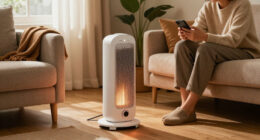
Shopping for a smart space heater means choosing how much connected control you actually need. Wi-Fi app-controlled space heaters let you adjust settings remotely through a maker’s app; smart-home-integrated heaters add compatibility with platforms such as Alexa, Google Home, or Apple Home, depending on the model. Both can make a room easier to manage, but neither changes the basic limits of a portable heater: it still needs a suitable outlet, careful placement, and supervision consistent with its instructions.

Get home appliances delivered free with Prime
- Fast, free delivery on millions of items
- Prime Video, Amazon Music and more included
- Member-only deals all year

FLANUR 1500W Smart PTC Ceramic Tower Space Heater
- ✔ Power: 1500W
- ✔ Heating element: PTC ceramic
- ✔ Stated coverage: Up to 300 sq. ft.

FLANUR 1500W Smart Ceramic Space Heater with WiFi and Voice Control
- ✔ Power: 1500W
- ✔ Heating element: PTC ceramic
- ✔ Stated coverage: 160–200 sq. ft.

SereneLife Smart Wi-Fi PTC Ceramic Space Heater, 1500W, White
- ✔ Power: 1500W
- ✔ Heating type: PTC ceramic, forced air
- ✔ Dimensions: 5.9 × 5.9 × 9.52 in
The main tradeoff is convenience versus ecosystem flexibility and cost. A Wi-Fi model is often the better value if you mainly want to set a schedule or warm a room before you arrive. A model that fits your existing smart-home setup can be worthwhile if you want voice commands or coordinated routines. Features vary by product, so check the exact platform support, safety functions, and controls before buying.
At a Glance
| Criteria | Wi-Fi app-controlled space heaters | Smart-home-integrated space heaters | Winner |
|---|---|---|---|
| Remote control and scheduling | Usually controlled through the manufacturer’s app; schedules and remote access vary by model. | Usually includes app control, with scheduling and remote access depending on the model. | Depends |
| Smart-home integration | May offer limited voice-assistant support, or none; verify compatibility for the specific model. | Designed to connect with one or more smart-home platforms; features and platform support vary. | B |
| Setup and everyday usability | Typically straightforward for users comfortable with an app, though setup depends on Wi-Fi and the maker’s service. | Can fit existing routines and voice controls, but may require extra setup across apps or hubs. | A |
| Safety controls | Can include tip-over shutoff, overheat protection, and timers; confirm each feature on the product. | Connected features do not replace physical safety protections; check the same safeguards as any portable heater. | Tie |
| Heating performance | Heating depends on wattage, heater type, room conditions, and placement, not the app connection. | Integration does not by itself make a heater warmer or more efficient; compare the underlying heater specifications. | Tie |
| Value | Often the lower-cost route to remote control and scheduling. | Higher prices make sense when platform integration will be used regularly. | A |
FLANUR 1500W Smart PTC Ceramic Tower Space Heater
This is the most complete all-rounder in the group for buyers who want a tall heater with several ways to control it. The 29-inch tower pairs 70° oscillation with a stated coverage of up to 300 sq. ft., a broader claim than the other products’ supplied specifications. It also includes a remote alongside Wi-Fi app control and Alexa or Google Assistant compatibility, so we are not tied to a phone for everyday adjustments. The FLANUR Smart Ceramic model also oscillates and connects to voice assistants, but its lack of a remote makes this one easier to operate across different routines.Its three heat levels, ECO mode, fan-only setting, thermostat range, and 12-hour timer give us more ways to adjust operation than a simple high-or-low heater. The stated minimum noise level of 23 dB is also lower than the other FLANUR model’s listed 36 dB, though those figures are manufacturer specifications rather than a guarantee in every setting. Tip-over and overheat protection plus a child lock address common household concerns. The tradeoffs are its 29-inch footprint and the need for 2.4GHz Wi-Fi to use app features; it is specified for dry indoor areas only. Buyers who need a truly small heater or don’t have compatible Wi-Fi may prefer SereneLife’s compact form or a simpler non-connected option.
Pros:
- Remote, app, Alexa, and Google Assistant controls
- Stated coverage up to 300 sq. ft. with 70° oscillation
- Three heat levels, ECO mode, and fan-only operation
- Tip-over, overheat, and child-lock protections
Cons:
- Requires 2.4GHz Wi-Fi for app features
- Specified for dry indoor areas only
- 29-inch tower takes more room than the compact SereneLife
Best for: Buyers who want a full-height tower, remote and app controls, and the broadest stated room coverage in this comparison.
Not ideal for: People seeking a compact tabletop heater, an appliance for damp areas, or app control without a 2.4GHz Wi-Fi network.
Bottom line: We recommend this FLANUR as the most versatile choice when we want tower-style coverage and both remote and smart controls.
“We recommend this FLANUR as the most versatile choice when we want tower-style coverage and both remote and smart controls.”
FLANUR 1500W Smart Ceramic Space Heater with WiFi and Voice Control
We would choose this FLANUR when a defined routine and layered controls matter more than having a remote in the box. It offers High, Low, ECO, and Fan Only modes, a 12-hour timer, and app scheduling through the Havaworks app, with Alexa and Google Assistant compatibility. That makes it a practical option for setting a heater around recurring needs. Like the taller FLANUR tower, it swivels through 70° and supports voice control; unlike that model, it does not include a remote and lists less coverage, at 160–200 sq. ft.The safety specifications are particularly extensive: overheat protection, tip-over auto shut-off, dual fuse protection, a child lock, and 24-hour auto shut-off are all listed. A 30-second cool-down cycle and carry handle add useful operating and moving details. We should still place it as directed and follow the manual; built-in protections do not replace attentive use. At a stated noise level as low as 36 dB, it may suit a personal room, though the other FLANUR tower lists a lower minimum. The main compromise is convenience: there is no remote, and app control depends on 2.4GHz Wi-Fi. It is also not recommended for soft carpets or bathrooms, so its placement is more constrained than a casual buyer might expect.
Pros:
- App scheduling, timer, and compatible voice control
- High, Low, ECO, and fan-only modes with adjustable thermostat
- 70° oscillation and carry handle
- Includes dual fuse protection and a cool-down cycle
Cons:
- No remote control included
- Requires 2.4GHz Wi-Fi for connected features
- Not recommended for soft carpets or bathrooms
Best for: Buyers who value app scheduling, several safety protections, oscillation, and a carry handle for moving the heater between suitable rooms.
Not ideal for: Anyone who wants a remote included, needs stated coverage beyond 200 sq. ft., or plans to use a heater in a bathroom or on soft carpet.
Bottom line: We see this as the feature-rich routine heater for buyers who are comfortable controlling it by app or voice and can meet its placement guidance.
“We see this as the feature-rich routine heater for buyers who are comfortable controlling it by app or voice and can meet its placement guidance.”
SereneLife Smart Wi-Fi PTC Ceramic Space Heater, 1500W, White
SereneLife takes a different approach from both FLANUR towers: it is a small, lightweight heater intended for tabletop or floor placement. At 5.9 × 5.9 × 9.52 inches and 2.9 lb, it is the easiest model here to move or put away, and the included remote means we can adjust it without opening an app. That portability may matter more than tower height for someone who wants localized warmth at a desk or in a smaller space. Its listed dimensions and weight provide a clearer compactness case than the two tower-shaped FLANUR options.It shares the lineup’s 1500W PTC ceramic heating, adjustable 41–95°F thermostat, Wi-Fi app control, and 12-hour timer. Power Heat, ECO, and Fan Only cover the basic operating choices, while overheat protection, tip-over safety, and a child lock round out its listed protections. Compared with the FLANUR 29-inch tower, though, the SereneLife specifications do not state a coverage area or oscillation, so we have less information for deciding whether it can serve a larger room or spread warmth around it. Its compact shape is its clearest advantage, while the limited coverage information is its biggest buying uncertainty. We would choose it for portability and skip it if broad room coverage is the priority.
Pros:
- Compact 5.9 × 5.9 × 9.52-inch form
- Light 2.9 lb weight with included remote
- Wi-Fi app control, adjustable thermostat, and 12-hour timer
- Three modes and listed tip-over, overheat, and child-lock features
Cons:
- No room coverage figure is supplied
- No oscillation is listed
- Designed for indoor use only
Best for: Buyers who want a light, compact heater for moving between suitable indoor spots or storing when it is not needed.
Not ideal for: People who need a stated room-coverage figure, a tower that oscillates, or a heater explicitly described for broad room warming.
Bottom line: We recommend SereneLife when compact portability matters more than a stated coverage range or tower-style heat distribution.
“We recommend SereneLife when compact portability matters more than a stated coverage range or tower-style heat distribution.”
As an Amazon Associate we earn from qualifying purchases.
Key Differences
The clearest distinction is where control happens. A Wi-Fi heater’s own app may be enough to set a schedule, change the temperature, or switch it off remotely. A smart-home-integrated model can add voice control and routines that connect the heater with other devices, but only if it supports the platform and commands you use. The label “smart” alone does not guarantee a particular feature.
Heating and safety deserve separate attention from connectivity. Smart-home integration does not automatically improve heat output, reduce electricity use, or make a heater safer. Those depend on the heater’s specifications, room, settings, and physical protections. For most buyers, a well-suited heater with reliable basic controls is a better purchase than a more connected model whose extra features will go unused.
That makes the choice fairly practical: pay more for ecosystem support when it solves a regular control problem, such as fitting the heater into routines you already use. If remote adjustments and a simple schedule are enough, a Wi-Fi app-controlled model is usually the stronger value. For either type, follow the manual’s placement and operating guidance, and do not assume that remote control makes unattended use safe.
Detailed Comparison
Remote control and scheduling (minor difference)
Both types can provide remote app control and schedules, but availability varies by product. Smart-home integration does not necessarily add better scheduling. This is a minor difference overall: compare the app features you will use rather than choosing by category name.Smart-home integration (Smart-home-integrated space heaters wins — moderate)
Smart-home-integrated heaters win when they work with the buyer’s existing platform and expose useful controls. The advantage is moderate for users who rely on voice commands or routines, but small for someone who only wants to adjust a heater in its own app. Check platform and feature compatibility before purchase.Setup and everyday usability (Wi-Fi app-controlled space heaters wins — minor)
Wi-Fi app-controlled models tend to involve fewer integrations and can be simpler to operate, though they still depend on the maker’s app and network. Integrated models may take extra configuration across services. The gap is minor to moderate, and matters most to buyers who want a quick, uncomplicated setup.Safety controls (major difference)
Neither category wins by default. Tip-over shutoff, overheat protection, timers, and other safeguards differ by model; smart features are not substitutes for physical protections or careful operation. This is a major buying check, but the comparison is product-specific, so inspect the manual and specifications for either option.Heating performance (minor difference)
Connectivity does not determine how effectively a heater warms a space. Compare heater type, rated output, thermostat behavior, and the room’s size and insulation. The difference between these categories is minor; a suitable heater specification matters more than its smart-home connection.Value (Wi-Fi app-controlled space heaters wins — moderate)
Wi-Fi app-controlled models are generally better value when remote switching and schedules are the main goals. Paying extra for smart-home integration is worthwhile when voice control or coordinated routines will be used often. This is a moderate difference because the added cost buys convenience, not inherently stronger heating.Wi-Fi app-controlled space heaters: Pros and Cons
Pros:
- Often costs less than a model with broader smart-home integration.
- Remote app control and scheduling may cover the main convenience needs.
- Can be simpler to set up if the manufacturer’s app is all you need.
Cons:
- May not connect to the buyer’s preferred voice assistant or automation platform.
- Features and remote access can depend on the maker’s app, Wi-Fi, and service support.
- The word “smart” does not guarantee specific scheduling or control functions.
Smart-home-integrated space heaters: Pros and Cons
Pros:
- Can fit voice commands and routines in a compatible smart-home setup.
- May offer more flexible ways to control the heater alongside other connected devices.
- A good fit for users who already manage home devices through one platform.
Cons:
- Often costs more, and the premium may buy little for app-only users.
- Compatibility and available commands vary between products and platforms.
- Setup can involve more accounts, apps, or configuration steps.
Who Should Choose What
Choose Wi-Fi app-controlled space heaters if:
- You mainly want to turn the heater on or off remotely and set a schedule.
- You prefer a lower purchase price and do not need voice commands or home routines.
- You are comfortable using the heater maker’s app and its listed features suit your needs.
Choose Smart-home-integrated space heaters if:
- You already use a smart-home platform and want the heater to fit into compatible routines.
- You will regularly use voice control or manage several devices through one system.
- The specific model supports your platform and the added cost is justified by features you will use.
Skip both if: Skip both if you need whole-home heating, expect a portable heater to safely run unattended against its instructions, or cannot find a model with suitable safety features and specifications for your room.
Value for Money
For most buyers, the Wi-Fi app-controlled heater is the better value: it can provide the practical benefit many people want, remote adjustment, without charging for integrations they may never use. A smart-home-integrated heater is worth paying more for when it supports your existing system and you will regularly use voice control or coordinated routines. The premium does not, by itself, buy more heat or lower operating costs. Compare the complete product specifications and expected electricity use before treating connectivity as a value upgrade.
Final Verdict
Choose a Wi-Fi app-controlled space heater if your goal is convenient remote control and scheduling at a sensible price. Choose a smart-home-integrated model if its confirmed platform support will make voice control or established routines meaningfully easier. For most households choosing between otherwise suitable heaters, the Wi-Fi model is the stronger buy; the deciding factor is whether you will use the additional integration often enough to justify its price. In either case, make safety protections, appropriate heater capacity, and the manufacturer’s operating instructions the first checks.
Frequently Asked Questions
Does a smart-home-integrated heater heat a room better?
Not because of its integration. Heating depends on the heater’s type and output, room conditions, and placement. Compare those specifications directly.
Is Wi-Fi app control enough for a space heater?
For many people, yes. If you mainly want to set a schedule or adjust settings remotely, the manufacturer’s app may provide what you need. Confirm the exact controls and remote access requirements for the model.
Are smart space heaters safe to control remotely?
Remote control does not change a heater’s operating risks. Check for protections such as tip-over shutoff and overheat protection, follow the manual’s placement guidance, and use it only as directed.
Is paying extra for smart-home compatibility worth it?
It can be if you will regularly use a supported voice assistant or include the heater in routines. If app control is enough, the lower-cost Wi-Fi model is usually the better value.
Fall yard work Picks

15-Foot Halloween Pumpkin Inflatable with LED Lights and Air Blower
As an affiliate, we earn on qualifying purchases.