TL;DR

Get home appliances delivered free with Prime
- Fast, free delivery on millions of items
- Prime Video, Amazon Music and more included
- Member-only deals all year
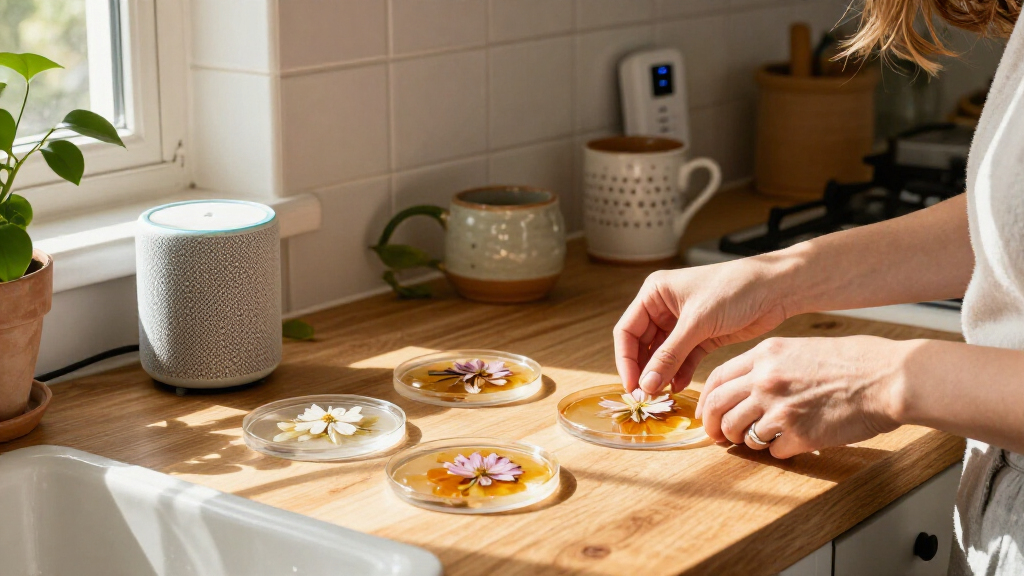
Livingetc reports that resin pieces containing preserved flowers are appearing in a range of interiors, including a Paris herbal infusion house and contemporary design projects. The article frames this as a renewed design interest, but provides no sales data or other measure of how widespread the trend is.
Preserved flowers set in resin are appearing in a range of interior projects, according to a new Livingetc feature, which points to a botanical tea bar in Paris and work by contemporary furniture and lighting designers. The examples suggest renewed creative interest in floral resin, a material that can turn plant matter into a lasting feature of a room, though the report does not quantify how widely the style is spreading.
One of the feature’s central examples is Apoticari’s La Tisanerie, a herbal infusion house that opened in September in Paris’s Haut-Marais. The floral-enriched resin bar counter serves as a focal point for the space’s botanical identity. Livingetc describes the venue as the city’s first dedicated herbal infusion house; that description is attributed to the publication, rather than supported in the supplied material by an independent survey or source.
The report also highlights furniture and lighting made with resin. It cites the Gelo side tables, a collaboration between Monologue and Paraforma, whose hand-cast resin forms are described as thick and varied in finish and color. It also discusses work by Dutch designer Sabine Marcelis and Austrian designer Laurids Gallée, including Gallée’s Node 01 light, which creative consultant Romain Casella praised for its use of resin and suspended light.
Botanical artist and designer Marcin Rusak is presented as another example. His Flora Herbarium Clear Amber 152 was due to appear at Salon Art + Design in New York from November 4 to 8, according to the feature. Rusak’s work treats flowers as more than decoration, asking what preserved plants might communicate to future viewers about the era in which the objects were made.
Why Designers Are Preserving Flowers
The appeal described in the report is partly visual: resin can hold flowers in place while letting light pass through or reflect from the material. That makes the botanical detail part of a table, light or counter rather than a separate arrangement. For venues such as Apoticari’s tea house, the material also connects the interior design to the products and rituals offered there.
Casella, founder and director of the London- and Geneva-based agency MAY, interprets the interest through nostalgia and the desire to freeze time. He compares the effect to an insect preserved in amber and says such objects can feel reassuring because they remain still. That is his reading of the trend, not a demonstrated explanation shared by every designer or buyer.
For readers following interiors, the examples point to a material being used across both commercial spaces and collectible design. They also show how an object can carry a story about nature and memory. The feature does not establish whether floral resin is gaining in sales, becoming more common across the industry, or mainly attracting attention in selected projects.
Products Worth Considering

Philips Hue Starter Kit with Bridge Pro and 4 A19 E26 Smart Bulbs

eufy Security Video Doorbell E340 Kit with Chime, 2K Resolution and 8GB Local Storage

eufy Security SoloCam E42 4-Camera Kit, 4K Solar Security Cameras with HomeBase 3
As an affiliate, we earn on qualifying purchases.
A Material With Earlier Design Lives
The Livingetc report says floral epoxy resin furniture originated in the 1940s and was revived in the 1980s. It places the current examples alongside renewed interest in amber-colored interiors and a broader design appetite for decorative focal points. Those are the publication’s trend observations; the supplied material does not provide market data to measure their reach.
The feature also connects the material to the idea of a single decorative gesture—one prominent object or design element that helps define a room. Livingetc says its Style Pulse S/S27 report named this approach among the design moments expected to shape interiors in the year ahead. The current examples range from a hospitality counter to tables and lighting, showing different ways designers are applying resin rather than establishing a single standard style.
Rusak’s perspective gives the preservation technique a longer time horizon. In a social media post cited by Livingetc, he wondered what someone might see in his work a century from now, and whether the flowers could record contemporary ideas about nature and beauty. The report positions that question as part of the appeal of preserving plant material, not as evidence that the objects will serve as historical records.
““We’re deliberately choosing to freeze time — and there’s something reassuring in that in such unstable times: it doesn’t move; it’s there, still.””
— Romain Casella, founder and director of MAY, speaking to Livingetc
How Broad Is the Resurgence?
The feature documents a set of projects and designer perspectives, but it does not provide sales figures, production numbers or survey data showing how common floral resin has become. Its description of the style appearing “everywhere” is a first-person observation and editorial framing, not a measured claim about the whole design market.
It is also unclear how long the renewed interest will last, or whether the highlighted work will lead to wider use in everyday interiors. The source does not give detailed information about the sourcing of the preserved flowers, the resin formulas used, or the durability and care requirements of the specific pieces. Readers should not assume that every product described as resin has the same materials or environmental profile.
Upcoming Design Showcases
The nearest scheduled event in the report is Salon Art + Design, where Rusak’s Flora Herbarium Clear Amber 152 was expected to be shown in New York from November 4 to 8 at the Park Avenue Armory, identified in the source as The Salonny. The feature also notes that Marcelis’s first solo museum exhibition, Sabine Marcelis: Light and Color, was scheduled at Zurich’s Museum für Gestaltung from October 30, 2026, to April 4, 2027.
Those presentations may offer further examples of how designers are using resin and preserved botanical material. Whether the attention translates into a broader, sustained interior trend remains to be seen; the supplied report does not include later attendance, sales or market updates.
Key Questions
What is floral resin?
Floral resin refers here to resin objects that incorporate preserved flowers or other botanical material, such as the tables, lighting and bar counter described by Livingetc.
Where is the Paris project featured in the report?
The feature highlights Apoticari’s La Tisanerie, a herbal infusion house in the Haut-Marais that opened in September. Its floral-enriched resin counter is described as an anchor for the venue’s botanical design.
Is floral resin a new design material?
Not according to the Livingetc feature, which says floral epoxy furniture dates to the 1940s and had a revival in the 1980s. The current report describes renewed interest rather than the invention of the material.
Does the report prove floral resin is a widespread trend?
No. It provides examples and designer commentary, but no market-wide sales or production data. Its account supports the view that the material is appearing in selected projects, not a claim about how common it is overall.
What event was scheduled to feature Marcin Rusak’s work?
Livingetc said Rusak’s Flora Herbarium Clear Amber 152 was due to be shown at Salon Art + Design in New York, November 4–8. The supplied source does not report what happened at the fair.
Source: livingetc.com